
A software team ingests firewall, VPN, and identity logs from three vendors into Falcon Next-Gen SIEM and needs one CQL query to correlate source IP addresses across all three sources. How does CPS support this?
Select an answer to reveal the explanation.
Short Explanation
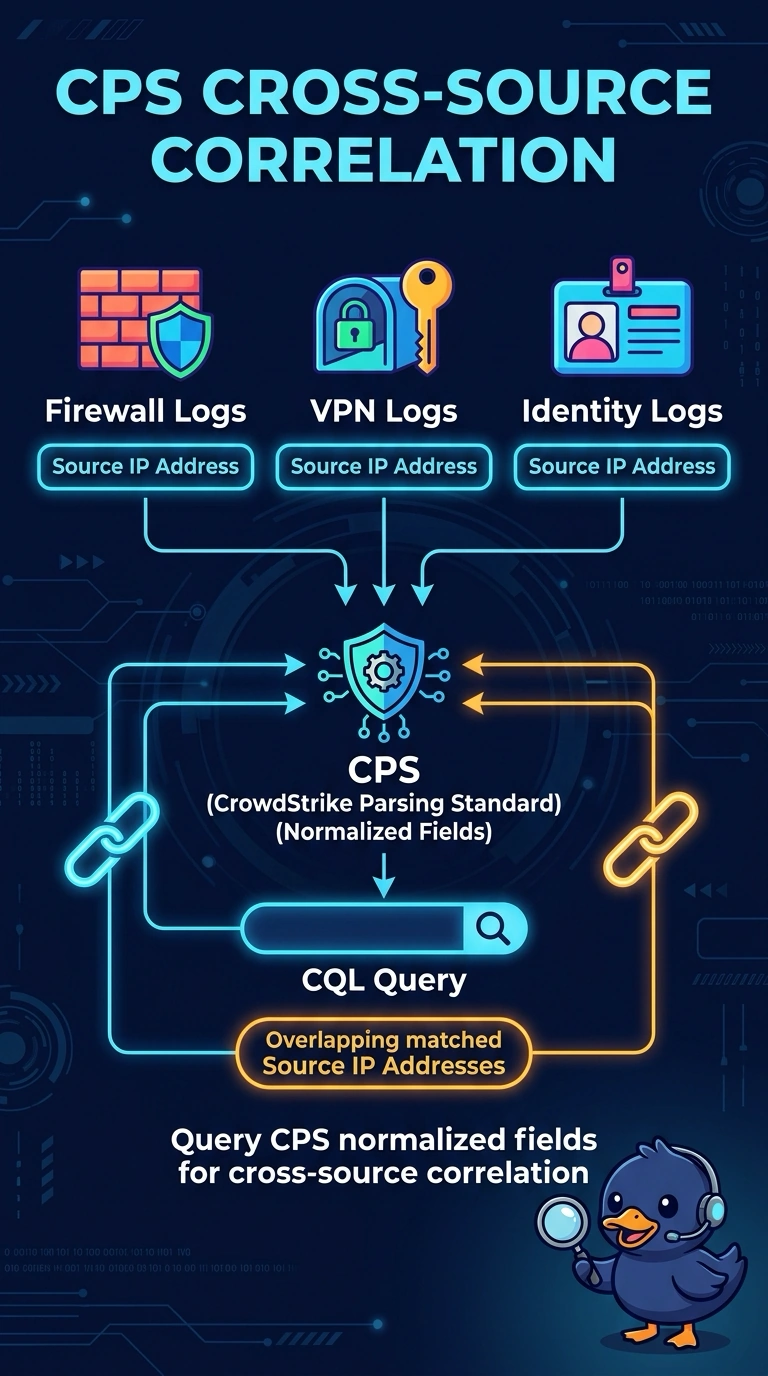
Think of CPS normalization as a universal translator that lets all your log sources speak the same language. It lets you write one CQL query to correlate fields across vendors while keeping the original telemetry around when you need deeper details.
Full Explanation
The CrowdStrike Parsing Standard normalizes source-specific event fields into a common schema so analysts can search and correlate across diverse technologies with a single query. Choosing to Query the CPS normalized fields for cross-source correlation lets one CQL search match source IP addresses consistently across firewall, VPN, and identity logs from different vendors. Choosing to Treat CPS normalization as automatic containment of the source IP confuses schema parsing with an active response action; normalization only structures data for analysis. Choosing to Write three separate queries because CPS removes all vendor context is doubly mistaken, because CPS enables unified cross-source queries while original vendor telemetry remains available when source-specific detail is needed. Choosing to Rely only on severity labels instead of querying event fields ignores actual network observables and cannot correlate an IP address across disparate log sources. As a scope caveat, normalized schemas streamline cross-source pivoting, yet analysts should still inspect original vendor fields when vendor-specific attributes are needed for confirmation. Run a CQL search using the normalized source IP field and verify that events from all three log sources appear in the results.
Prefer to study offline? Printable PDF study book + test engine ($7.50, unofficial). These questions stay free here.