
A financial firm analyst uses CrowdStrike Parsing Standard (CPS) normalized fields to search across multiple firewall and VPN sources, but now needs a vendor-specific failure reason code not mapped in the common schema. How should the analyst proceed?
Select an answer to reveal the explanation.
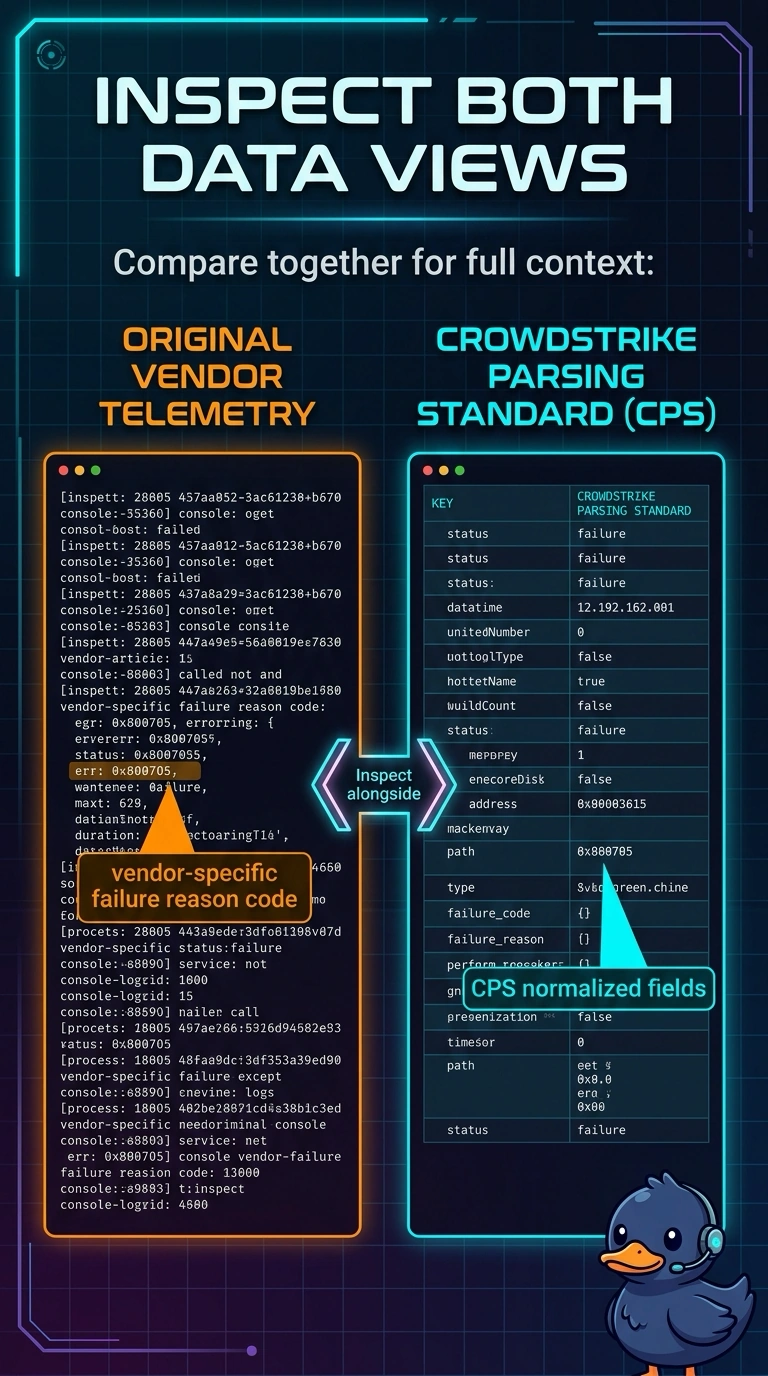
Short Explanation
CPS is like a universal translator—it lets you compare logs from different vendors side by side, but some local idioms don't fit the common dictionary. Don't assume a missing normalized field means the data is gone. Inspect the original vendor telemetry alongside your CPS fields to get the exact code.
Full Explanation
Because CPS normalizes shared concepts into a common schema while preserving raw source detail, an analyst should "Inspect the original vendor telemetry alongside the CPS normalized fields" when an investigation requires a vendor-specific attribute. Using CPS for cross-source filtering and pivoting into original event fields gives both breadth and precision. Choosing to "Conclude the failure reason was never logged because it is absent from CPS" misinterprets schema normalization as data loss, when the underlying vendor field may still be present in the raw event. Choosing to "Disable CPS normalization across all ingested firewall and VPN log sources" would break cross-source correlation rules and unified dashboards that depend on common fields. Similarly, choosing to "Replace all CQL queries with manual reviews of individual endpoint alerts" abandons network authentication visibility altogether. As a caveat, vendor-specific fields vary in naming and format across products, so avoid assuming one vendor's failure code syntax applies to another. For an operational check, filter to the relevant normalized event first and then examine the raw message or vendor-specific fields on matching records.
Prefer to study offline? Printable PDF study book + test engine ($7.50, unofficial). These questions stay free here.