
A media company SOC confirms an attacker used stolen employee credentials to log into the corporate VPN from a commercial anonymizing proxy IP. Why is blocking only that single IP insufficient for containment?
Select an answer to reveal the explanation.
Short Explanation
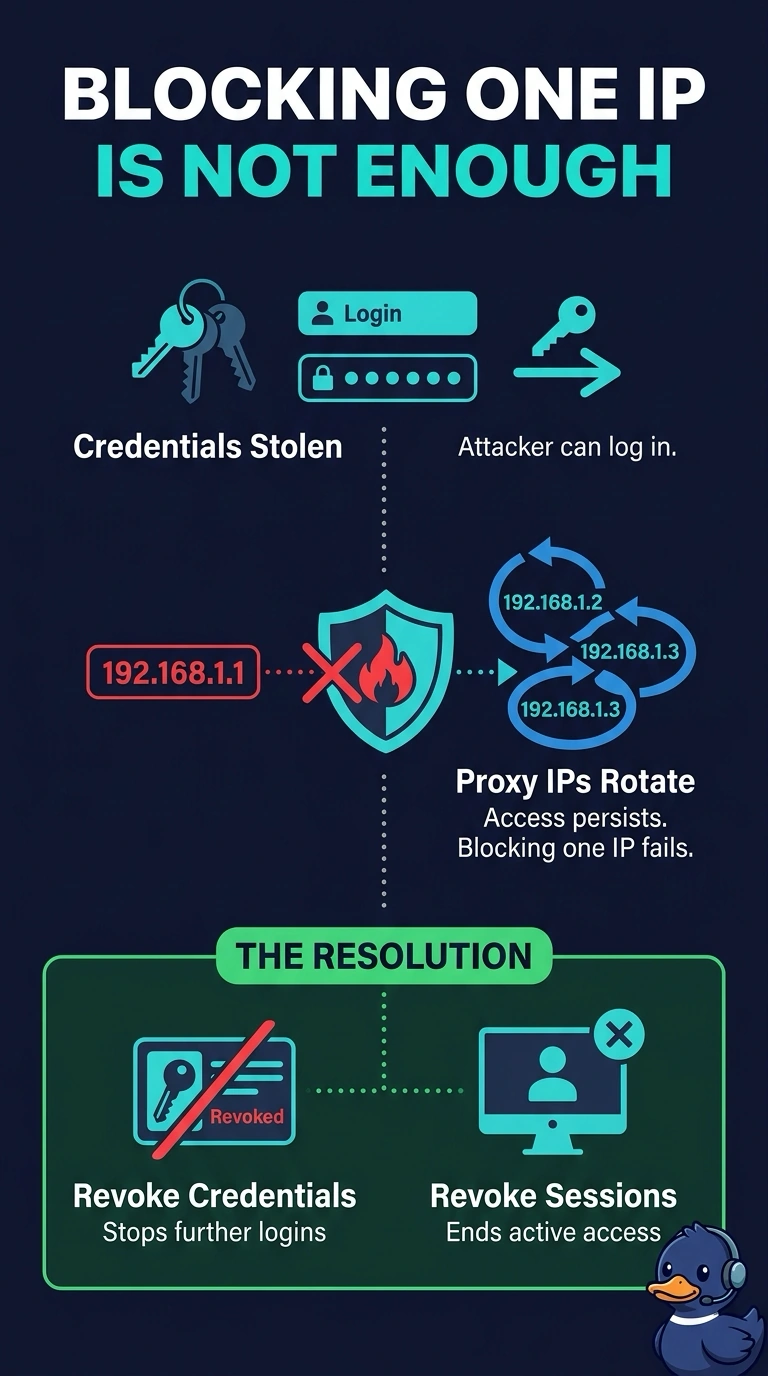
Blocking one proxy IP is like locking one exit door while the intruder still holds a master key—you only force them to walk out a different door. The trap is treating a network IP block as full containment when the attacker already possesses valid credentials and active sessions.
Full Explanation
When an adversary authenticates with stolen valid credentials through an anonymizing service, The attacker can rotate proxy IPs and retain access until credentials and sessions are revoked. Commercial proxies and VPN exit nodes give an attacker a large pool of changing source addresses, and existing authenticated sessions may remain valid until explicitly terminated. Believing Blocking an external IP in the firewall automatically deletes all active user authentication tokens is a dangerous misconception because perimeter firewall rules do not invalidate identity-provider session tokens or reset user passwords. Similarly, Commercial proxy IP addresses are permanently bound to a single compromised employee workstation is false; shared proxy exit IPs are ephemeral and unrelated to the employee's corporate hardware. Finally, Anonymizing proxies prevent the SIEM from recording any subsequent internal user authentication is incorrect because once inside the VPN, the user's identity and internal resource access are still logged by identity and host telemetry. As a caveat, revoking sessions without resetting the compromised credential or checking MFA enrollment leaves the door open for immediate re-entry. Perform an operational check by verifying active VPN and cloud sessions are terminated and auditing post-login activity for that user account.
Prefer to study offline? Printable PDF study book + test engine ($7.50, unofficial). These questions stay free here.