
A software company SOC analyst confirms that an attacker executed credential-harvesting malware on a senior developer's laptop. Beyond isolating the laptop and resetting the developer's corporate password, what should the analyst investigate next to determine the full blast radius?
Select an answer to reveal the explanation.
Short Explanation
Resetting a developer's password while leaving stolen build tokens active is like changing your front-door lock after someone copied your warehouse key. You need to look where developer secrets actually live, because attackers target CI/CD credentials and signing keys that bypass normal user logins.
Full Explanation
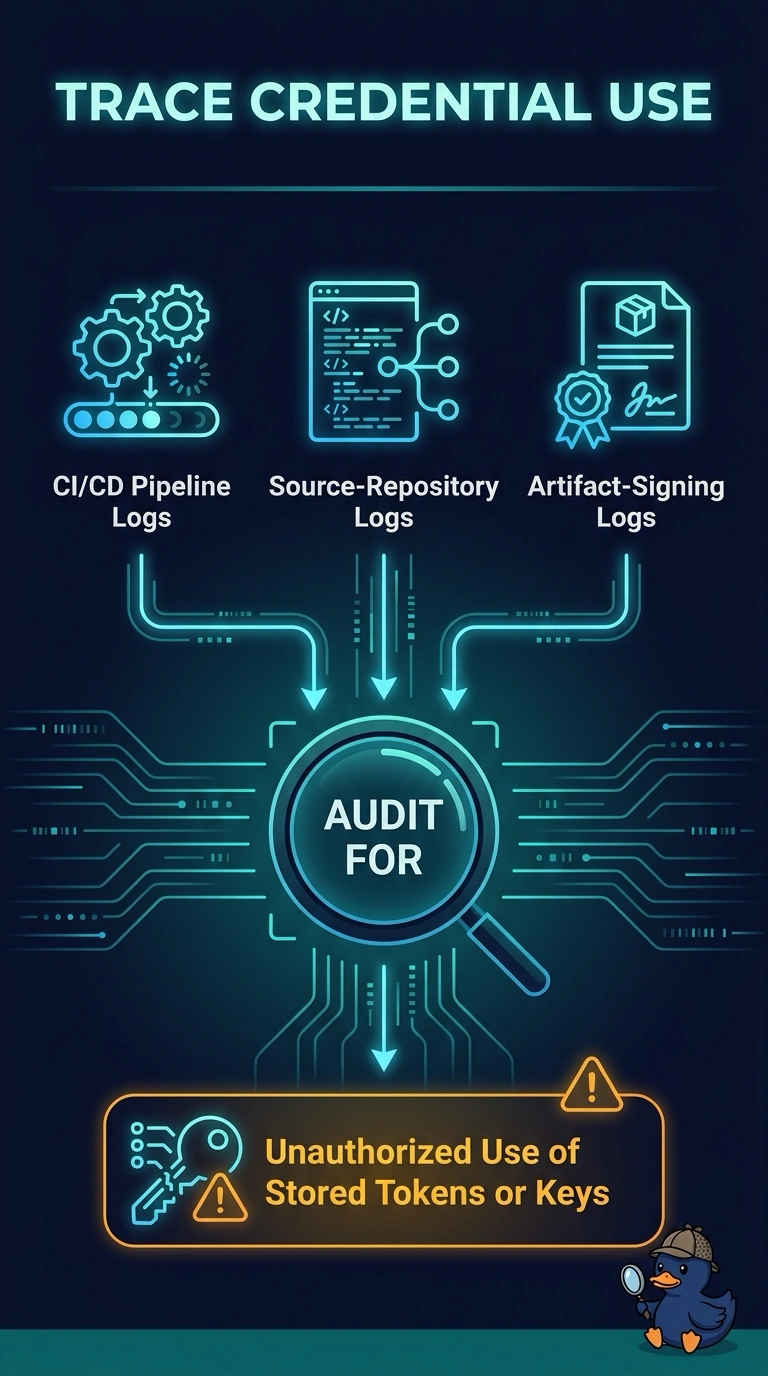
Developer workstations routinely hold SSH keys, personal access tokens, and cloud deployment secrets that operate independently of a corporate user password, so isolating the host alone does not stop downstream supply-chain abuse. The right next step is to Audit CI/CD pipeline, source-repository, and artifact-signing logs for unauthorized use of stored tokens or keys, because this reveals whether harvested credentials were used to push code, alter build jobs, or pull private repositories from another IP address. Choosing to Reimage the developer's laptop immediately to remove any remaining local persistence mechanisms before checking logs destroys volatile forensic artifacts and leaves external token abuse undetected. Choosing to Run a CQL query limited to the developer's corporate email inbox to see if any phishing messages were forwarded externally misses non-email developer workflows where stolen API keys and Git tokens are actually used. Choosing to Close the investigation once the endpoint sensor confirms the credential-harvesting binary has been quarantined on disk assumes containment of the file equals containment of the credentials it already read. As a caveat, automated service tokens may not generate interactive login alerts, so focus on anomalous source IPs, user agents, and off-hours commits. As an operational check, query source-control and CI/CD audit logs in Falcon Next-Gen SIEM for token activity tied to the developer's account since the earliest malware execution timestamp.
Prefer to study offline? Printable PDF study book + test engine ($7.50, unofficial). These questions stay free here.