
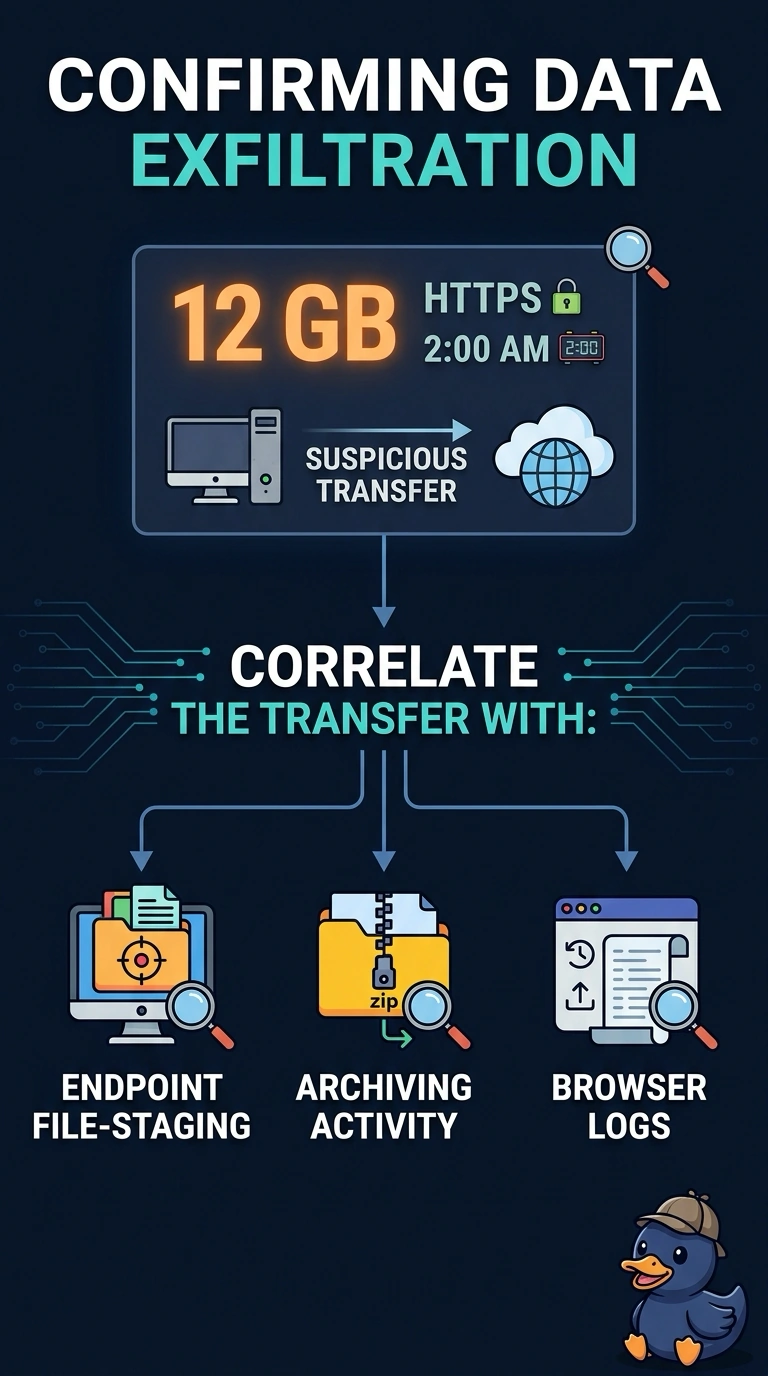
A media company SOC analyst spots a 12 GB outbound HTTPS transfer from a finance workstation to an unfamiliar cloud storage domain at 2:00 AM. Which telemetry correlation best confirms whether sensitive data exfiltration occurred?
Select an answer to reveal the explanation.
Short Explanation
A big outbound spike tells you bytes left the building, but endpoint activity tells you what was packed into the suitcase. The trap is stopping at network volume alone instead of correlating the transfer with file-staging or archive creation.
Full Explanation
Large outbound transfers can stem from legitimate backups or media syncs, so confirming exfiltration requires linking network volume to host behavior. Choosing to Correlate the transfer with endpoint file-staging, archiving, and browser logs reveals whether a user or process collected sensitive folders, compressed them, and uploaded them during that exact window. Choosing to Check whether the workstation's antivirus signature database updated last Tuesday verifies routine AV hygiene rather than explaining the 2:00 AM upload. Choosing to Verify whether the finance department uses a different subnet than marketing confirms network segmentation, not what data left the host. Choosing to Count how many total workstations exist in the media company's headquarters provides asset inventory context without addressing the transfer itself. Caveat: encrypted HTTPS payloads hide file contents from network logs, making endpoint process, command-line, and file-access telemetry essential for confirmation. Operational check: query endpoint process and file-write events on the workstation in the hour preceding the 2:00 AM transfer and match the initiating process to the network connection.
Prefer to study offline? Printable PDF study book + test engine ($7.50, unofficial). These questions stay free here.