
A retail distribution center SOC sees a third-party firewall alert for outbound traffic to a known command-and-control IP, but the firewall log lists only the facility's shared NAT gateway as the source IP. How should the analyst identify which internal workstation initiated the connection?
Select an answer to reveal the explanation.
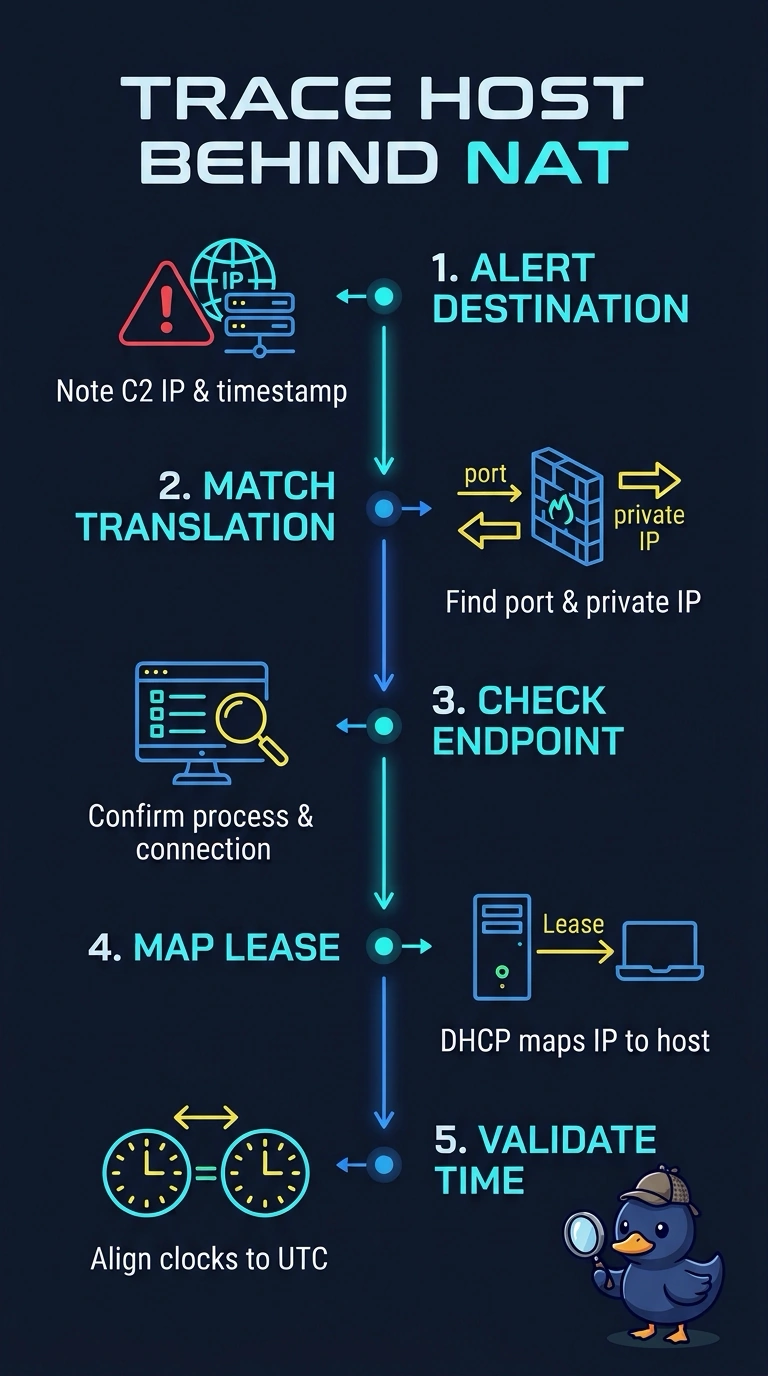
Short Explanation
Think of the shared NAT gateway like an apartment building address — you need the unit number to find the right resident. You correlate NAT/proxy or endpoint records by destination, timestamp and ports to get the internal IP, then use DHCP history to map it to the host. DHCP provides address-to-client history, not outbound destination records; use it after obtaining the internal address from connection or translation evidence.
Full Explanation
Perimeter firewalls outside a translation boundary only see the translated public address, not the private host behind it. Choosing to Correlate NAT/proxy or endpoint connection records by destination, timestamp and translated ports, then use DHCP leases to map any internal IP to the host solves this gap because translation tables, proxy logs, and endpoint telemetry retain the pre-translation private IP and source port tied to the destination and time. DHCP provides address-to-client history, not outbound destination records; use it after obtaining the internal address from connection or translation evidence. By contrast, choosing to Block the shared NAT gateway IP address at the perimeter firewall to stop all outbound traffic immediately would sever connectivity for the entire distribution center without identifying the infected endpoint. Choosing to Query threat-intelligence feeds for additional external IP addresses associated with the same command-and-control group enriches external adversary infrastructure but cannot reveal which internal workstation initiated the connection. Similarly, choosing to Re-run the perimeter firewall search over a longer thirty-day window to see which external ports were used most often still only returns the same shared gateway address without internal attribution. Confirm clocks are aligned to UTC before correlating timestamps.
Prefer to study offline? Printable PDF study book + test engine ($7.50, unofficial). These questions stay free here.