
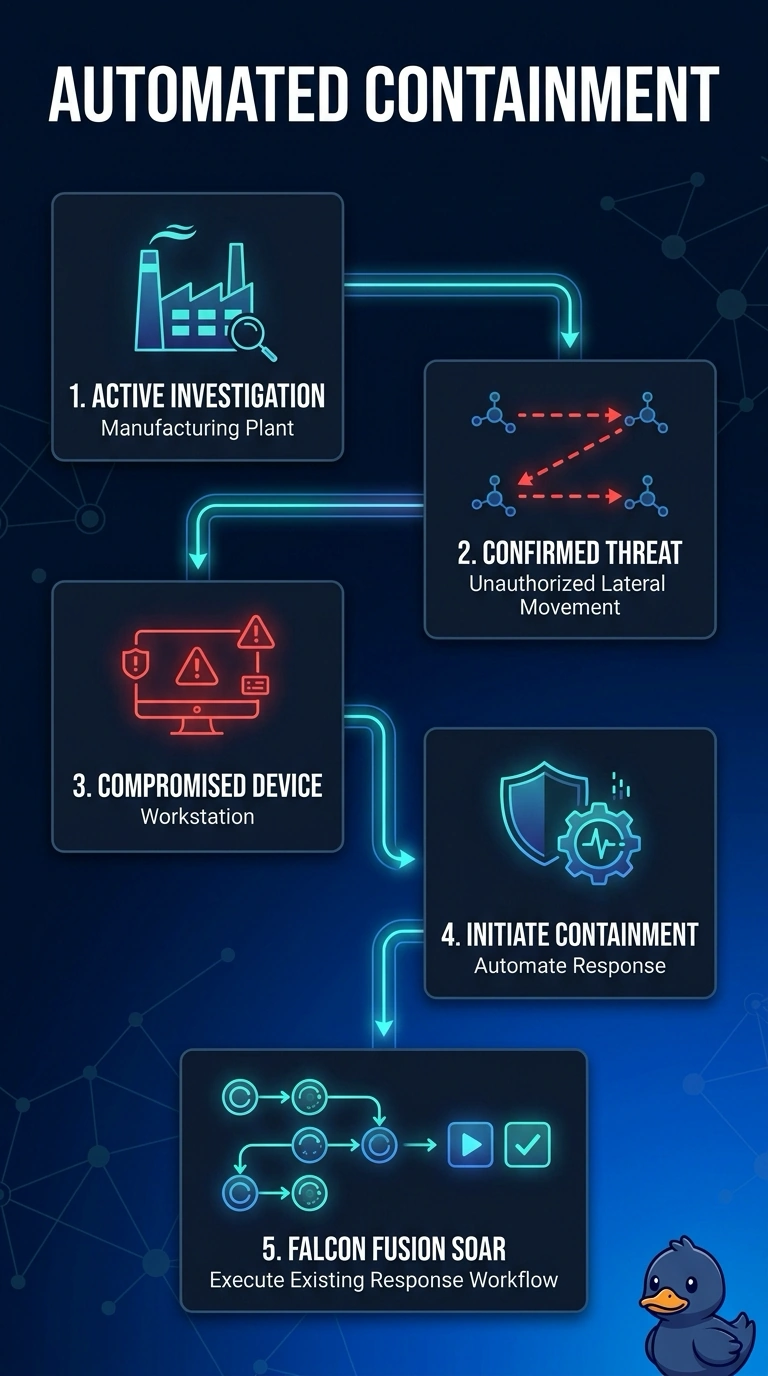
During an active investigation at a manufacturing plant, an analyst confirms unauthorized lateral movement from a compromised workstation and needs to initiate automated containment. Which capability fits this task?
Select an answer to reveal the explanation.
Short Explanation
When a fire is already burning, you grab a fire extinguisher instead of writing a new smoke-detector manual. Queries and correlation rules help you spot or investigate threats, whereas an existing Falcon Fusion SOAR workflow is built to execute containment and response.
Full Explanation
Once an investigation confirms active lateral movement on a manufacturing workstation, the analyst needs an orchestration mechanism that performs containment rather than another search or detection rule. Selecting to Execute an existing Falcon Fusion SOAR response workflow leverages prebuilt automation designed to orchestrate investigation enrichment and host response actions quickly and consistently. Choosing to Create a new CQL groupBy query to summarize recent workstation logins only aggregates historical telemetry for analysis and does not isolate the compromised endpoint. Choosing to Build a new correlation-rule template to alert on future lateral movement creates forward-looking detection logic for later events while leaving the currently compromised workstation connected to the plant network. Choosing to Normalize the workstation telemetry into CPS schema fields is a data-modeling step for cross-source querying, not a containment action. As a scope caveat, analysts should rely on approved, existing SOAR workflows and verify host identifiers before triggering automated containment so critical manufacturing equipment is not inadvertently disrupted. Check the active case target host details and confirm the SOAR workflow execution status completes.
Prefer to study offline? Printable PDF study book + test engine ($7.50, unofficial). These questions stay free here.