
A logistics company SOC analyst sees alerts on a dispatch server for an unusual PowerShell launch, an outbound network connection, and a credential access attempt. What should the analyst do to determine how the activity progressed?
Select an answer to reveal the explanation.
Short Explanation
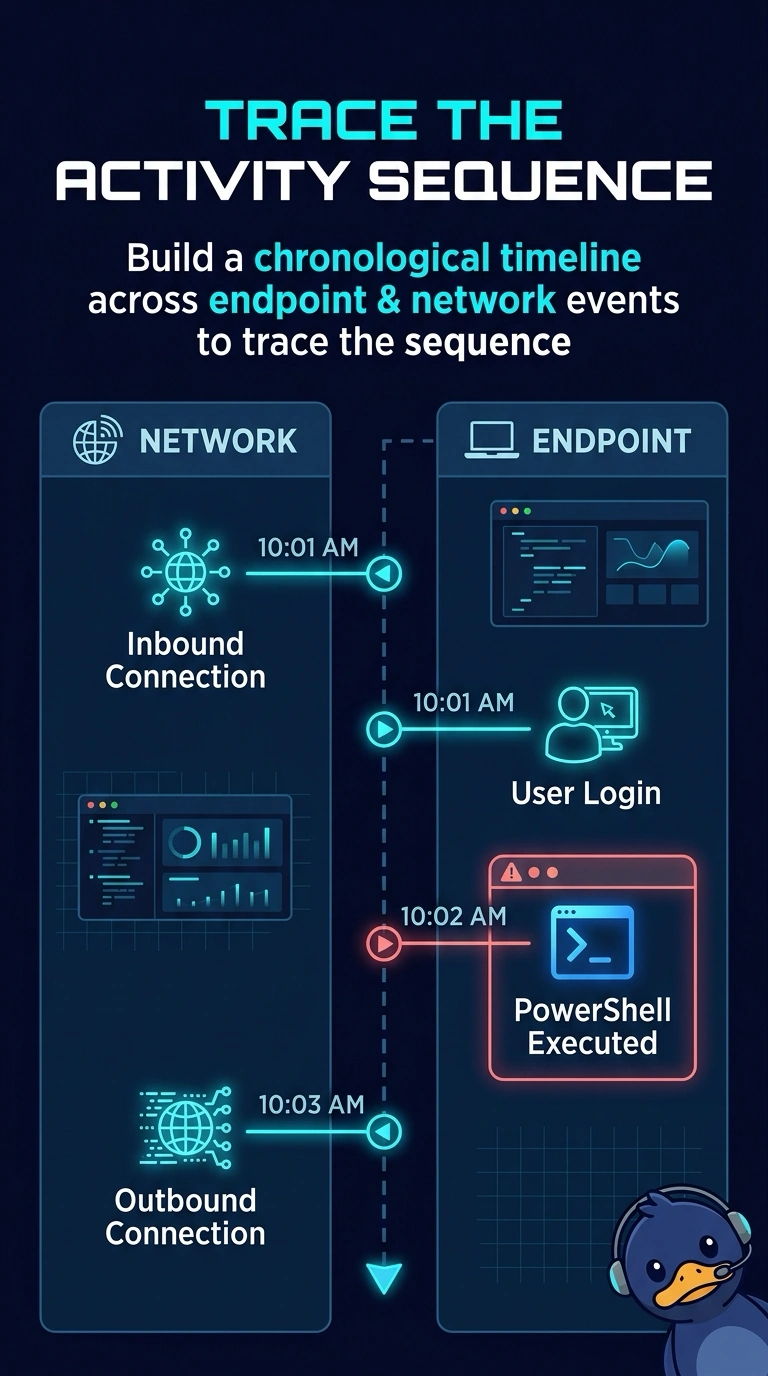
Think of an incident like a crime scene where order matters just as much as the clues themselves. If you only chase the loudest alert, you miss how the attacker got in and what moved laterally. Build a chronological timeline across endpoint and network events to see the full sequence before acting.
Full Explanation
To understand how an intrusion unfolded, an analyst must "Build a chronological timeline across endpoint and network events to trace the sequence" of adversary behavior. Ordering telemetry by timestamp across host processes, authentication logs, and network connections reveals initial access, execution, and follow-on actions such as credential access or external communication. Choosing to "Close the earlier alerts and investigate only the single highest-severity detection on the host" discards critical precursor activity that explains how the attacker arrived. Choosing to "Delete scheduled tasks on the dispatch server before reviewing any process or network telemetry" alters host state prematurely and risks destroying persistence clues needed for scoping. Likewise, to "Reimage the dispatch server immediately without preserving process or network event context" eliminates forensic visibility and leaves the root cause unaddressed. As a caveat, ensure timestamps across different log sources are aligned to a consistent time zone such as UTC before drawing conclusions. For an operational check, list the earliest suspicious process execution alongside its parent process and any outbound connections within the same window to confirm the causal chain.
Prefer to study offline? Printable PDF study book + test engine ($7.50, unofficial). These questions stay free here.