
A university SOC analyst tests a new correlation rule and confirms that matching test events exist in CQL, yet no ticket arrives in the team's external ticketing queue. What should the analyst check first?
Select an answer to reveal the explanation.
Short Explanation
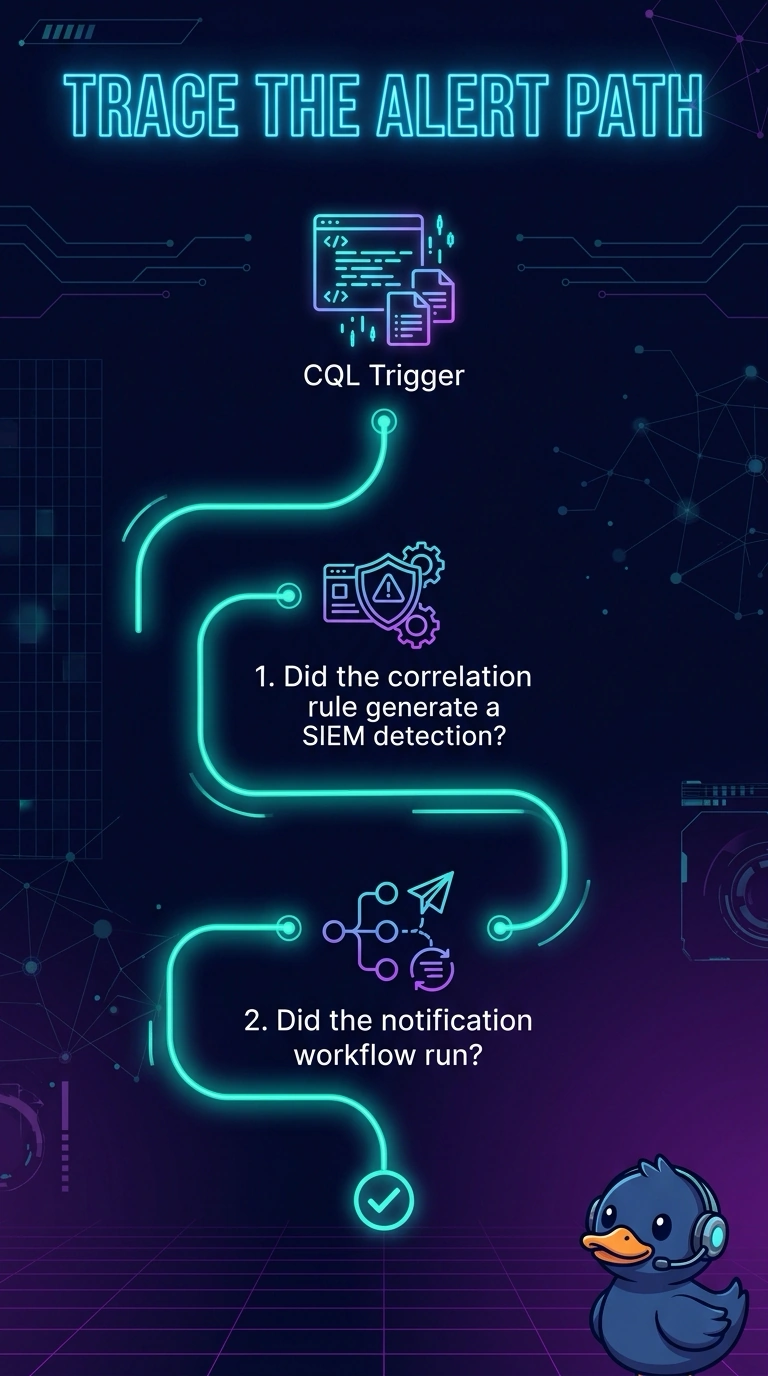
You can narrow this down by checking whether the correlation rule generated a SIEM detection and whether the notification workflow ran. Detection and ticket delivery are separate steps, so checking both helps you find where the handoff failed.
Full Explanation
Troubleshooting a missing ticket starts by separating detection logic from downstream orchestration. Check whether the correlation rule generated a SIEM detection and whether the notification workflow ran: this shows whether the rule failed to fire or whether an existing Falcon Fusion SOAR workflow encountered an error, filter condition, or integration issue while creating the external ticket. Matching the rule’s MITRE ATT&CK tactic tag to the ticketing system’s severity labels concerns metadata and does not prevent a SIEM detection from firing. Checking whether test events were ingested more than 24 hours after endpoint sensor installation is irrelevant when those events are already visible in CQL. Suspecting that CPS normalization removed the raw event message before the CQL search misunderstands normalization: it maps fields into a common schema while keeping underlying telemetry searchable. As a caveat, verify that the rule’s active or published state, schedule, timestamp basis, query output, and trigger mode did not hold back the test detection; inspect an explicitly configured deduplication workflow separately. As a practical check, inspect the SIEM detections list for the test timeframe, then review the SOAR workflow execution log for errors.
Prefer to study offline? Printable PDF study book + test engine ($7.50, unofficial). These questions stay free here.