
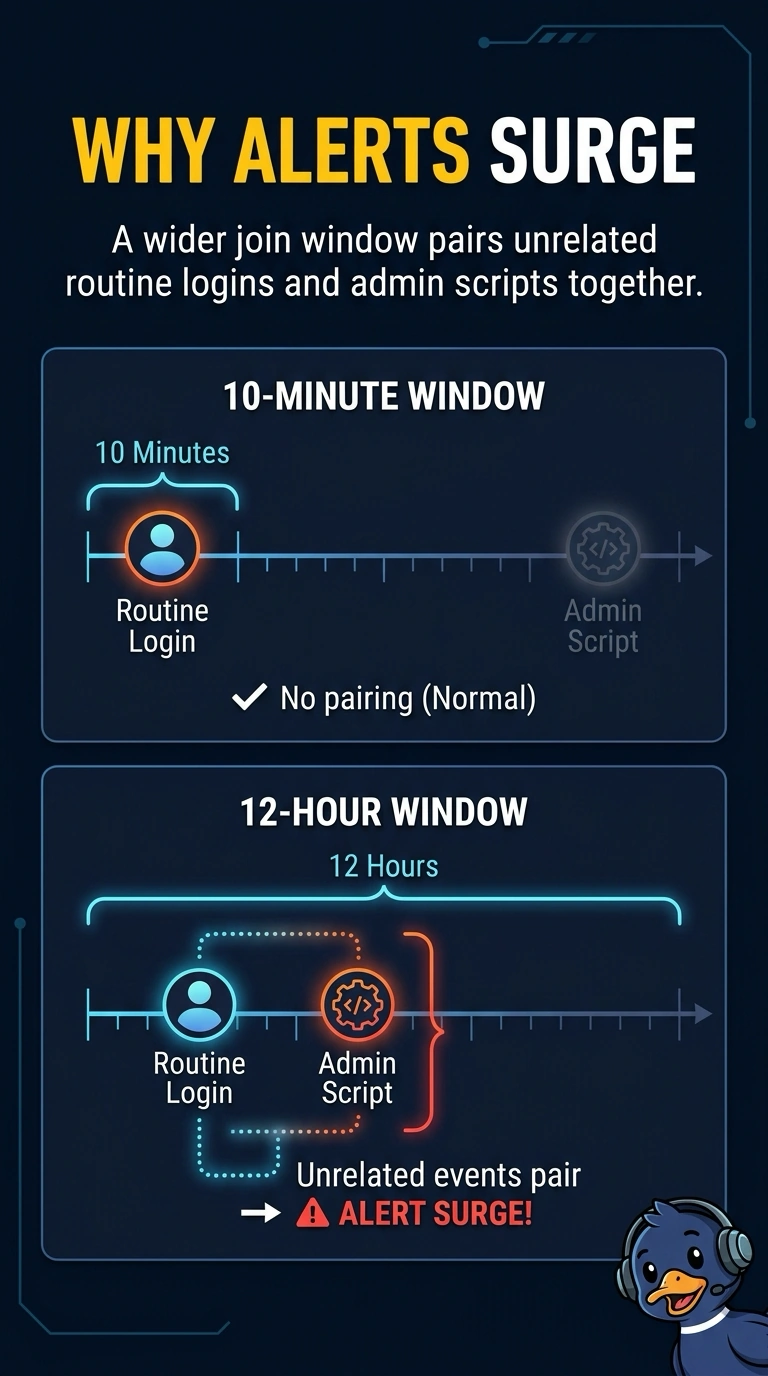
An e-commerce SOC widens a correlation rule's join window from ten minutes to twelve hours to catch slower attacks linking a failed VPN login with an admin script launch, and false-positive alerts surge. Why does this happen?
Select an answer to reveal the explanation.
Short Explanation
Stretching a correlation window sounds like a smart way to catch patient attackers, right? The trap is that over twelve hours, almost anyone can mistype a password in the morning and run a normal script at lunch, flooding your queue with noise.
Full Explanation
Correlation rules link events that share a key entity within a defined lookback interval, so the width of that interval directly controls behavioral specificity. A wider join window increases the chance that unrelated routine user logins and normal administrative scripts get paired together, because benign daily activities by the same user or host now fall inside the same twelve-hour span. The idea that widening the join window disables CPS field normalization across VPN and endpoint logs is false because CPS parsing occurs independently of rule time windows. Claiming correlation rules in Falcon Next-Gen SIEM automatically convert warnings into critical alerts misrepresents rule severity, which is configured in the rule definition rather than altered by window length. Saying a twelve-hour window forces the SIEM to re-ingest archived logs from third-party firewalls is incorrect because correlation rules query already ingested telemetry rather than triggering upstream re-ingestion. Caveat: narrowing the window too aggressively can miss slower multi-stage attacks, so pair reasonable windows with stronger causal filters such as unusual source IPs or anomalous script arguments. Operational check: test candidate join windows against historical data to measure both false-positive volume and detection coverage before updating the live rule.
Prefer to study offline? Printable PDF study book + test engine ($7.50, unofficial). These questions stay free here.