
A municipal utility SOC analyst writes a CQL query that successfully spots unauthorized VPN logins from unapproved countries and saves it as a dashboard panel. A week later, the analyst wonders why matching logins appear on the dashboard chart but never create alerts in the detection queue. What explains this behavior?
Select an answer to reveal the explanation.
Short Explanation
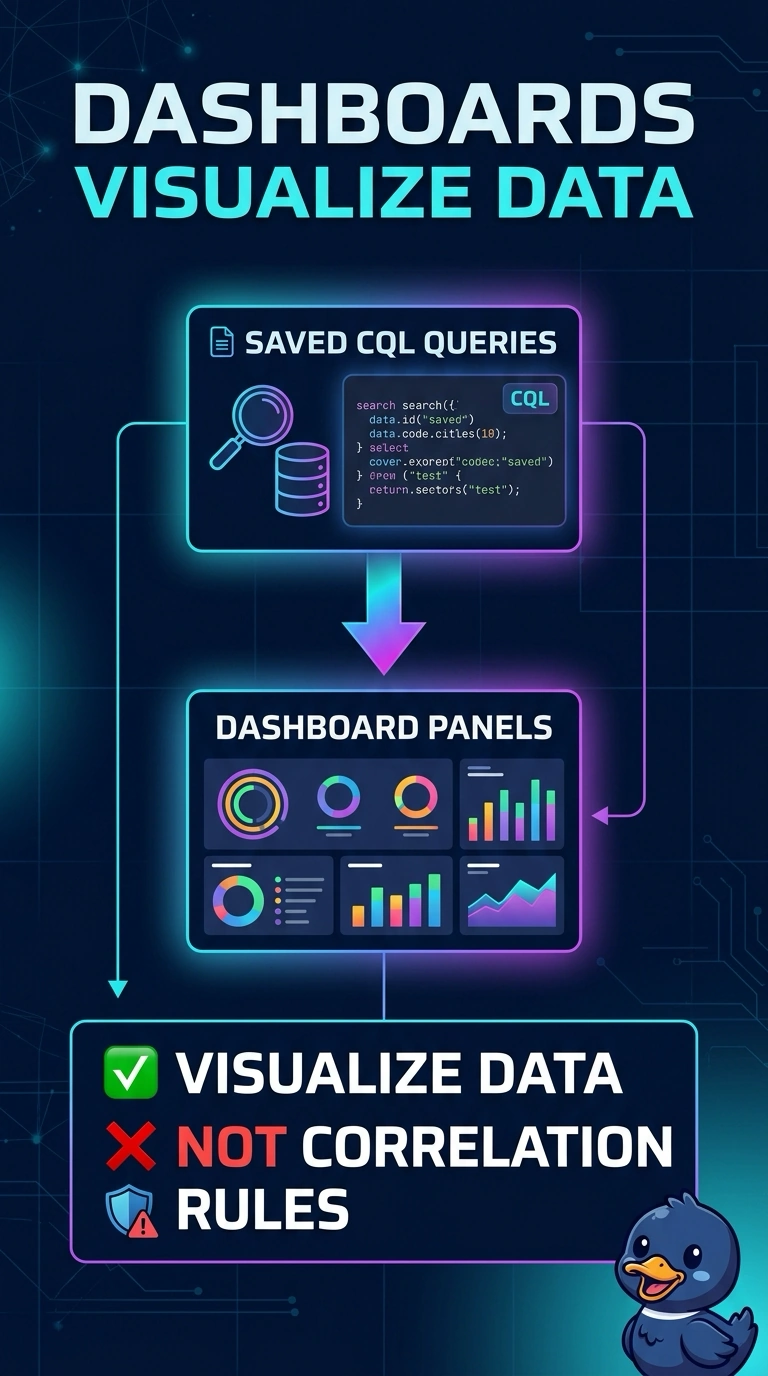
Expecting a dashboard panel to page your team is like expecting a wall thermometer to call the fire department. Dashboards and saved searches show you what is happening, whereas correlation rules are what actually turn matching queries into actionable detections.
Full Explanation
In Falcon Next-Gen SIEM, Saved CQL queries and dashboard panels visualize data rather than acting as correlation rules. Dashboards and ad-hoc searches are designed for interactive querying, trend monitoring, and visual reporting; to generate persistent alerts in the detection queue, the query logic must be deployed and enabled as a correlation rule with defined evaluation settings. The claim that Dashboard panels automatically suppress matching detections unless the analyst manually exports them is wrong because panels do not generate or suppress detections at all. The idea that Third-party VPN logs require an active Falcon Fusion SOAR workflow before CQL can parse them is wrong because parsing and CQL querying happen at ingestion and search time, independent of SOAR orchestration. The claim that Correlation-rule detections only trigger when at least three different log sources match at once is wrong because correlation rules can evaluate single or multiple log sources depending on how the rule query is written. As a caveat, converting a dashboard query into a correlation rule requires tuning thresholds and scheduling so it does not flood analysts with noise. As an operational check, review the correlation-rule configuration list to verify whether a rule exists and is enabled for the VPN login condition.
Prefer to study offline? Printable PDF study book + test engine ($7.50, unofficial). These questions stay free here.