
A healthcare network SOC team deploys a custom correlation rule in Falcon Next-Gen SIEM to detect unauthorized remote-administration tool launches across clinic workstations. During a tabletop review, a manager asks whether the correlation rule itself will stop the tool from running on an endpoint. How should the analyst explain what a correlation rule does?
Select an answer to reveal the explanation.
Short Explanation
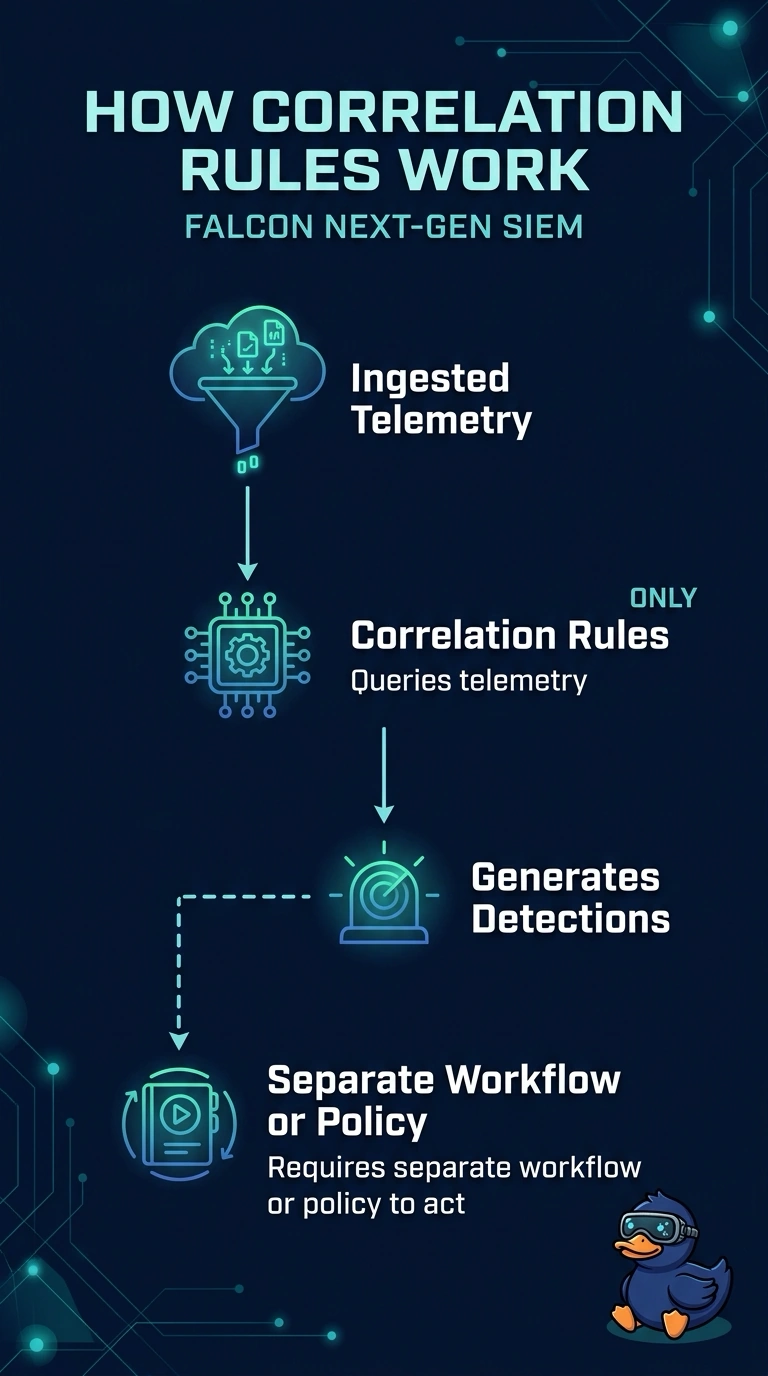
Think of a correlation rule like a smoke detector: it spots trouble from the signals it receives, but it does not swing a fire hose by itself. You might assume a SIEM rule blocks threats on the spot, yet its job is to query ingested telemetry and raise a detection, leaving containment to a separate workflow or endpoint policy. Don't confuse alerting logic with active prevention!
Full Explanation
In Falcon Next-Gen SIEM, correlation rules evaluate queries against ingested data to surface suspicious patterns, which is why the correct description is that It queries ingested telemetry to generate detections and requires a separate workflow or policy to act. Because correlation rules operate on telemetry already collected in the SIEM, they provide detection visibility across sources rather than inline prevention. Claiming that It intercepts process creation directly on the endpoint and terminates matching commands before they execute confuses SIEM correlation logic with real-time endpoint sensor prevention policies. Likewise, stating that It automatically isolates any workstation matching the rule criteria without needing a separate SOAR workflow overlooks that automated containment in this architecture is orchestrated by Falcon Fusion SOAR workflows rather than the rule query itself. Finally, saying that It forwards vendor alerts into the SIEM without evaluating any custom query logic or correlation criteria describes third-party passthrough detections, not custom correlation rules. As a key caveat, even when a correlation rule triggers an automated response workflow, ingestion and rule-evaluation latency means the activity has already occurred before the alert fires. For an operational check, review the rule configuration and linked Falcon Fusion SOAR workflows to confirm whether matching detections only create alerts or also trigger an approved containment action.
Prefer to study offline? Printable PDF study book + test engine ($7.50, unofficial). These questions stay free here.