
A university SOC analyst reviews a correlation-rule alert triggered when a standard administrative script ran shortly after an unusual external VPN login from an unmanaged country. Why should the analyst avoid closing the alert solely because the script itself is routinely used by IT?
Select an answer to reveal the explanation.
Short Explanation
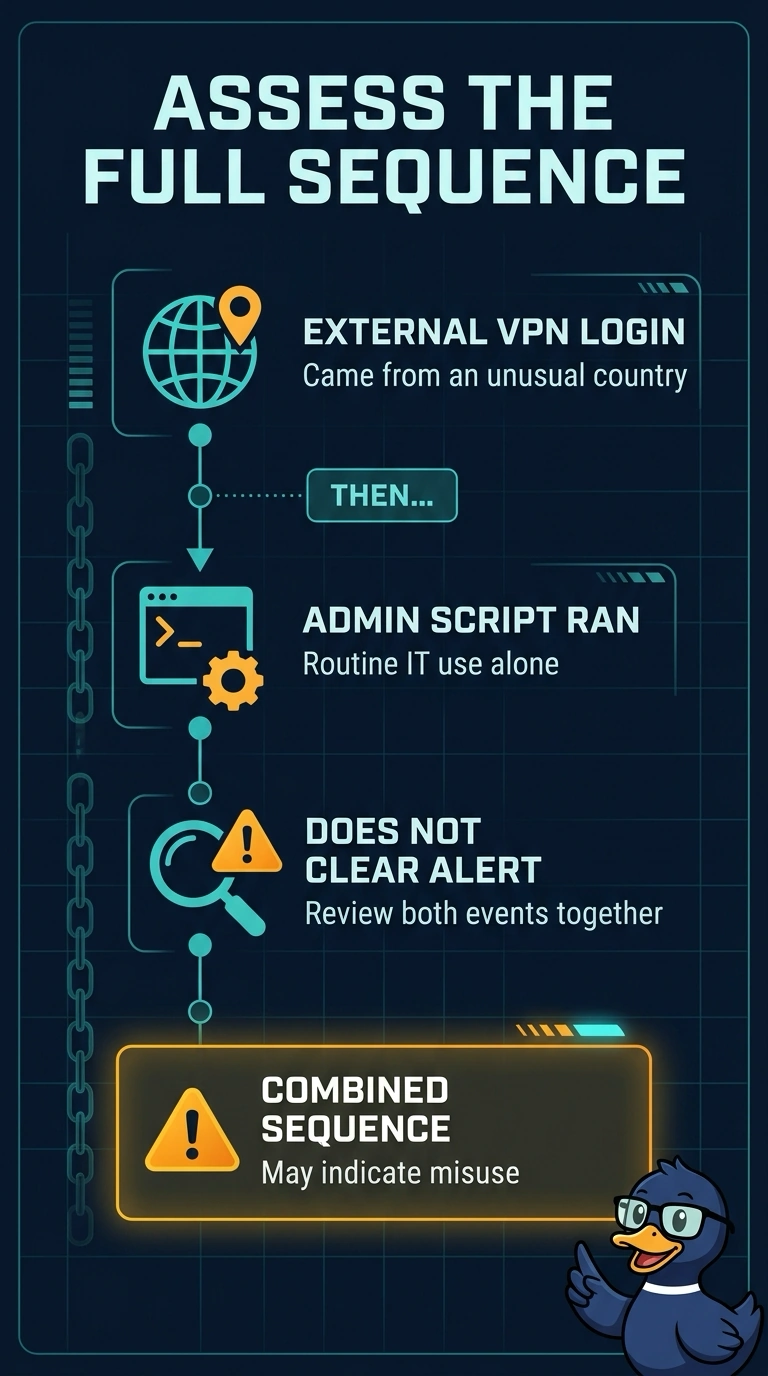
A key turning in a lock is normal—until it happens at three in the morning from someone who should not have the key. When you triage a correlation alert, the danger often lies in the sequence of events, not a single command in isolation. The trap is clearing a multi-source alert just because one piece looks familiar.
Full Explanation
Recognizing that The combined sequence of an anomalous login and administrative execution may indicate misuse captures the core purpose of multi-source correlation rules. Adversaries frequently abuse legitimate administrative scripts once they gain valid credentials, so the suspicious context comes from pairing the routine script with an unexpected external login. Claiming IT administrative scripts always generate critical-severity native detections is false because benign administrative tools normally run without triggering high-severity endpoint alerts on their own. Assuming Correlation rules only fire when malware hashes match threat intelligence overlooks behavioral and sequence-based SIEM detections that require no known malicious hash. Believing Closing any correlation alert permanently deletes the underlying raw logs confuses alert triage status with SIEM log retention, as closing an alert does not erase ingested telemetry. As a caveat, an authorized administrator traveling abroad could still trigger both conditions legitimately. As an operational check, inspect the alert's contributing events together, verify the VPN source IP and MFA outcome against approved travel or change tickets, and confirm whether the user initiated the script.
Prefer to study offline? Printable PDF study book + test engine ($7.50, unofficial). These questions stay free here.