
A university SOC analyst reviews two Falcon Next-Gen SIEM detections: both map to the MITRE ATT&CK Persistence tactic, but one involves a newly created scheduled task and the other involves a modified startup script. How do the tactic and technique classifications differ in this alert metadata?
Select an answer to reveal the explanation.
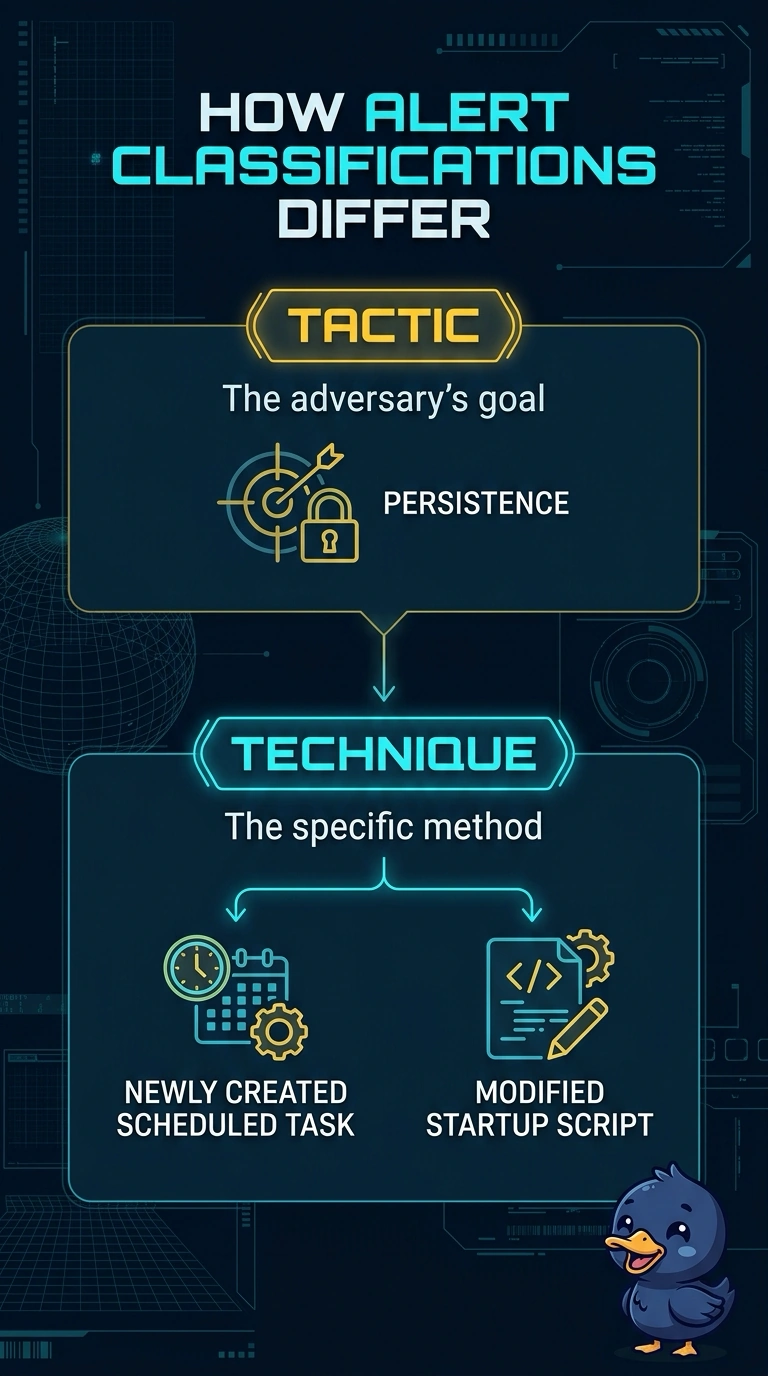
Short Explanation
You can think of the tactic as why an intruder broke into your building, and the technique as how they picked the lock. The trap is treating these labels as interchangeable or as proof of compromise. Knowing the difference helps you hunt for other methods serving the same adversary goal.
Full Explanation
MITRE ATT&CK organizes adversary behavior hierarchically: the tactic describes the adversary’s goal, while the technique describes the specific method used to achieve it, such as maintaining persistence through a scheduled task or startup script. Treating the tactic as the affected host and the technique as the user account confuses behavioral classifications with entity fields recorded in alert metadata. Treating the tactic as confirmed compromise and the technique as a false positive is also incorrect; legitimate administrative tools can trigger either classification, so context is needed to evaluate an alert. The claim that tactics apply only to cloud logs while techniques apply only to endpoint logs is incorrect as well, because ATT&CK tactics and techniques span cloud, identity, network, and endpoint domains. As an exam caveat, an ATT&CK tag alone is not proof of maliciousness; check process lineage and user authorization. As a practical check, when a persistence alert is confirmed, pivot across the host for other persistence techniques.
Prefer to study offline? Printable PDF study book + test engine ($7.50, unofficial). These questions stay free here.