
A healthcare network SOC maintains one custom correlation rule that triggers on unusual PowerShell flags, firewall port scans, or rare admin logins under a single alert title. Why should the team split this into separate focused rules?
Select an answer to reveal the explanation.
Short Explanation
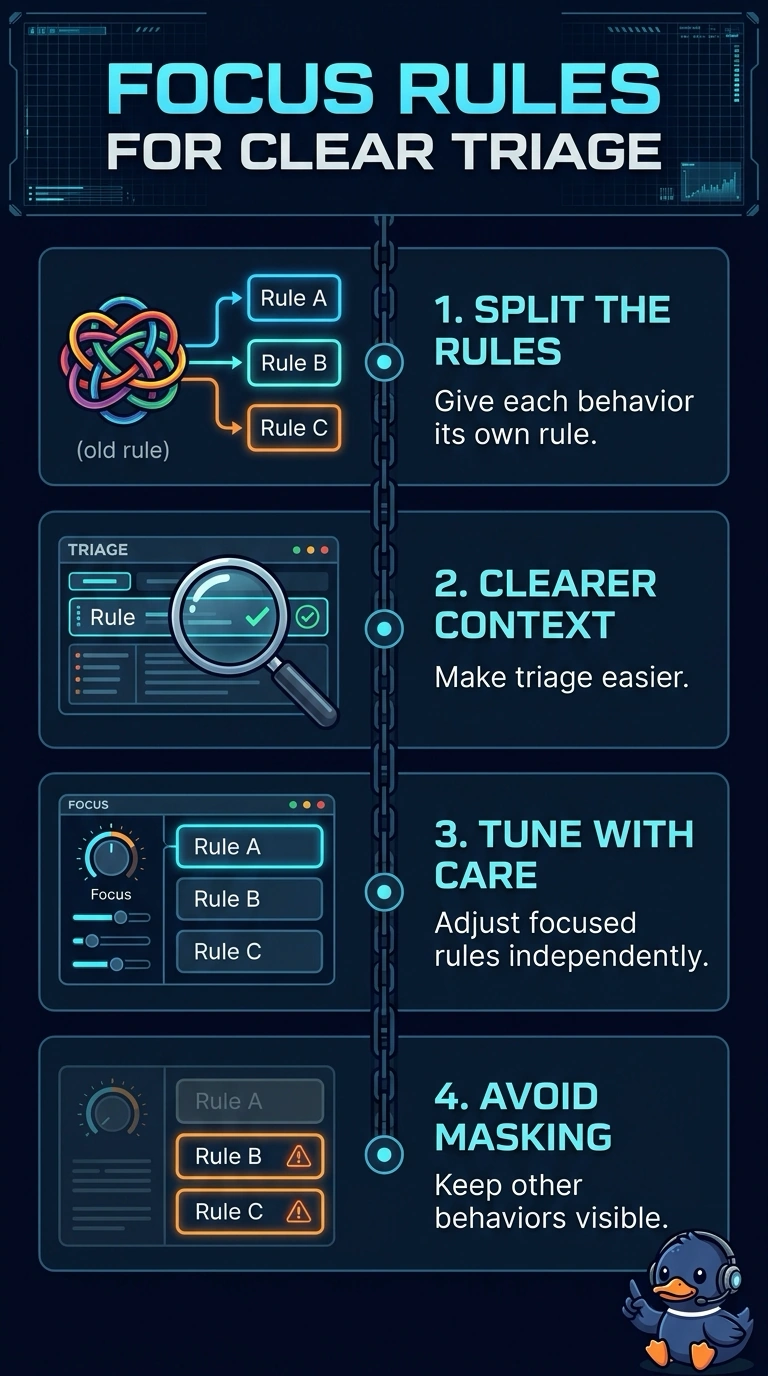
Bundling unrelated detections into one rule is like wiring your smoke detector, doorbell, and burglar alarm to the same buzzer—you cannot tell which emergency is happening. Focused rules give your team clear triage context and let you tune noisy logic without hiding other threats, whereas the trap is assuming combined rules prevent ATT&CK tagging or that splitting them bypasses parsing and passthrough alerts.
Full Explanation
Separating distinct detection behaviors into dedicated rules is essential because Focused rules provide clearer triage context and allow tuning without masking other behaviors. When one rule mixes unrelated endpoint, network, and identity triggers, analysts must manually inspect raw events just to learn which condition fired, and adding an exclusion for noisy admin scripts could inadvertently suppress real port-scan alerts. Claiming Separate rules automatically disable all third-party passthrough alerts from the firewall is incorrect because custom correlation rules operate independently and do not turn off passthrough ingestion. Similarly, Focused rules allow the SIEM to bypass log parsing and alert directly on unformatted text is false; CQL can query raw text, existing fields or fields parsed at query time; splitting rules does not itself populate missing fields or bypass required query logic. Finally, Combining multiple conditions in one rule prevents the SIEM from assigning any MITRE ATT&CK tag is inaccurate, though a single generic rule does make accurate per-technique mapping much harder to maintain. As a caveat, avoid over-splitting into hundreds of redundant rules that duplicate the exact same detection logic. Perform an operational check by testing each focused rule against historical data to confirm clean alert titles, accurate entity fields, and manageable alert volume.
Prefer to study offline? Printable PDF study book + test engine ($7.50, unofficial). These questions stay free here.