
A school district SOC team deploys a new correlation rule intended to alert on repeated failed VPN logins from the same account, but the rule triggers an alert on every single mistyped password. What should the rule author check in the correlation rule logic?
Select an answer to reveal the explanation.
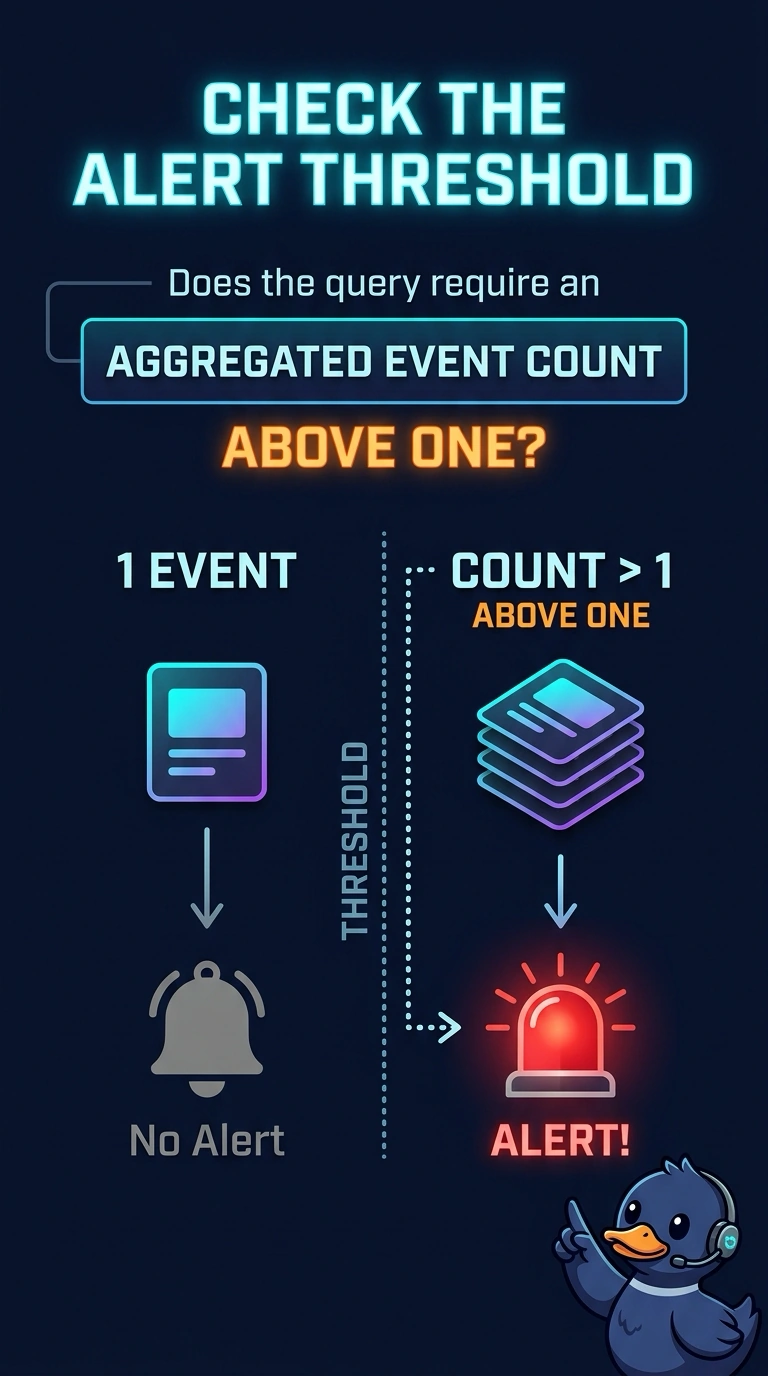
Short Explanation
A rule meant to catch repeated login failures shouldn't page your team every time someone fat-fingers a single password! The trap is writing a correlation query that matches individual failure events without a count threshold. You stop the noise by requiring an aggregated failure count above one.
Full Explanation
A frequency-based correlation rule — A query matching a single failure can trigger without repeated activity. Summary mode produces one detection for the results by default; Verbose mode produces per-result detections subject to its limit. Detection count also depends on rule mode and scheduling — unless it groups events and enforces a threshold, so the author must check Whether the query requires an aggregated event count above one within the evaluation window. Checking Whether the rule's MITRE ATT&CK tactic label is set to Credential Access only affects alert categorization metadata and does not alter how often the query triggers. Verifying Whether third-party passthrough alerts are enabled in the same workspace pertains to external vendor alert ingestion rather than the evaluation logic of a custom correlation rule. Similarly, checking Whether the case management workflow automatically assigns new alerts addresses post-detection triage routing rather than why the rule fires on single failures. As a caveat, choose a count threshold and time window calibrated to your environment's normal user retry behavior so you do not swap alert noise for missed attacks. As an operational check, test the updated rule query against historical VPN logs to verify single failures no longer match.
Prefer to study offline? Printable PDF study book + test engine ($7.50, unofficial). These questions stay free here.