
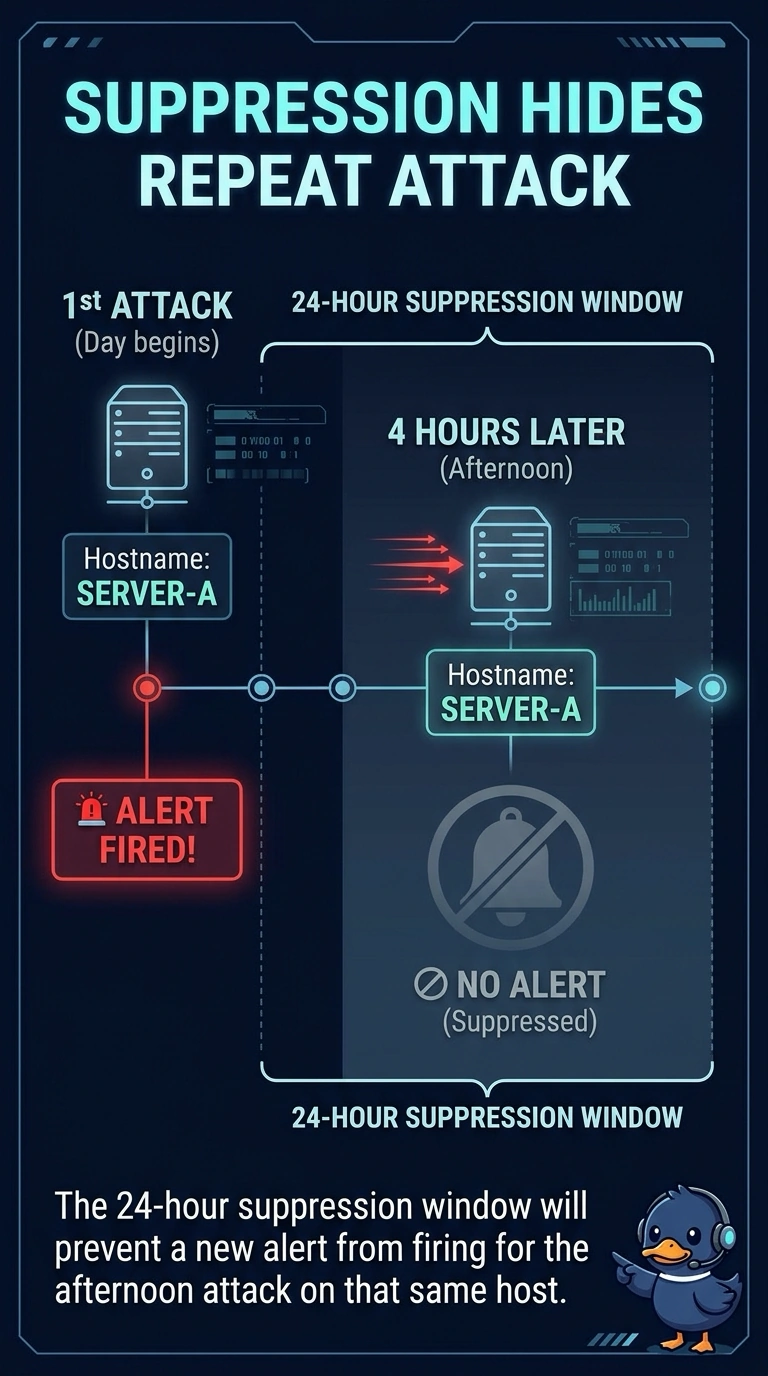
A financial firm SOC uses a custom deduplication workflow that implements a 24-hour alert suppression window keyed by hostname on a correlation rule that detects suspicious credential-access activity. An analyst investigates and closes an initial morning alert as benign testing, and a real attacker runs the same technique on that host four hours later. What risk does this suppression configuration create?
Select an answer to reveal the explanation.
Short Explanation
A 24-hour suppression window acts like muting your smoke detector for an entire day after burning toast at breakfast. If a real fire starts at lunch, you will not hear a peep—so keep suppression windows tight enough that fresh attacks still wake you up.
Full Explanation
In this custom deduplication workflow, suppression prevents duplicate notifications for the same condition within a defined period, which helps reduce queue noise when properly sized. However, in this scenario, The 24-hour suppression window will prevent a new alert from firing for the afternoon attack on that same host, leaving analysts blind to a genuine compromise simply because a benign event triggered the rule earlier that day. Claiming that The SIEM will automatically delete the earlier closed alert from case history when the new activity occurs is incorrect because suppression stops new alert generation rather than erasing closed records. Claiming that The correlation rule will immediately disable itself globally across all endpoints after the morning alert closes confuses per-entity suppression with turning off a rule. Claiming that The suppression setting will convert the afternoon correlation-rule match into a third-party passthrough detection misunderstands detection origins, since a rule's origin never changes due to suppression. As a caveat, this workflow suppresses notifications, not underlying detections, so raw telemetry remains in the SIEM for analysts hunting directly in CQL even if no alert fires. As an operational check, review high-impact correlation rules and verify that suppression windows match realistic triage intervals rather than spanning full days.
Prefer to study offline? Printable PDF study book + test engine ($7.50, unofficial). These questions stay free here.