
A software company SOC builds a custom correlation rule to detect potential data staging by alerting whenever any workstation runs a file-compression utility, and routine developer builds immediately flood the alert queue. How should the team refine the detection logic?
Select an answer to reveal the explanation.
Short Explanation
Alerting every time someone packs a box in a shipping warehouse will bury your team in noise. The trap is either throwing away the rule or flagging arbitrary command lengths instead of pairing archive activity with suspicious context.
Full Explanation
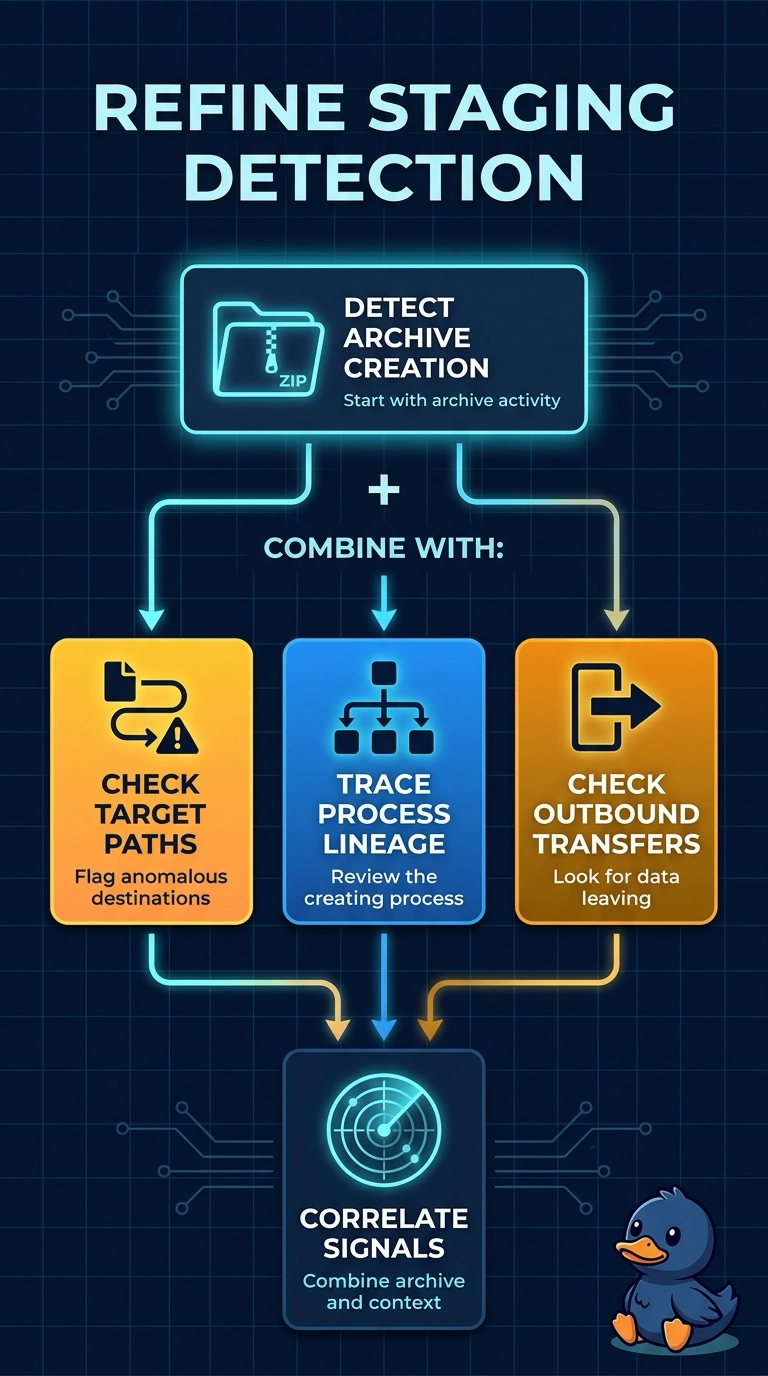
Effective correlation rules separate routine administrative or build workflows from adversary data staging by requiring behavioral context. Selecting Combine archive creation with anomalous target paths, process lineage, or outbound transfers focuses alerts on suspicious patterns, such as an unusual parent script archiving sensitive directories before an external upload. In contrast, Disable the correlation rule entirely because compression utilities are too common to monitor eliminates visibility into a frequent pre-exfiltration step. Choosing Raise the rule severity to critical so analysts prioritize investigating every developer build worsens alert fatigue without improving signal fidelity. Meanwhile, Alert only on compression commands that exceed one hundred characters in command-line length relies on an arbitrary threshold that misses short malicious commands while still matching long build scripts. As a caveat, legitimate backup or deployment tools may also compress sensitive folders, so validate exclusions against known automation accounts. As an operational check, test the refined CQL rule against historical developer build logs and simulated staging commands to verify noise drops while true-positive logic still fires.
Prefer to study offline? Printable PDF study book + test engine ($7.50, unofficial). These questions stay free here.