
A university SOC analyst tests a correlation rule that links firewall events and identity logs by username, and sees unrelated unauthenticated events grouped into alerts. What rule logic issue should the analyst check?
Select an answer to reveal the explanation.
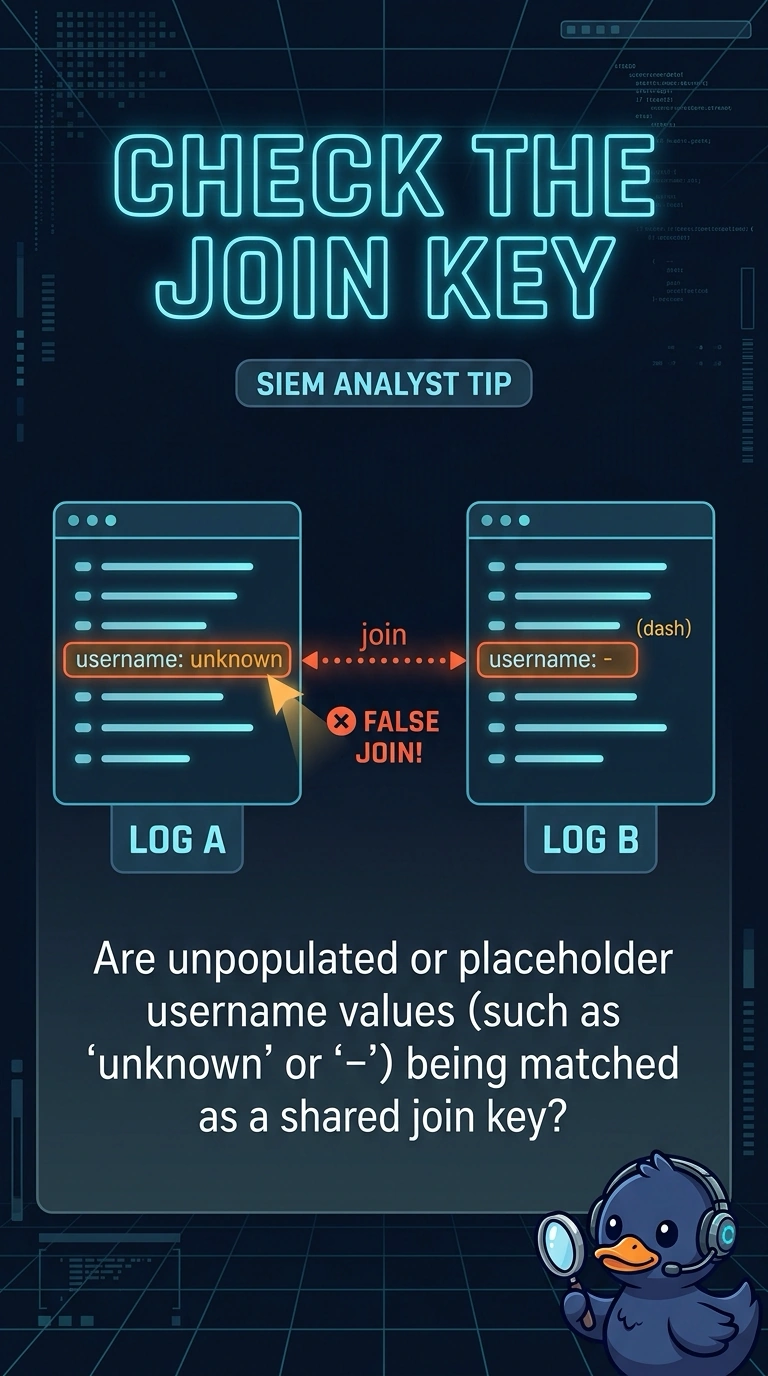
Short Explanation
If two strangers both write N/A on a form, they do not become the same person. When you join logs on a field without filtering out empty or placeholder values, unrelated events collide into noisy false alerts.
Full Explanation
When multi-source correlation joins events on an identifier, the analyst must check "Whether unpopulated or placeholder username values such as unknown or dash are being matched as a shared join key" across those sources. Many network appliances log a dash, empty string, or generic placeholder when traffic is unauthenticated, causing the rule to link completely unrelated sessions together. Checking "Whether the correlation rule's MITRE ATT&CK tactic tag is preventing normalized field extraction" misunderstands rule metadata, since ATT&CK labels classify detections rather than altering parser extraction. Investigating "Whether first-party endpoint detections are overriding the custom correlation rule's severity" does not explain why unrelated events are being grouped into the same correlation match. Reviewing "Whether the SIEM time zone setting is shifting all firewall events into the next calendar day" would affect temporal alignment rather than causing unauthenticated events to match by username. As a caveat, different log sources can also use distinct placeholder strings for missing users, so inspect samples from each source. Operationally, add explicit CQL filters to require non-empty, non-placeholder usernames before the correlation rule joins events.
Prefer to study offline? Printable PDF study book + test engine ($7.50, unofficial). These questions stay free here.