
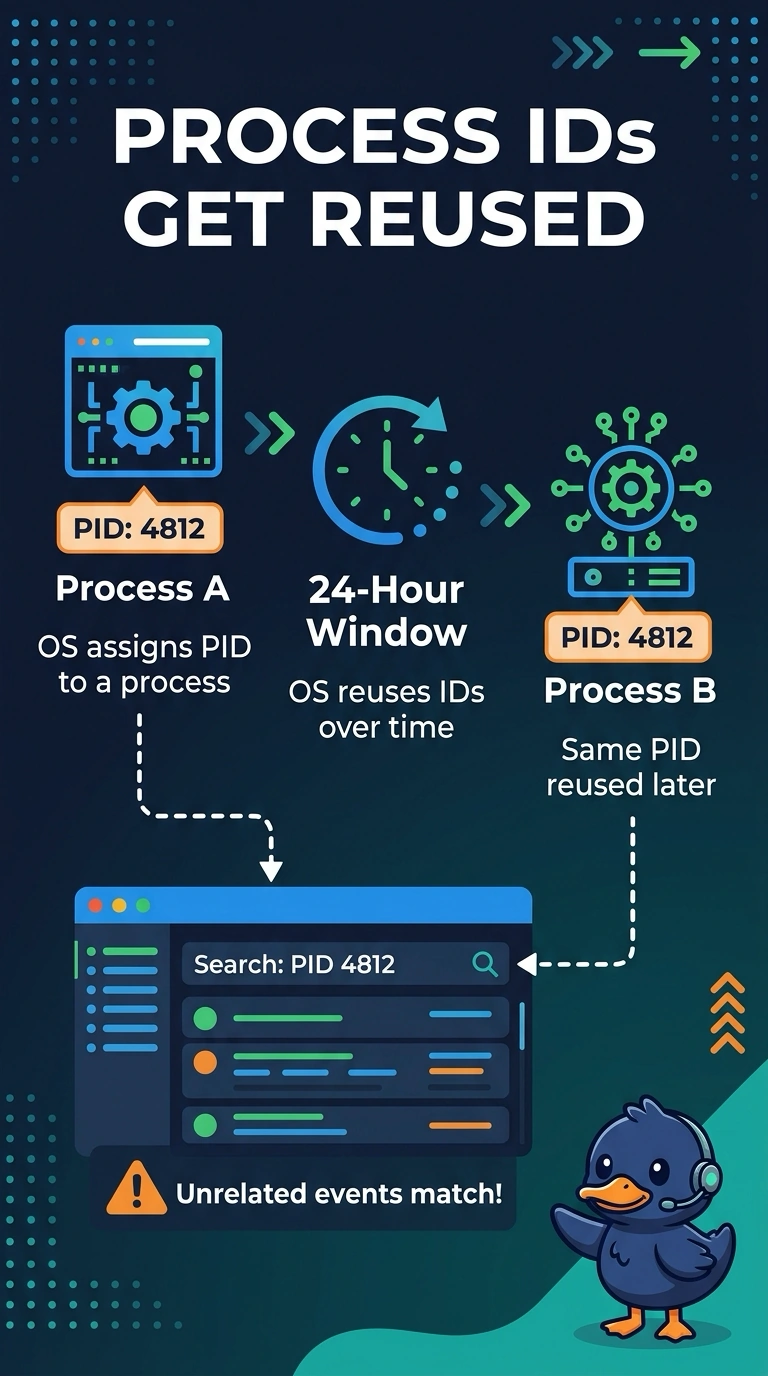
A university SOC writes a correlation rule joining endpoint process events with network events over a 24-hour window using only the numeric process ID, and sees unrelated applications linked in alerts. Why does this happen?
Select an answer to reveal the explanation.
Short Explanation
Using a numeric process ID across a 24-hour window is like tracking hotel guests by room number alone after checkout because someone new moves in. The trap is assuming a PID stays unique all day. Pair it with host and process-instance context so your correlation rule does not stitch together unrelated programs.
Full Explanation
Correlation rules need stable, unique join keys when linking events across time; otherwise, unrelated activities collide into false-positive alerts. That is why Operating systems reuse numeric process IDs over time, causing unrelated events to match when a 24-hour window joins solely on a short-lived PID. Claiming that Falcon Next-Gen SIEM automatically merges all endpoint logs into a single generic process ID is incorrect because telemetry preserves distinct process identifiers as logged by the host. Stating that Twenty-four-hour correlation windows only support third-party firewall passthrough detections misstates how correlation rules operate across log sources. Claiming that MITRE ATT&CK mappings override join keys whenever a rule runs longer than one hour confuses threat-framework metadata tags with query join logic. As a caveat, even within short windows, joining on PID without a host identifier will also collide across different endpoints that happen to assign the same number. As an operational check, inspect the contributing events of a noisy alert and update the correlation join key to combine host identity with a unique process GUID or narrow time-bound session fields.
Prefer to study offline? Printable PDF study book + test engine ($7.50, unofficial). These questions stay free here.