
A financial services SOC notices that third-party passthrough alerts from a cloud email gateway are all labeled with critical severity, while native Falcon detections for similar activity appear as medium. What should the analyst evaluate first?
Select an answer to reveal the explanation.
Short Explanation
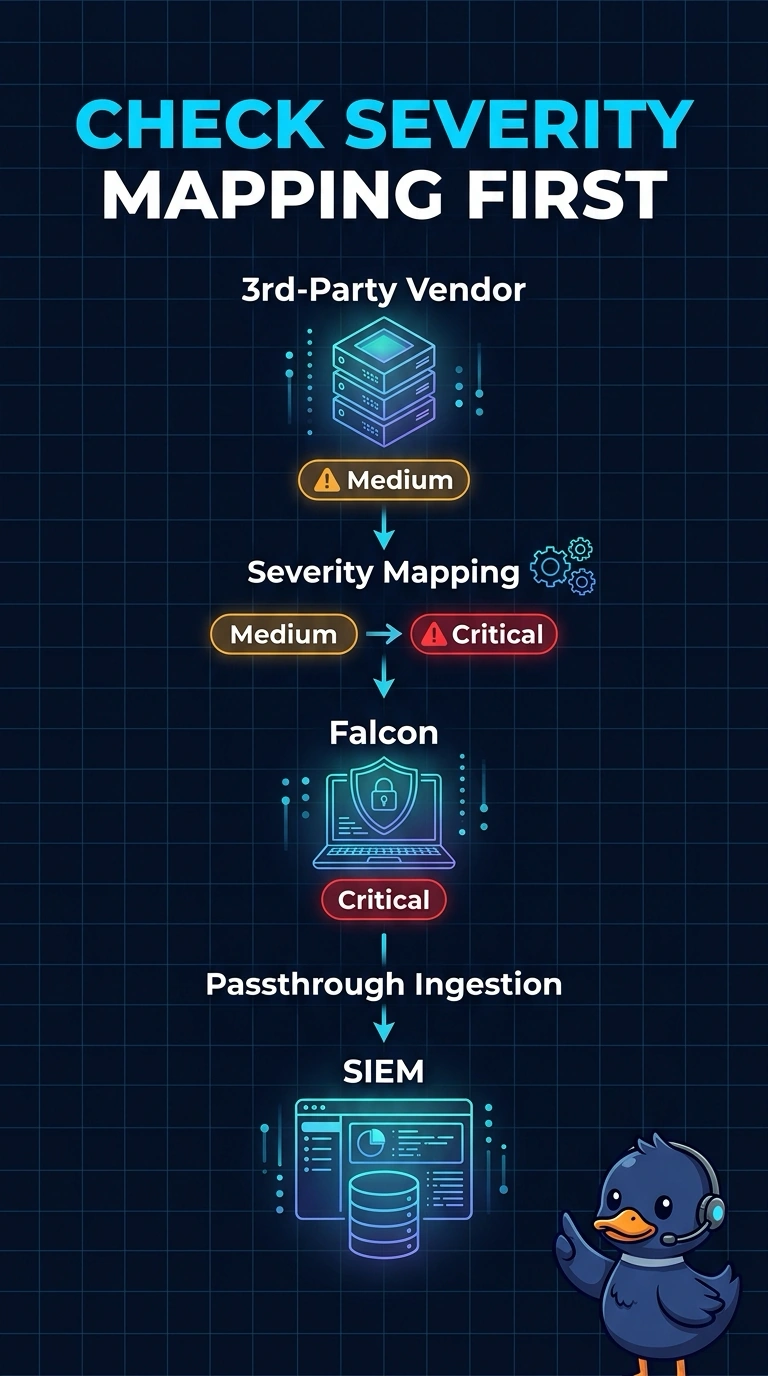
Every vendor has its own volume knob for severity, so a third-party critical might just mean a routine policy hit. Before you treat every passthrough alert as an emergency, check how that external tool defines its labels.
Full Explanation
Third-party passthrough detections carry the upstream vendor's own severity scoring, so you should first evaluate "How the third-party vendor maps severity labels before passthrough ingestion into the SIEM" rather than assuming different origins share identical scales. Upstream tools often tag broad policy violations as critical, whereas native Falcon detections score behavioral risk differently. Assuming "Whether Falcon Next-Gen SIEM correlation rules are downgrading native endpoint detections automatically" confuses separate detection origins, because custom correlation rules do not rewrite native endpoint alert severities. Asking "Whether the email gateway logs should be excluded from CPS normalization to preserve alerts" is counterproductive, since CPS normalization enables cross-source querying without erasing passthrough detections. Acting on "Whether all critical passthrough alerts should trigger immediate host isolation workflows" is dangerous because unvalidated third-party severity labels can cause unnecessary business disruption. Keep in mind as a caveat that a low or medium native detection on a critical asset can still outrank a noisy third-party critical alert. For an operational check, inspect sample email gateway passthrough metadata alongside native endpoint context to calibrate triage priority.
Prefer to study offline? Printable PDF study book + test engine ($7.50, unofficial). These questions stay free here.