
A logistics SOC builds a custom correlation rule that joins firewall events with cloud identity logins over a five-minute window, but the rule consistently misses real multi-stage activity when a remote firewall batches and forwards logs twenty minutes late. The rule uses Created (@timestamp) time, a five-minute search lookback and a five-minute behavioral join span; the source timestamps are correct. What is the most likely cause?
Select an answer to reveal the explanation.
Short Explanation
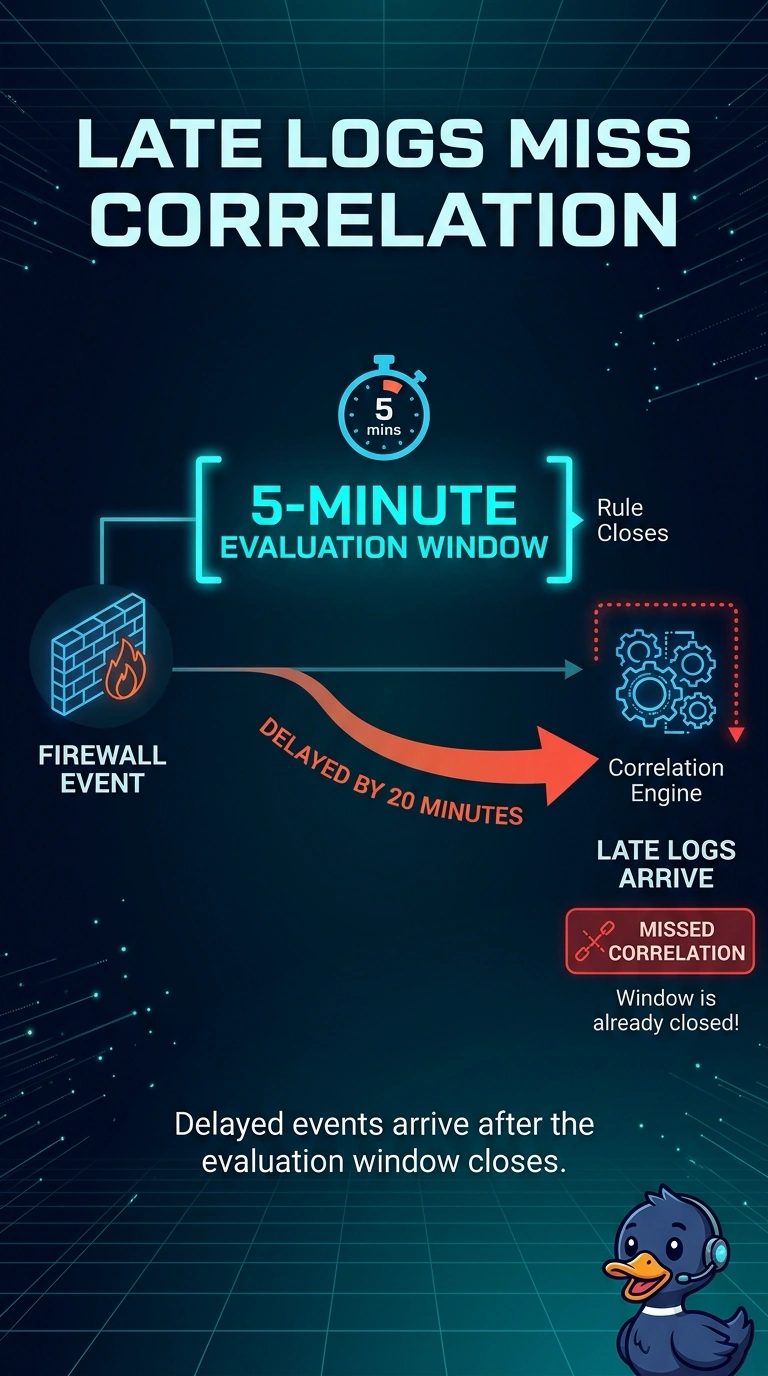
Imagine trying to catch a train that already left the station twenty minutes ago—that's what happens when batched logs miss a tight rule window. When your firewall forwards logs twenty minutes late, the five-minute correlation window closes before the matching telemetry arrives. Don't blame passthrough alerts or ATT&CK tags when ingestion timing is the real culprit!
Full Explanation
Behavioral span, search lookback, frequency and timestamp basis are separate settings. A five-minute sequence span alone does not prove late-arrival loss if a larger lookback still searches both events. Here the rule uses Created (@timestamp) time with a five-minute search lookback, so choosing Delayed firewall log ingestion causes events to arrive after the correlation rule's evaluation window closes accurately explains why twenty-minute-late events fall outside searches and the firewall event is missed with the cloud login. In contrast, choosing Third-party firewall passthrough alerts always override custom correlation rules and suppress their output is false because passthrough alerts and custom rules are separate detection origins that do not silence each other. Choosing MITRE ATT&CK tactic tags automatically disable correlation rules whenever two log sources use different vendors misunderstands ATT&CK metadata, which classifies behavior rather than disabling cross-vendor rules. Similarly, choosing Normalized CPS fields drop all cloud identity events unless the firewall log arrives before the login event is incorrect because CPS standardizes schemas independently of arrival order. As an exam caveat, distinguish between the event-generation timestamp inside the log and the ingest timestamp when the SIEM receives it.
Prefer to study offline? Printable PDF study book + test engine ($7.50, unofficial). These questions stay free here.