
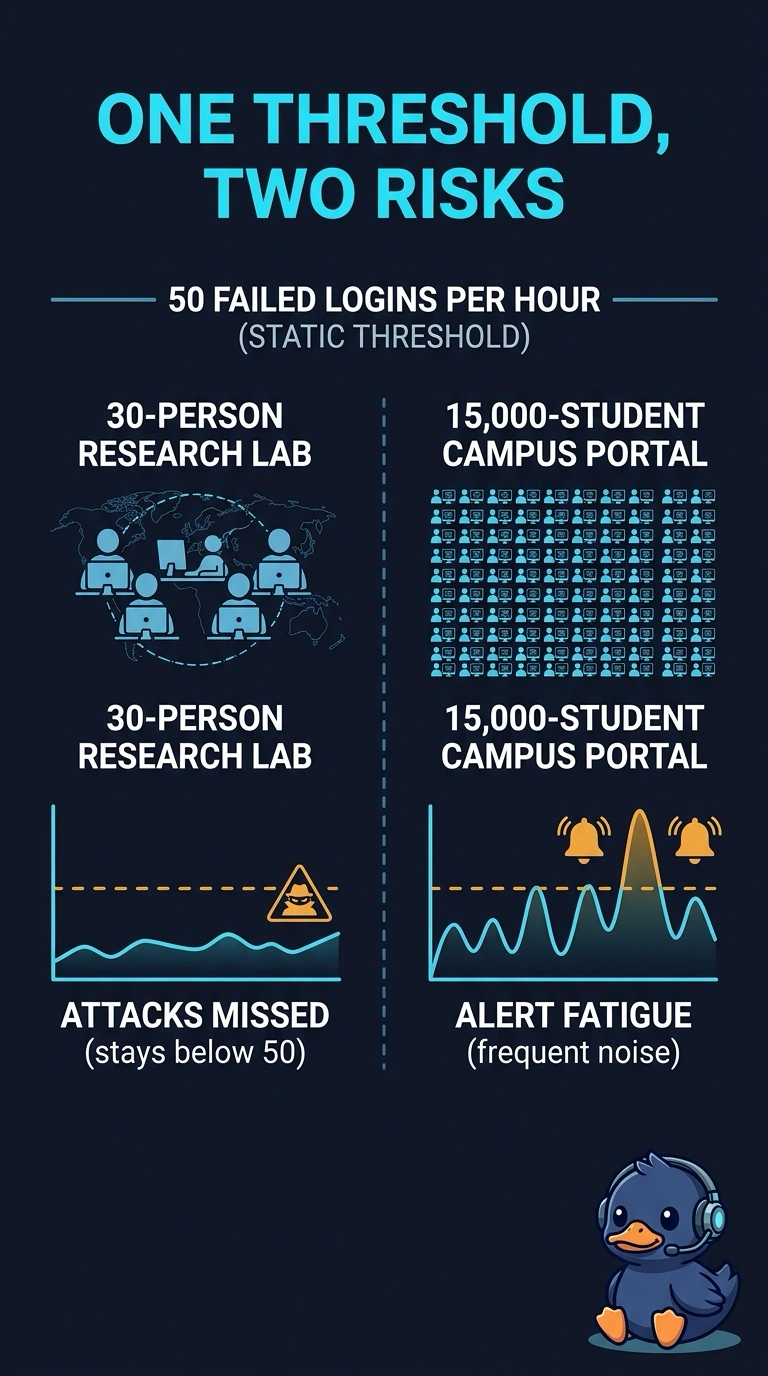
A university SOC applies a single correlation rule with a fixed threshold of 50 failed logins per hour across both a 30-person research lab and a 15,000-student campus portal. What analytical limitation does this static threshold introduce?
Select an answer to reveal the explanation.
Short Explanation
One shoe size doesn't fit both a toddler and a basketball player, and the same goes for static alert thresholds! A fixed count of 50 failed logins can flood you with noise on a 15,000-student portal while letting a slower attack slip right past a 30-person lab. Always match your detection thresholds to the scale of the environment.
Full Explanation
Authentication volume scales with user population, so a single raw event threshold behaves very differently across environments of unequal size. Choosing One static threshold can be noisy on large populations yet miss attacks on small ones captures the core analytical trade-off: normal typos across 15,000 students easily cross 50 failures an hour, whereas 40 targeted guesses against a 30-person lab never trigger the rule. By contrast, choosing Static thresholds automatically disable all first-party endpoint detections across smaller subnets is incorrect because custom correlation rules operate independently and never turn off native endpoint analytics. Choosing Fixed count rules cannot reference CPS normalized fields when evaluating authentication telemetry is false, as correlation rules routinely aggregate over normalized CPS fields. Likewise, choosing Threshold rules strip MITRE ATT&CK tactic metadata whenever event counts exceed fifty per hour misstates how rules work, since ATT&CK mappings are static rule metadata rather than conditional deletions. As an exam caveat, tailoring separate correlation rules or entity-scoped groupings per environment helps balance fidelity. As an operational check, review historical baseline login-failure distributions separately for the lab and the portal before tuning thresholds.
Prefer to study offline? Printable PDF study book + test engine ($7.50, unofficial). These questions stay free here.