
A university SOC analyst reviews a correlation alert triggered when a busy shared lab server logged both a failed admin login and an outbound connection within five minutes. What should the analyst verify in the alert metadata before escalating?
Select an answer to reveal the explanation.
Short Explanation
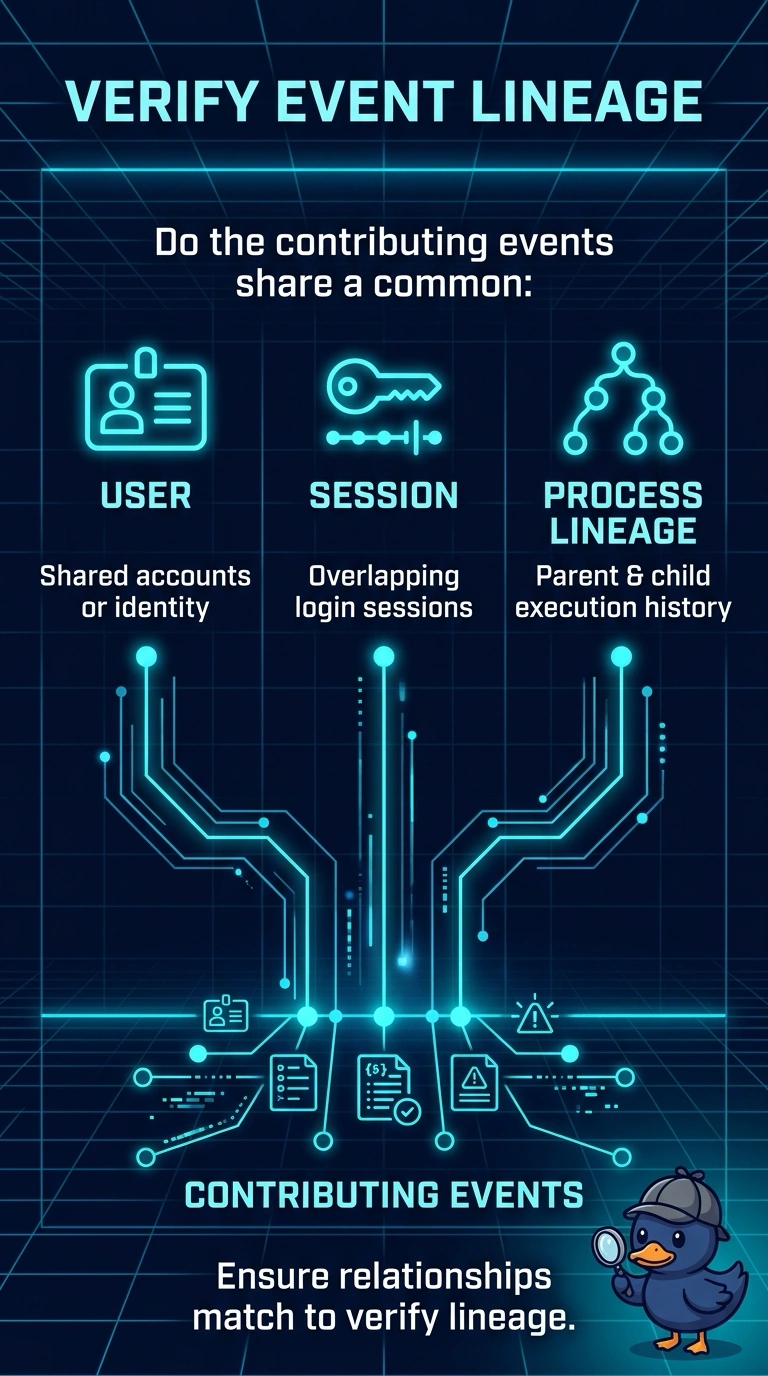
Two things happening in the same room five minutes apart do not automatically mean they are connected. Before you escalate a multi-stage alert on a busy shared server, check that the underlying events actually share a user, session, or process thread. The trap is assuming time proximity on a multi-user host proves a single attack chain.
Full Explanation
Correlation rules that join events solely by hostname and a short time window can accidentally pair unrelated actions on busy multi-user servers. Checking "Whether the contributing events share a common user, session, or process lineage" confirms whether the failed login and outbound connection belong to the same causal sequence or merely coincided. Checking "Whether the correlation rule's name contains a MITRE ATT&CK tactic identifier in its title" only reflects how the rule was labeled, not whether the matched events are related. Checking "Whether the lab server has more than one network interface card installed" focuses on hardware inventory rather than behavioral correlation between the two events. Checking "Whether the alert can be converted into a visual chart before inspecting any logs" skips the foundational evidence verification needed during triage. Caveat: an attacker who compromises a shared server might pivot between accounts, so unrelated-looking user fields can still warrant checking parent processes or source IPs. Operational check: open the contributing events in CQL and compare the user, source IP, and process IDs across both stages.
Prefer to study offline? Printable PDF study book + test engine ($7.50, unofficial). These questions stay free here.