
A manufacturing SOC builds a correlation rule to detect internal lateral movement over remote administration ports, but the rule fires repeatedly when servers connect to themselves during local health checks. How should the analyst refine the rule?
Select an answer to reveal the explanation.
Short Explanation
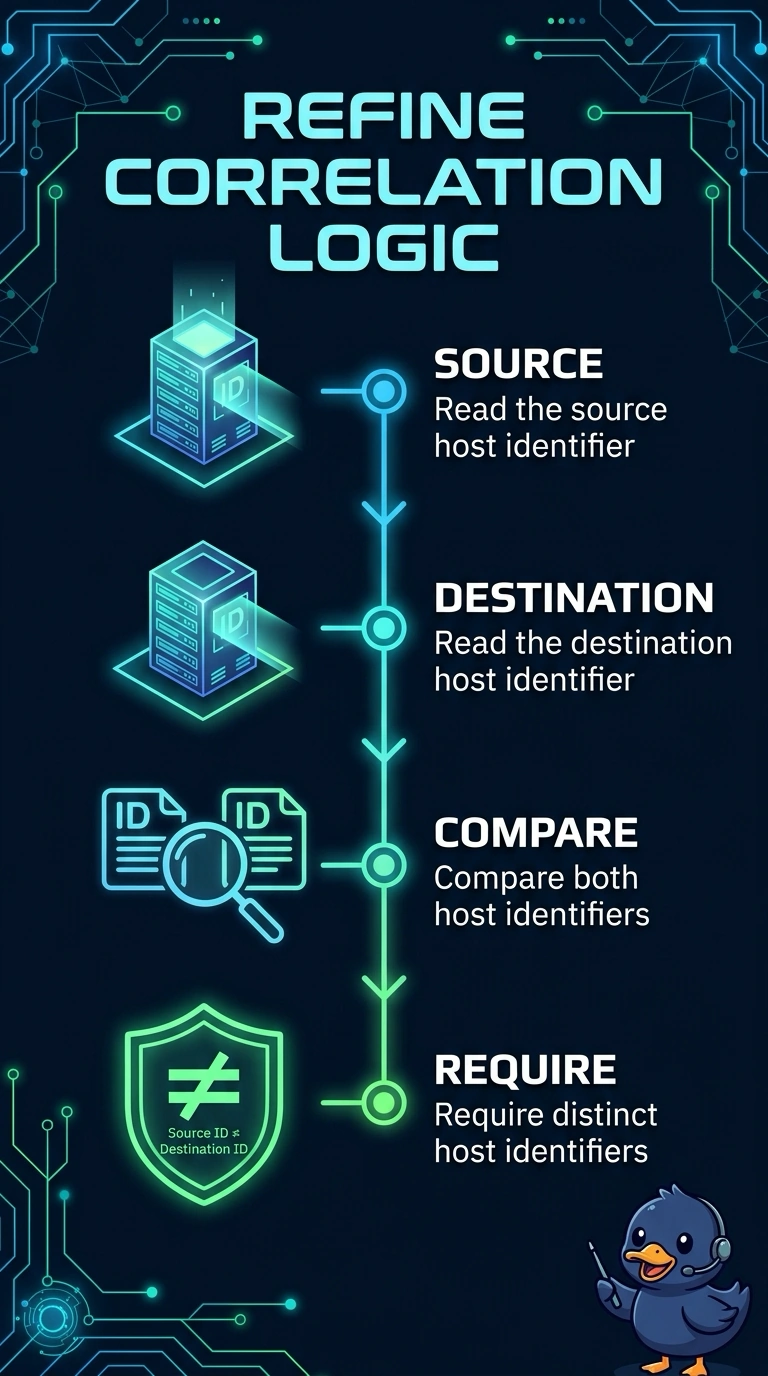
You’re looking for movement between different machines, not a server talking to itself. Requiring distinct source and destination host identifiers fixes the entity logic and filters out local health checks. Raising severity or disabling logging won’t solve the noise, and a third-party passthrough detection isn’t the right fit for SIEM correlation logic.
Full Explanation
Lateral movement detections are intended to identify connections between separate systems, so matching the same source and destination host creates avoidable noise from local services. Requiring distinct source and destination host identifiers removes self-targeted health-check noise while preserving visibility into genuine host-to-host movement. Raising the alert severity to critical so analysts prioritize reviewing local health checks only amplifies false-positive fatigue; it does not fix the condition causing the alerts. Disabling all remote administration logging across internal manufacturing servers would blind the SOC to real lateral movement and remove legitimate administrative audit data. Changing the rule into a third-party passthrough detection is unsuitable because passthrough detections originate from external tools rather than SIEM correlation queries. Exam caveat: legitimate IT jump hosts still connect between distinct systems, so known administrative activity may require further review. Practical check: validate the updated rule against historical data to confirm self-connections no longer match while simulated cross-host connections still trigger it.
Prefer to study offline? Printable PDF study book + test engine ($7.50, unofficial). These questions stay free here.