
A university SOC notices that a correlation rule alerting on ten failed SSH logins within five minutes fires constantly during legitimate script deployments. If the team simply raises the threshold to 500 failures, what risk does that introduce, and what is the better tuning approach?
Select an answer to reveal the explanation.
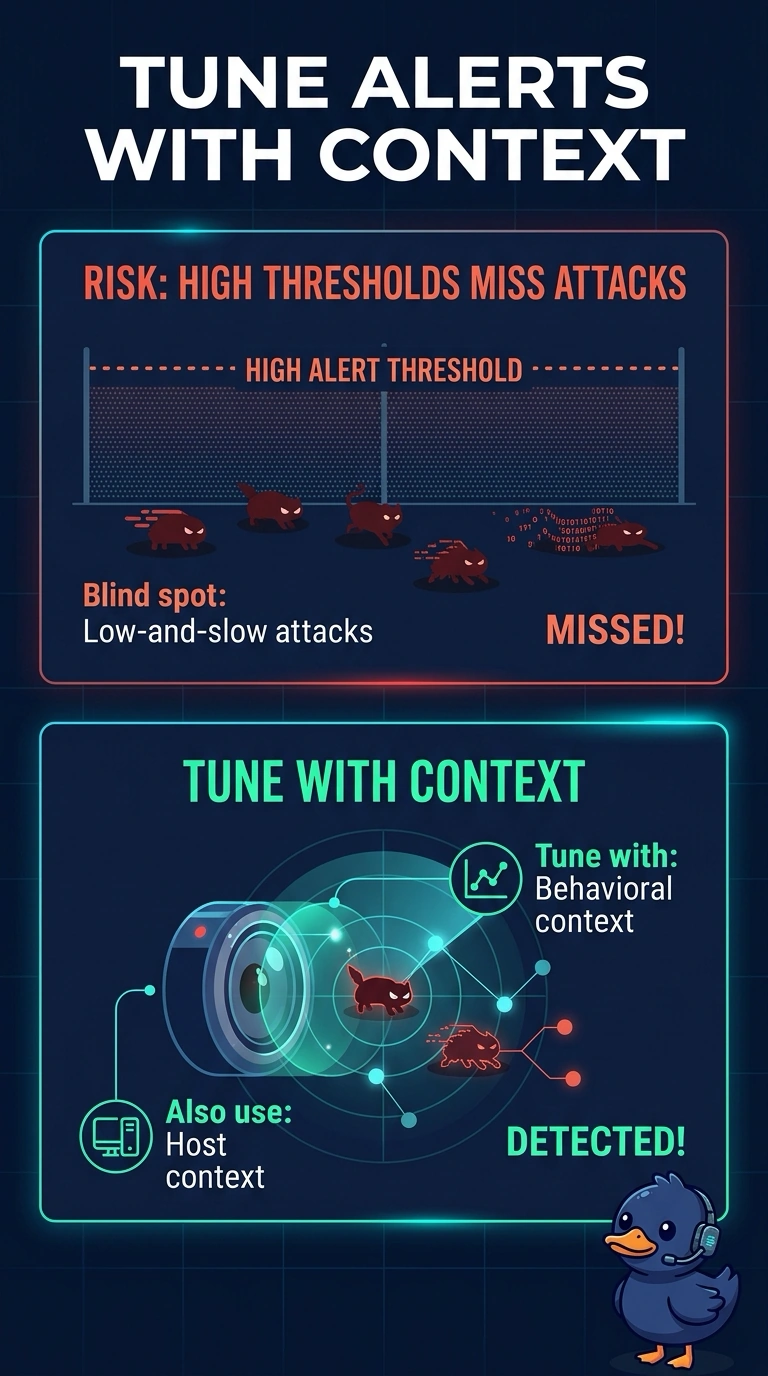
Short Explanation
Cranking a threshold sky-high quiets your alert queue, right up until a patient attacker walks right underneath it. The trap is treating a pure volume hike as harmless tuning instead of adding behavioral context.
Full Explanation
Attackers frequently throttle brute-force or password-spraying attempts to stay below high volume thresholds. Recognizing that High thresholds miss low-and-slow attacks; add behavioral or host context instead keeps detection sensitive to real threats—for example, by correlating failed logins with a subsequent successful login or excluding only verified deployment servers—rather than blinding the rule. Claiming that Raising the threshold fixes the noise safely without any impact on attack detection ignores how easily attackers evade high static counts. Claiming that Raising the threshold converts the correlation rule into a third-party passthrough confuses rule tuning with detection origin, as correlation rules remain SIEM-authored logic. Claiming that High thresholds automatically block source IP addresses through Falcon Fusion SOAR is false because changing a query threshold does not attach or trigger a SOAR response action. Caveat: every added exclusion or behavioral condition must still be tested so authorized deployment tools do not become blind spots if compromised. Operational check: compare historical true-positive and benign deployment events against the updated rule logic before saving.
Prefer to study offline? Printable PDF study book + test engine ($7.50, unofficial). These questions stay free here.