
A school district SOC receives a critical-severity third-party passthrough alert from a network appliance flagging a student lab Chromebook, alongside a low-severity correlation alert on a district payroll server. Why should the analyst avoid relying solely on the passthrough alert's critical label to prioritize triage?
Select an answer to reveal the explanation.
Short Explanation
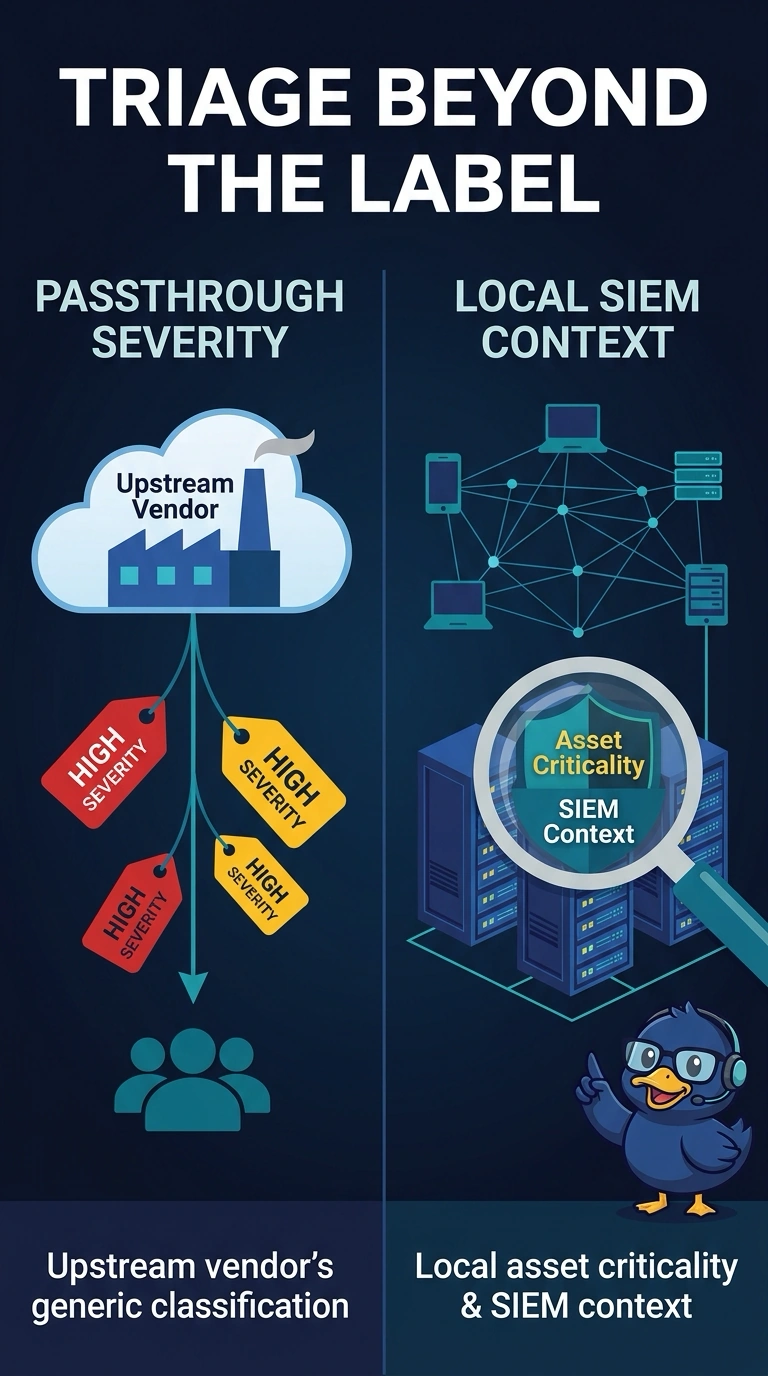
A third-party severity label is like a generic weather warning issued for an entire state—it does not know whether you are standing in a basement or on an open rooftop. Because "critical" from an external appliance ignores what the affected device actually does in your environment, a low-severity alert on a payroll server can carry far greater risk. The trap is letting an upstream vendor's label dictate your triage queue.
Full Explanation
Third-party passthrough detections bring alerts from external security tools into Falcon Next-Gen SIEM, preserving the vendor's original severity rating. Because "Passthrough severity reflects the upstream vendor's generic classification rather than local asset criticality and SIEM context" explains why a routine lab Chromebook alert can appear higher than a sensitive payroll server alert, analysts must weigh business impact and corroborating telemetry during triage. Conversely, "Third-party passthrough alerts are automatically downgraded to informational priority whenever CPS normalization succeeds" is wrong because normalization standardizes fields without altering alert severity. Similarly, "Critical passthrough alerts represent unparsed raw log lines that have not yet been matched against any detection logic" is false because passthrough alerts already originate from an upstream vendor's detection engine. Finally, "Correlation rules always supersede third-party passthrough alerts in Falcon Next-Gen SIEM regardless of the affected system's role" overstates a fixed precedence rule that does not exist; triage priority depends on context, not origin alone. As a caveat, never dismiss a critical passthrough alert without checking whether the flagged behavior actually succeeded or reached sensitive systems. Operational check: compare asset role, user privilege, and corroborating endpoint or identity events for both alerts before assigning triage priority.
Prefer to study offline? Printable PDF study book + test engine ($7.50, unofficial). These questions stay free here.