
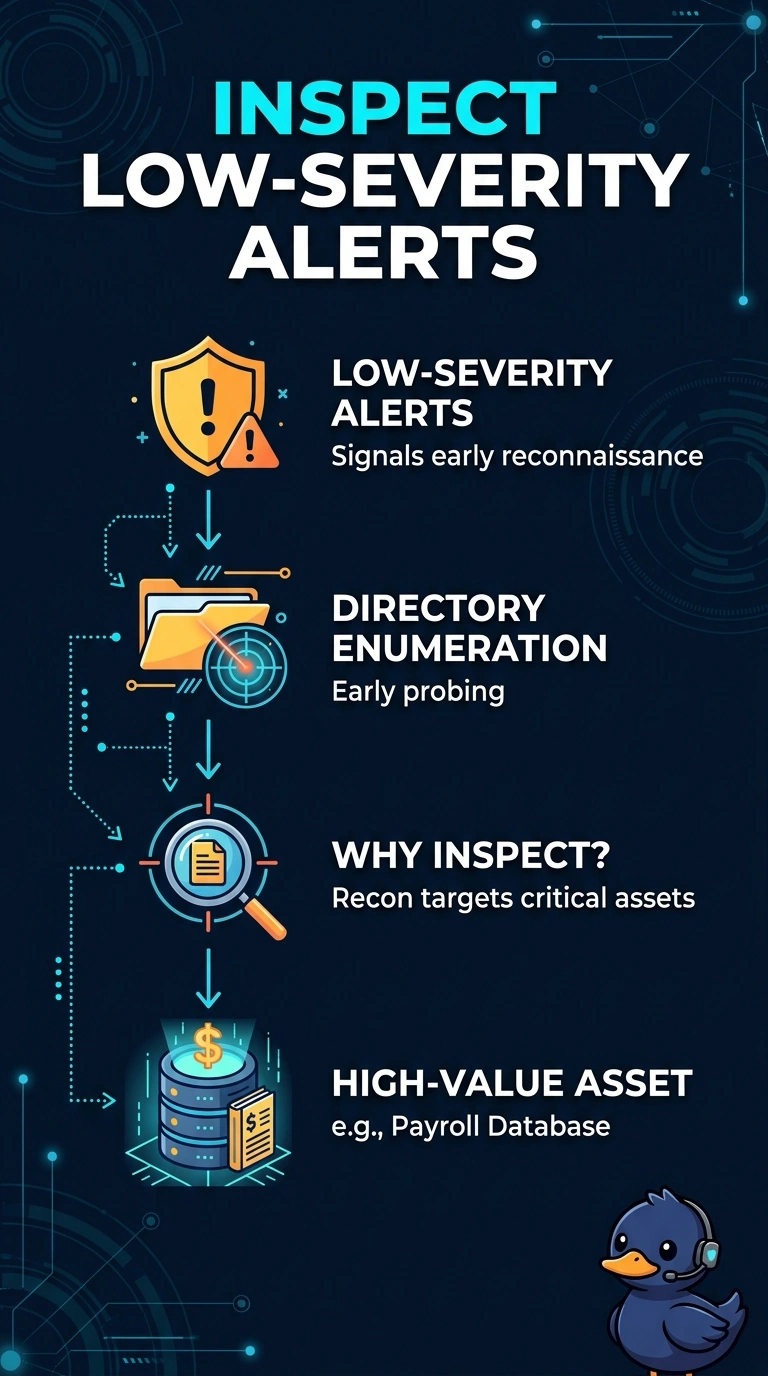
A financial firm SOC analyst sees several low-severity detections for unusual directory enumeration on a server hosting sensitive payroll databases and considers auto-closing them to clear the queue. Why should the analyst inspect these alerts first?
Select an answer to reveal the explanation.
Short Explanation
A low-severity label is not a free pass, especially when the target is a crown-jewel payroll server rather than a test machine. The trap is letting severity alone dictate your triage when asset criticality turns quiet reconnaissance into high risk.
Full Explanation
Severity ratings measure an individual rule's baseline impact rather than local business risk, which makes Low-severity detections can signal early reconnaissance on high-value assets the correct reason to investigate. Adversaries often run quiet discovery commands before privilege escalation or data staging, and their significance rises sharply on a payroll database host. Claiming Low-severity alerts automatically escalate into critical cases after one hour invents an automatic escalation behavior that does not replace analyst triage. Assuming Every low-severity detection is guaranteed to be a third-party passthrough rule is false because first-party, third-party, and correlation-rule detections can all carry low severity. Believing Auto-closing low-severity alerts deletes the underlying raw SIEM telemetry confuses alert disposition with log retention. As a caveat, repeated benign discovery from authorized monitoring tools should be verified and tuned rather than ignored blindly. For an operational check, inspect the initiating user, command line, and parent process in the alert metadata to confirm whether the enumeration came from an approved administrative task.
Prefer to study offline? Printable PDF study book + test engine ($7.50, unofficial). These questions stay free here.