
A retail SOC analyst sees three low-severity alerts within twenty minutes on the same store server: an unusual script launch, a local account enumeration, and an outbound connection to an uncategorized IP. How should the analyst treat these alerts during analysis?
Select an answer to reveal the explanation.
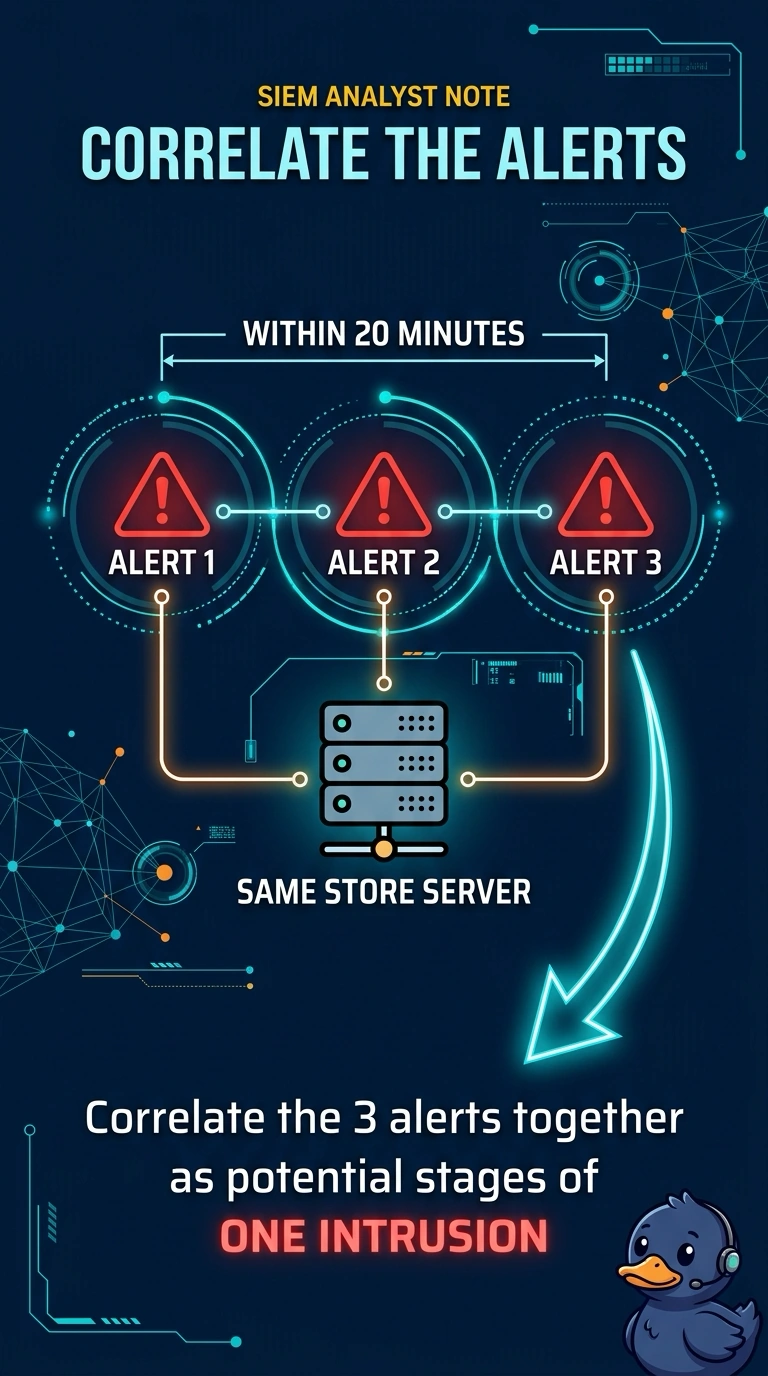
Short Explanation
Three quiet footsteps in the same hallway within twenty minutes matter a lot more together than each creak does alone. The trap is dismissing low-severity alerts one by one because none hit critical on its own. Correlate the script launch, account enumeration, and outbound connection together to see if you are looking at one connected intrusion.
Full Explanation
Adversary intrusions frequently unfold as a sequence of small steps—execution, discovery, and command-and-control—each of which may only trigger a low-severity signal in isolation. Choosing to Correlate the three alerts together as potential stages of one intrusion lets the analyst evaluate the combined behavioral chain on the store server rather than underestimating individual alerts. Choosing to Suppress each alert individually because none reached critical severity risks hiding active lateral preparation or staging behind premature tuning. Choosing to Treat each alert as unrelated noise unless a third-party firewall blocks it ignores endpoint execution and local enumeration signals that perimeter firewalls cannot observe. Choosing to Delete the low-severity alerts and monitor only high-severity detections blinds the SOC to early-stage adversary tradecraft before major impact occurs. Caveat: correlated alerts on one server can still stem from a single complex administrative script, so behavioral context remains essential. As an operational check, build a chronological timeline of the store server's process, identity, and network events across the twenty-minute window and group related alerts into a single investigation case.
Prefer to study offline? Printable PDF study book + test engine ($7.50, unofficial). These questions stay free here.