
A financial services SOC analyst sees a detection mapped to a MITRE ATT&CK execution technique on a developer workstation. How should the analyst use this ATT&CK mapping during triage?
Select an answer to reveal the explanation.
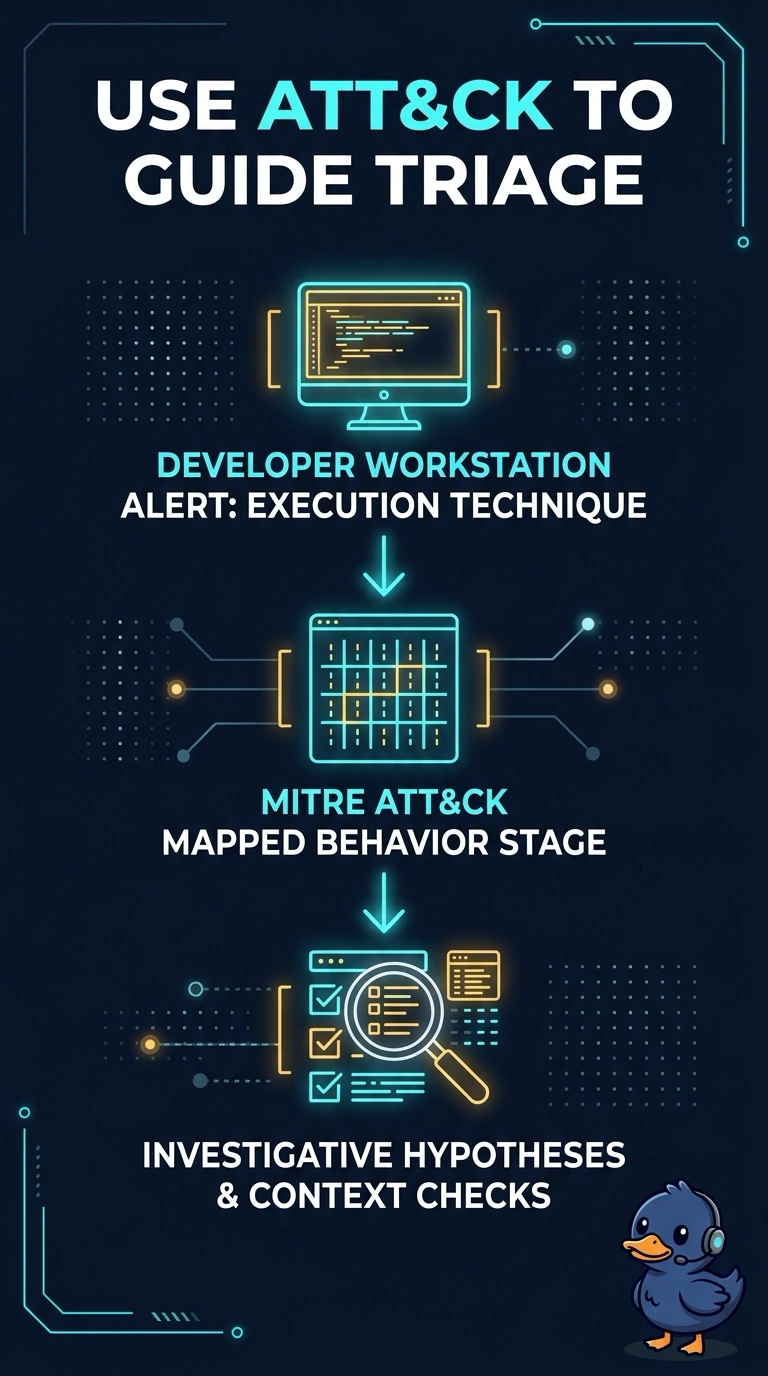
Short Explanation
An ATT&CK tag tells you what kind of behavior was observed, not whether the person at the keyboard had permission to do it. Use the mapping to focus your next investigative checks, and avoid the trap of treating a technique label as automatic proof of malice.
Full Explanation
In Falcon Next-Gen SIEM, MITRE ATT&CK mappings categorize observed behaviors into adversary tactics and techniques, so you should Use the mapped behavior stage to guide investigative hypotheses and context checks rather than treating the label as a final verdict. Knowing that an event resembles an execution technique helps you examine parent processes, command lines, and neighboring activity for follow-on stages. Choosing to Treat the mapped technique as definitive proof of an active intrusion ignores that legitimate developer scripts and administrative tools often match execution patterns. Deciding to Skip inspecting process arguments because the technique label explains intent misses the actual command details needed to separate normal work from abuse. Attempting to Reclassify the detection origin as a third-party passthrough alert confuses behavioral framework tagging with where the alert originated. Caveat: ATT&CK mappings describe how an action looks in a behavioral taxonomy, not business authorization or impact. Operational check: inspect the underlying process tree, user account, and signed binary details on the developer workstation to validate whether the execution was authorized.
Prefer to study offline? Printable PDF study book + test engine ($7.50, unofficial). These questions stay free here.