
A university SOC receives a first-party Falcon detection for credential-access behavior on a lab host and a third-party passthrough alert from a perimeter appliance for suspicious traffic. How should the analyst assess telemetry fidelity across these two origins?
Select an answer to reveal the explanation.
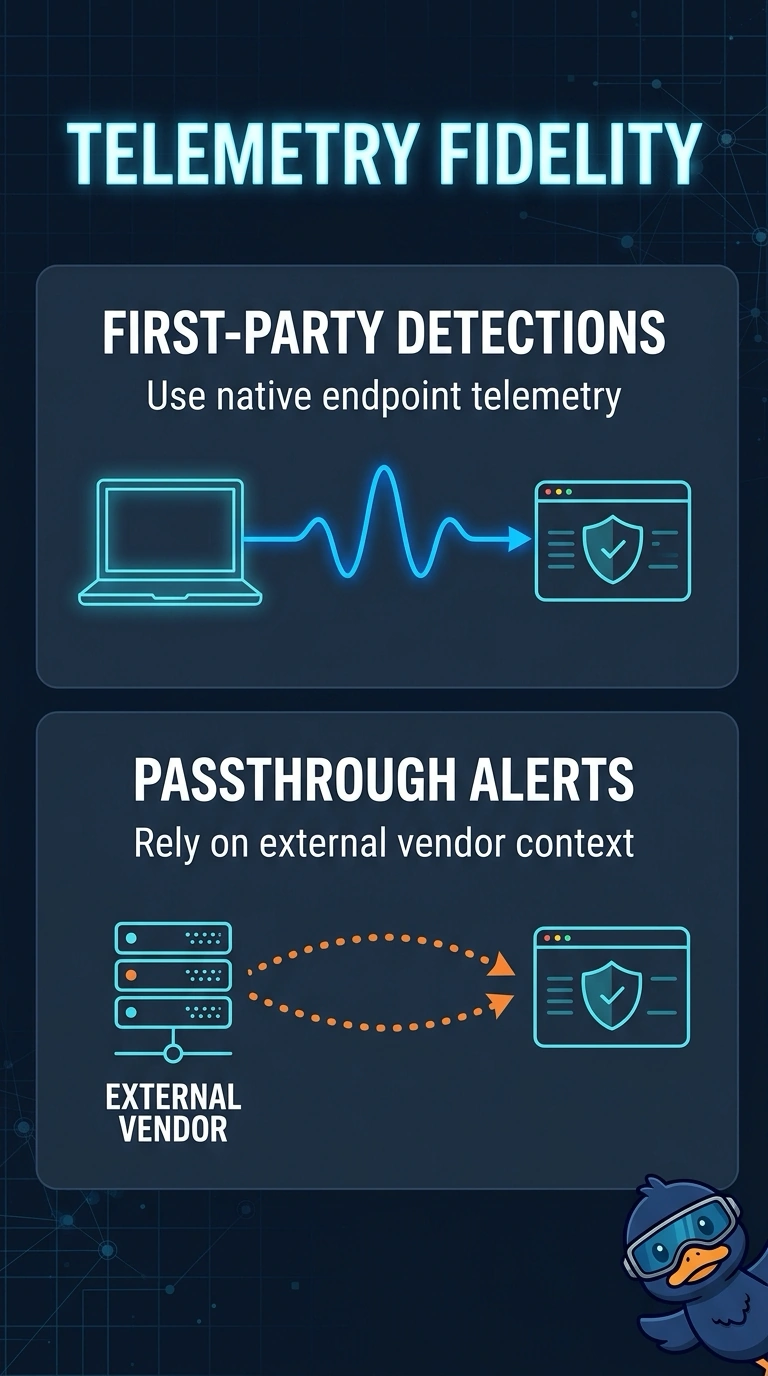
Short Explanation
A smoke detector inside a room tells you far more about a fire than a passerby calling from across the street. When you triage alerts, knowing where the signal came from shapes how much context you already have. The trap is assuming every alert in the same console carries identical telemetry.
Full Explanation
Understanding detection origins is essential because First-party detections use native endpoint telemetry while passthrough alerts rely on external vendor context. Native Falcon detections benefit from deep process, user, and host-state visibility, whereas third-party passthrough alerts only surface whatever fields the external appliance chose to forward. Choosing to Treat the third-party passthrough alert as higher fidelity because perimeter appliances inspect all external traffic overlooks that network devices lack visibility into host processes and local user sessions. Deciding to Ignore the first-party detection until a custom correlation rule independently reproduces the exact same finding wastes valuable response time and discounts high-context native telemetry. Opting to Assume both alerts share identical underlying sensor fields because both appear in the same Next-Gen SIEM view confuses unified alert presentation with identical data depth. As a caveat, neither detection origin is infallible, and third-party alerts remain valuable when correlated with endpoint records. As an operational check, inspect the alert origin and available entity fields in the detection metadata before deciding which additional log sources to query.
Prefer to study offline? Printable PDF study book + test engine ($7.50, unofficial). These questions stay free here.