
A distributed office SOC analyst reviews an alert triggered by a custom SIEM query that links firewall denies with endpoint process launches. Which detection origin describes this alert?
Select an answer to reveal the explanation.
Short Explanation
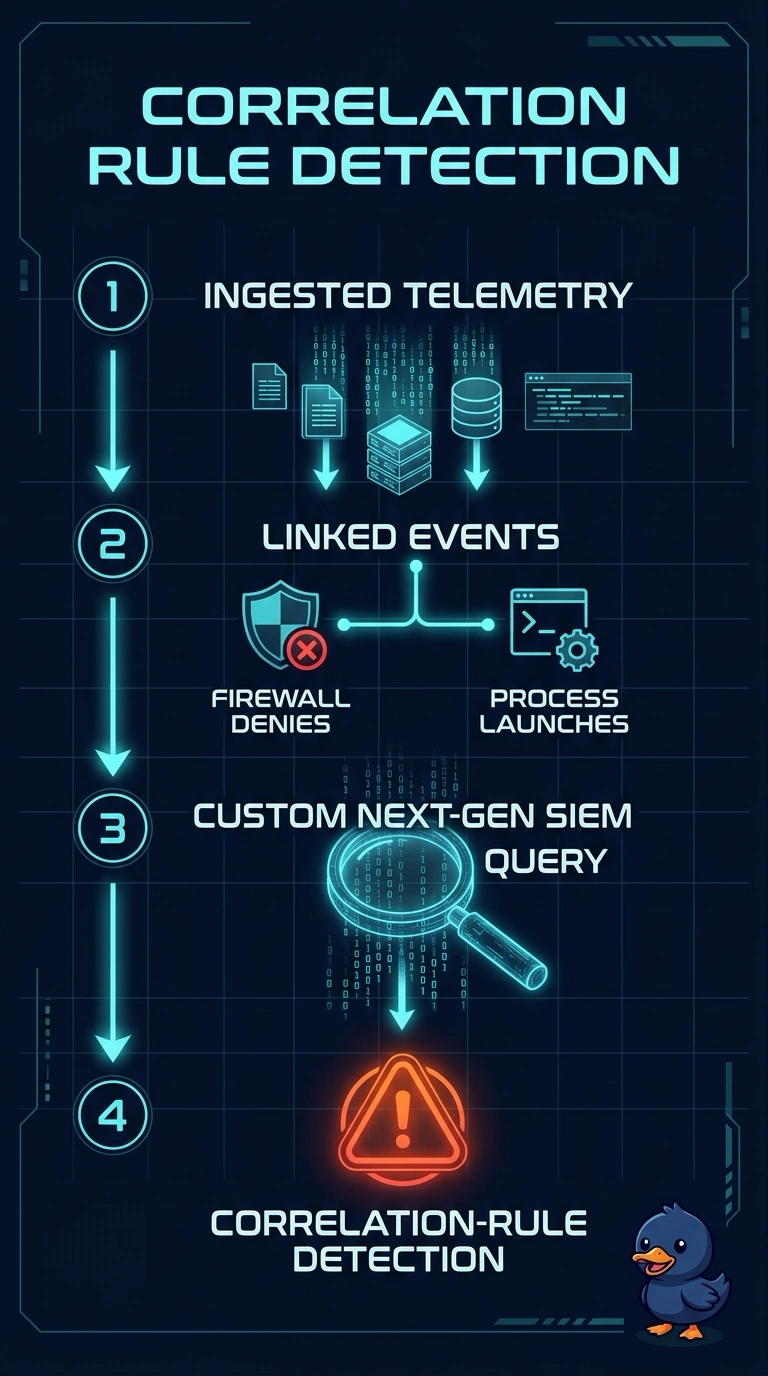
Every alert has a family tree, and knowing where it came from tells you what to inspect next. When a Next-Gen SIEM query links events across sources to raise an alert, you’re looking at a correlation-rule detection, not an external passthrough.
Full Explanation
When a custom query links firewall denies with endpoint process launches and raises an alert, its origin is a correlation-rule detection generated by a Next-Gen SIEM query over ingested telemetry. Correlation rules query SIEM data across sources to identify relationships and produce detections, which fits the alert described. A third-party passthrough detection forwarded unmodified from an external appliance originates outside the SIEM’s own correlation logic; the SIEM passes along a detection made by another tool rather than generating it through the described query. A manual case management note entered by an analyst during shift handoff records human investigation progress, not an automated detection triggered by linked telemetry. A CPS normalization rule that maps vendor fields into a common schema prepares ingested events for consistent querying and correlation, but field mapping alone does not generate an alert. As an exam caveat, detection origin helps you locate the underlying query or external sensor, but it does not establish whether the behavior is malicious. As a practical check, open the detection metadata to confirm the correlation rule name and inspect the contributing events.
Prefer to study offline? Printable PDF study book + test engine ($7.50, unofficial). These questions stay free here.