
An e-commerce SOC team wants to generate a detection whenever an identity log shows an anomalous login followed shortly by a firewall rule change from that same user. Which detection mechanism fits this requirement?
Select an answer to reveal the explanation.
Short Explanation
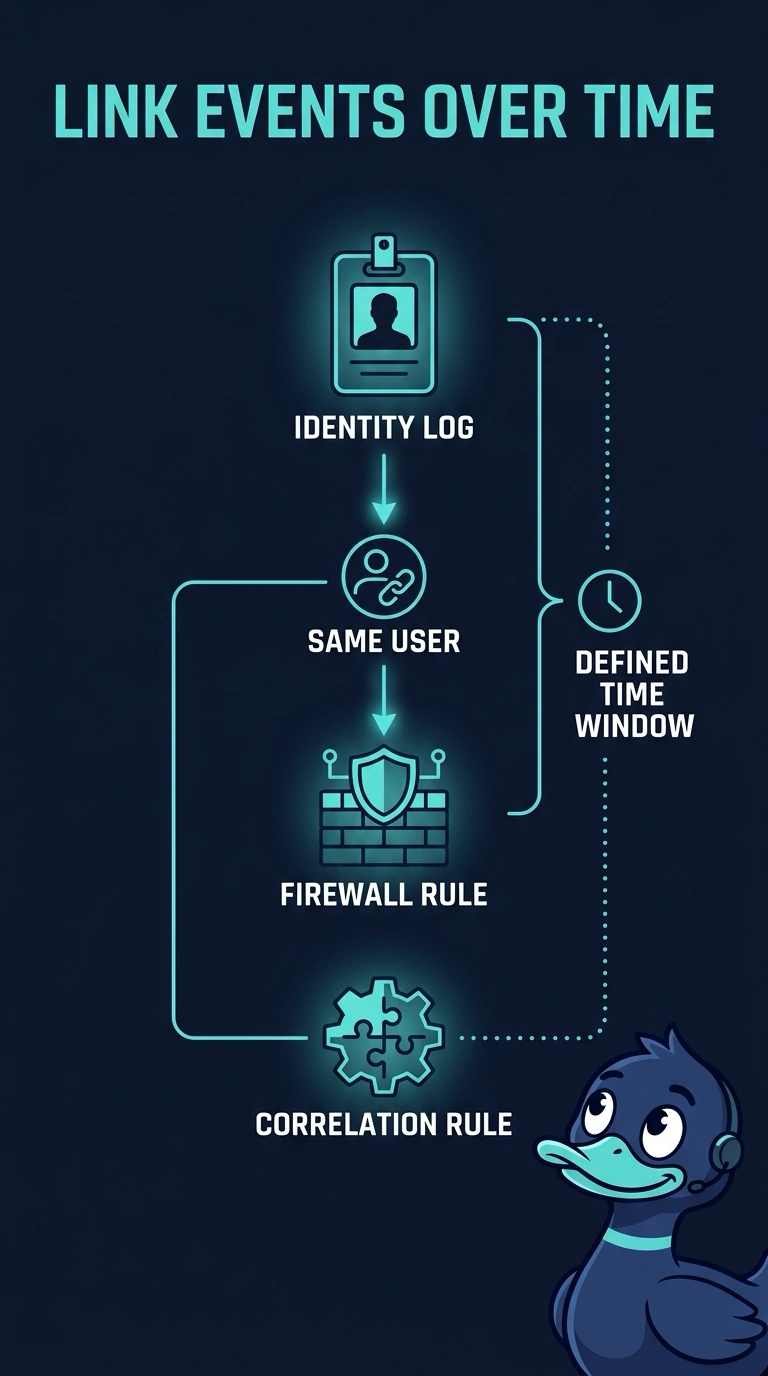
One odd login or one firewall edit on its own might look harmless, just like two puzzle pieces sitting in separate boxes. A single-source alert won't connect those dots for you. Use a correlation rule to link both log sources across time so your SIEM flags the combined pattern automatically.
Full Explanation
Detecting a multi-step sequence across distinct systems requires "A correlation rule linking identity and firewall events over a defined time window" because Next-Gen SIEM correlation rules evaluate queries across ingested datasets to generate detections. Correlating the anomalous authentication with the subsequent configuration change catches behaviors that appear benign in isolation. Choosing "A single-event third-party passthrough alert from the firewall vendor alone" only forwards what the firewall sees on its own and lacks visibility into the preceding identity anomaly. Choosing "A static dashboard panel that displays total daily firewall configuration changes" provides visual monitoring for humans rather than automated alerting on correlated user sequences. Likewise, "A manual case note added after an analyst notices an unusual login report" is a documentation step rather than an automated detection mechanism. As a caveat, correlation rules depend on consistent user identifiers and accurate timestamps across both sources to join events reliably. For an operational check, test the underlying correlation query against historical identity and firewall logs to verify that the join field and time window produce accurate matches without excessive noise.
Prefer to study offline? Printable PDF study book + test engine ($7.50, unofficial). These questions stay free here.