
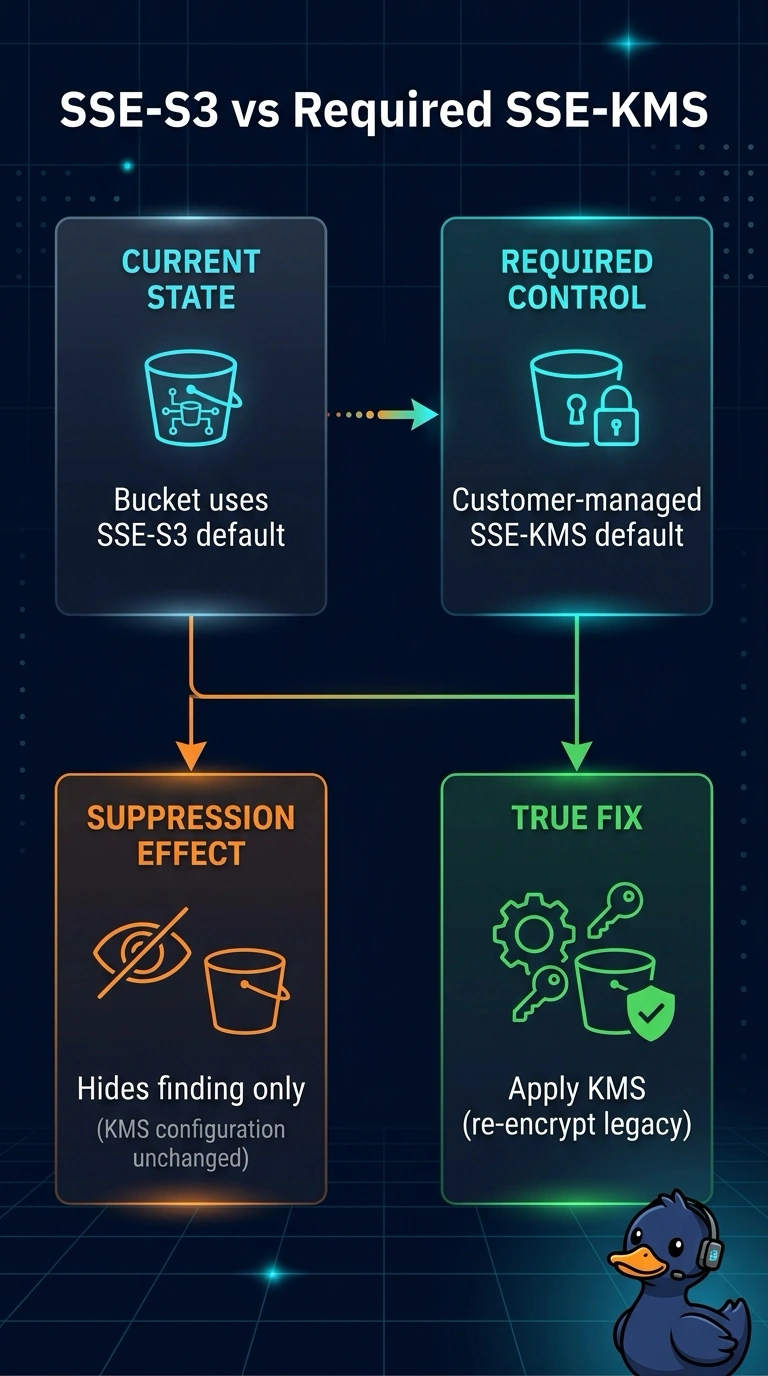
A retail cloud administrator wants to clear an active finding for an S3 bucket from the compliance dashboard by creating a permanent suppression rule without changing the bucket settings. There is an S3 organizational requirement for a customer-managed SSE-KMS default; the bucket instead uses SSE-S3. Why should the security team reject this approach?
Select an answer to reveal the explanation.
Short Explanation
Putting a sticky note over your car's check-engine light makes the dashboard look calm, but you still have the same engine problem. S3 automatically encrypts new uploads; suppression does not implement the stronger required key policy, remediate public access, or re-encrypt legacy objects. Don't confuse a cleaner report with real risk reduction when you need remediation.
Full Explanation
Alert suppression only filters what appears in queues and reports, which is why "Suppression hides the finding while leaving the required KMS configuration unchanged." is the correct objection. There is an S3 organizational requirement for a customer-managed SSE-KMS default; the bucket instead uses SSE-S3. S3 automatically encrypts new uploads; suppression does not implement the stronger required key policy, remediate public access, or re-encrypt legacy objects. It still fails audit until the SSE-KMS default is configured on the bucket and in code templates. "Suppression rules automatically delete the underlying cloud storage bucket" is incorrect because suppression is a reporting filter and never destroys live cloud infrastructure. "Suppression rules trigger immediate Fusion SOAR paging alerts on every scan" fails because suppression silences matching findings rather than escalating them into incident notifications. "Suppression rules only apply to container runtime detections and ignore cloud posture" is wrong because posture findings can be suppressed, which is why governance must restrict permanent exceptions. As a caveat, a time-bound exception with approval may fit only during legacy migration. As an operational check, apply the required SSE-KMS default and confirm the finding status transitions to resolved on the next posture evaluation.
Prefer to study offline? Printable PDF study book + test engine ($7.50, unofficial). These questions stay free here.