
A school district cloud security analyst reviews a Falcon Cloud Security configuration finding noting that a backend database subnet permits unrestricted outbound internet traffic on all ports. Why does this configuration risk matter even when inbound internet access is blocked?
Select an answer to reveal the explanation.
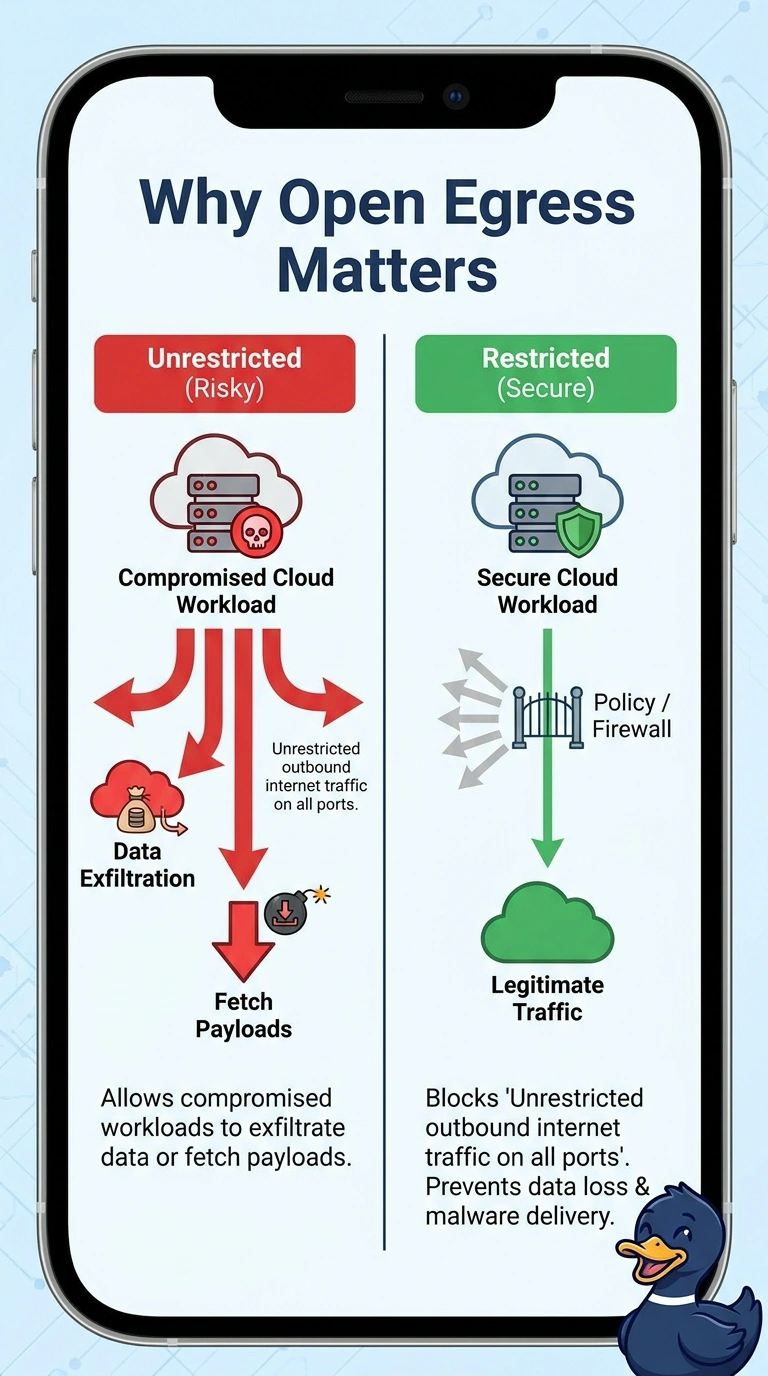
Short Explanation
Blocking inbound traffic is like locking the front door while leaving the back loading dock wide open for anyone carrying boxes out. The trap is assuming a private subnet with no public inbound IP is completely safe from network-based abuse. You should restrict outbound egress so a compromised workload cannot freely beacon out or exfiltrate sensitive records.
Full Explanation
Even when a database tier cannot be reached directly from the internet, a vulnerability in an upstream application or compromised credential can still grant an attacker execution inside that network segment. Because Unrestricted egress allows compromised workloads to exfiltrate data or fetch payloads, Falcon Cloud Security flags overly broad outbound firewall or security-group rules as a meaningful configuration risk. Claiming Unrestricted egress automatically disables encryption at rest on all attached storage volumes is incorrect because network routing rules do not alter storage encryption settings. Assuming Unrestricted egress prevents the Falcon sensor from reporting runtime telemetry to the cloud is wrong because sensor connectivity requires outbound access to Falcon endpoints, whereas overly broad egress opens connections to arbitrary destinations. Saying Unrestricted egress bypasses pre-runtime container image assessment in the CI/CD pipeline fails because pipeline image scanning evaluates build artifacts before deployment and is unrelated to runtime VPC routing. Caveat: legitimate workloads often need outbound access to specific package repositories, update servers, or managed APIs, so overly aggressive egress blocks can break operations. As an operational check, review actual traffic logs for the subnet and narrow egress rules to required ports, protocols, and destination CIDR blocks or service endpoints.
Prefer to study offline? Printable PDF study book + test engine ($7.50, unofficial). These questions stay free here.