
During an entitlement review at a distributed office enterprise, a security analyst finds a non-administrative application role whose attached policy grants wildcard action permissions across multiple cloud services, even though no suspicious activity has occurred yet. Why should this finding be prioritized?
Select an answer to reveal the explanation.
Short Explanation
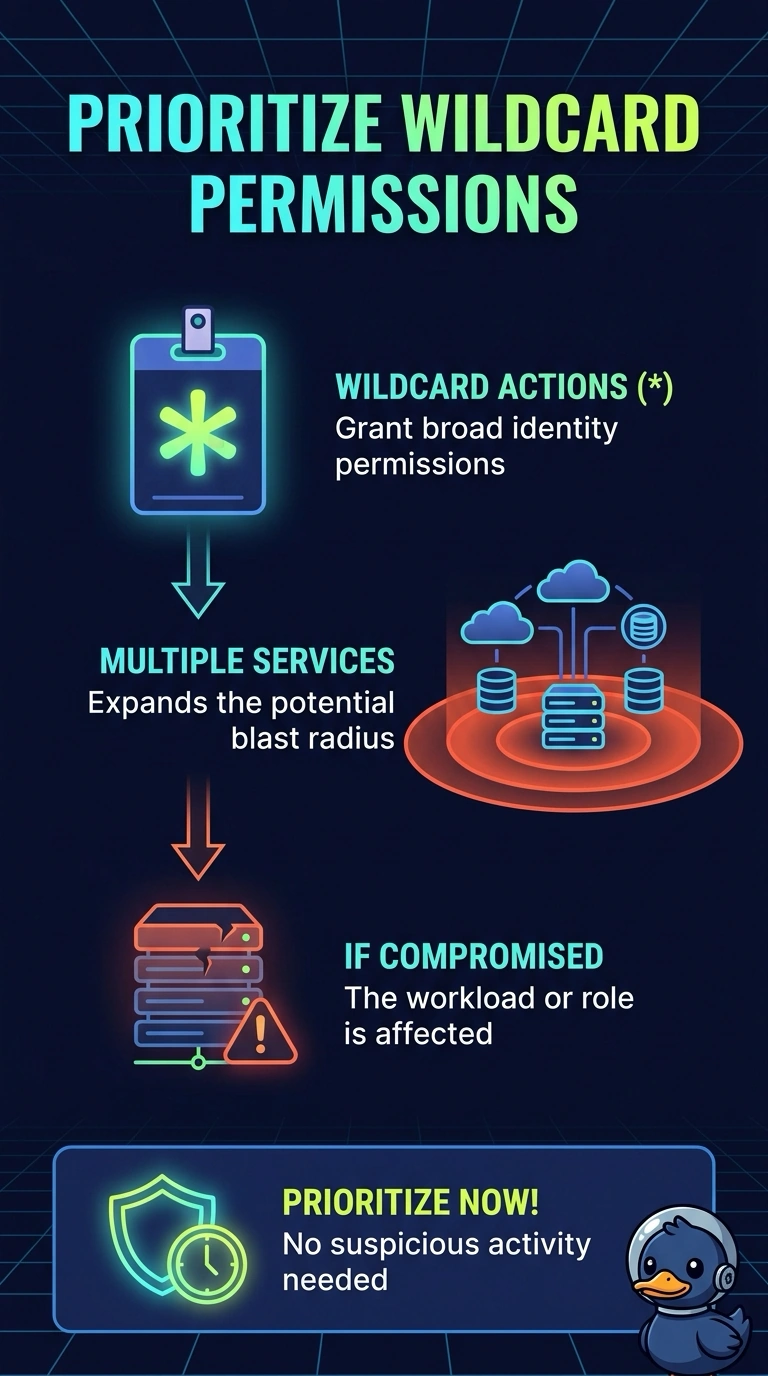
Giving an application wildcard permissions is like handing a delivery driver a master key to every vault in the building—nothing may be missing today, but one mistake compromises everything. You prioritize least-privilege cleanup because excessive entitlements dramatically expand an attacker's blast radius. The trap is confusing latent identity risk with active runtime alerts or registry scans.
Full Explanation
Wildcard identity actions create a broad blast radius if the workload or role is compromised is correct because Cloud Infrastructure Entitlement Management (CIEM) highlights over-privileged identities before an incident occurs. Determine effective access including resource scope, conditions, boundaries, SCPs and explicit denies; a wildcard Action element alone does not guarantee unrestricted access to every resource, but broad actions can still expand blast radius if compromised. Wildcard identity actions automatically trigger blocking Kubernetes admission control rules is incorrect because Kubernetes admission policies evaluate pod deployment specifications rather than cloud IAM wildcard policies. Wildcard identity actions convert static cloud posture findings into active runtime detections is incorrect because overly permissive IAM policies represent latent configuration and entitlement risk rather than active malicious execution. Wildcard identity actions disable pre-runtime image assessment on container registries is incorrect because registry scanning evaluates container image layers and operates independently of application IAM role permissions. As a caveat, tightening wildcard policies without reviewing recent usage can break legitimate application workflows. As an operational check, inspect the identity's observed permissions and activity history in Falcon Cloud Security before scoping the policy down to required actions.
Prefer to study offline? Printable PDF study book + test engine ($7.50, unofficial). These questions stay free here.