
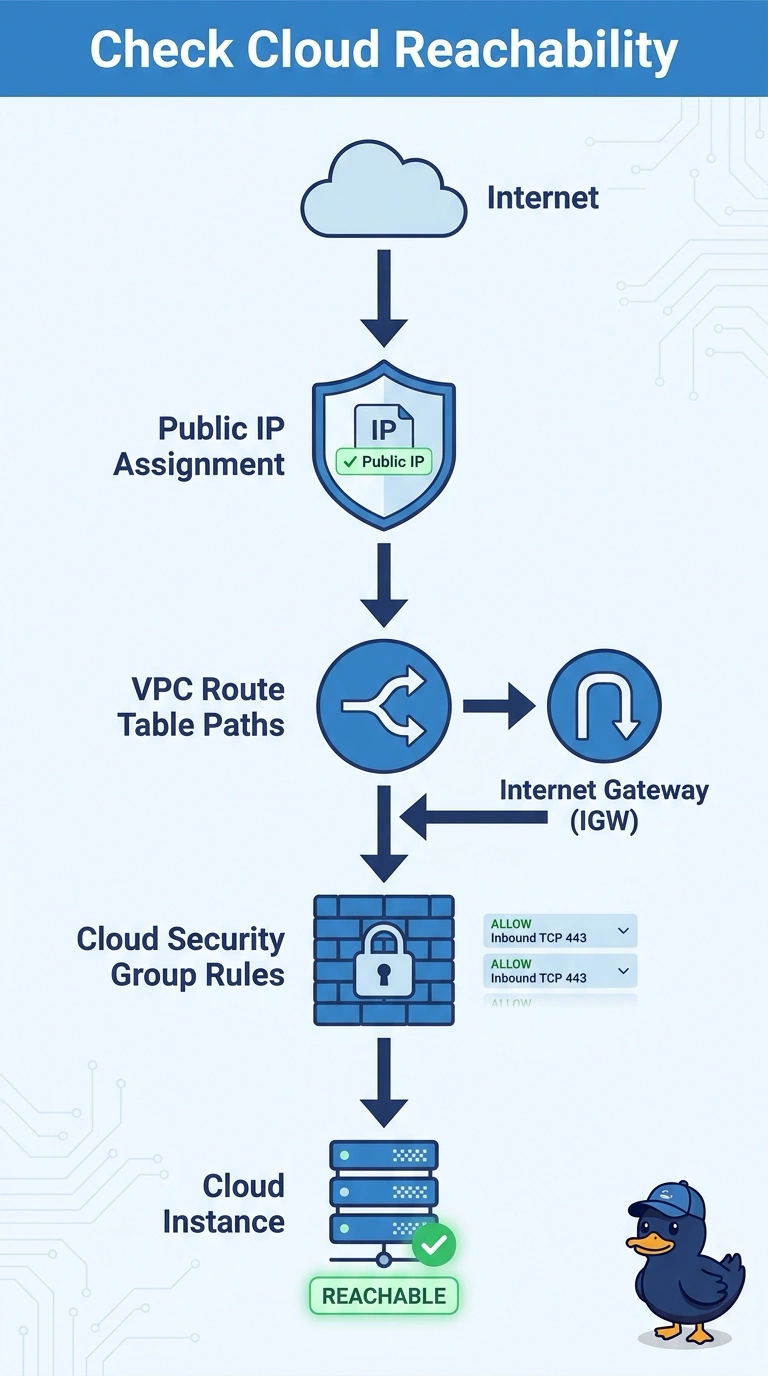
A manufacturing cloud analyst reviews an exposed-asset finding for a cloud virtual machine whose local OS firewall drops external traffic, yet Falcon Cloud Security still flags the instance as internet-reachable. Which cloud configuration should the analyst inspect next?
Select an answer to reveal the explanation.
Short Explanation
Think of your cloud network perimeter as the locked gate at the end of the driveway—even if your front door is deadbolted, an open gate still exposes your property to the street. Don't get distracted by container or image settings when exposure analysis is pointing at cloud-layer network reachability.
Full Explanation
The cloud security group rules, public IP assignment, and VPC route table paths is the correct area to inspect because provider-configuration analysis evaluates cloud control-plane networking—such as public IP addresses, internet gateway routes, and permissive security group ingress rules. Provider-configuration analysis can flag potential internet exposure even when a guest firewall supplies a compensating control. Verify the finding's actual evidence and test effective end-to-end reachability; do not equate a control-plane path with confirmed application access or claim every Falcon exposure analysis ignores runtime controls. The container image assessment policy attached to the private registry fails because image assessment governs pre-runtime container packages and secrets, not virtual machine network reachability. The Kubernetes admission controller webhook configuration in the cluster is incorrect because admission controllers validate Kubernetes pod creation requests and have no bearing on cloud VPC routing or VM security groups. The local OS package manager cache inside the virtual machine image is also wrong because installed packages do not determine whether the cloud control plane exposes the instance to the public internet. As a caveat, relying solely on an internal OS firewall leaves the VM vulnerable if the firewall service is misconfigured or stopped later. As an operational check, remove unnecessary public IP assignments or restrict the security group ingress rules to trusted CIDR ranges, then re-verify the exposure finding.
Prefer to study offline? Printable PDF study book + test engine ($7.50, unofficial). These questions stay free here.