
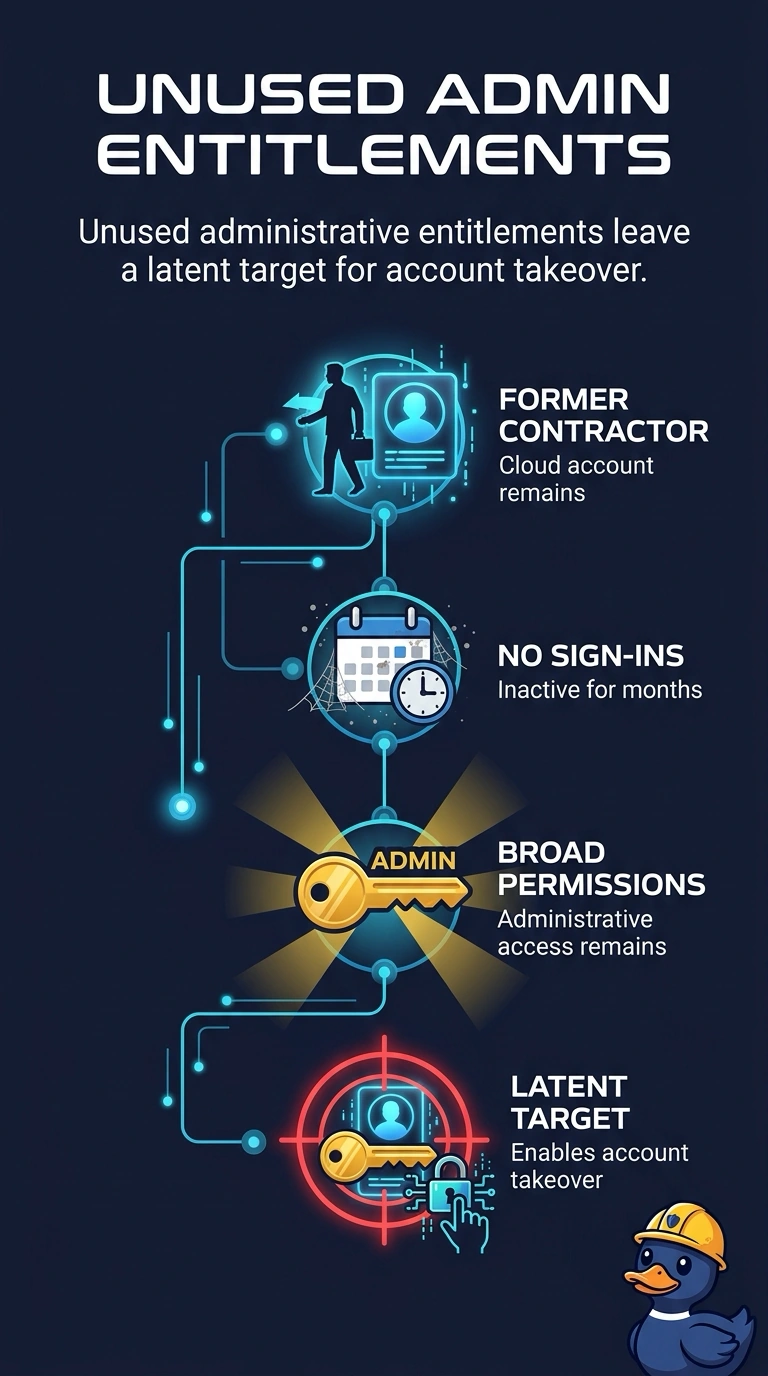
During a quarterly review at a distributed enterprise, an analyst finds a former contractor's cloud user account that has shown no sign-in activity for months but still holds broad administrative permissions. Why should the team prioritize removing this identity's entitlements?
Select an answer to reveal the explanation.
Short Explanation
An inactive admin account is like a spare master key left under a doormat—nobody uses it today, yet anyone who finds it walks right in. If you ignore dormant identities just because they have not triggered an active alert yet, you fall right into the trap.
Full Explanation
Choosing Unused administrative entitlements leave a latent target for account takeover explains why Cloud Infrastructure Entitlement Management (CIEM) flags over-privileged inactive identities as high priority. Even without recent sign-ins, an attacker who compromises stale credentials or access keys for that account immediately inherits broad administrative control across cloud resources. Choosing Dormant accounts automatically bypass all cloud posture benchmark checks is incorrect because posture and identity evaluations continue inspecting inactive accounts and their attached policies. Choosing Inactive cloud users prevent runtime Falcon sensors from reporting host telemetry confuses cloud control-plane identity hygiene with host-level sensor communication. Choosing Idle identities generate continuous Indicators of Attack in container registries misstates both concepts, since Indicators of Attack reflect suspicious runtime behavior rather than dormant user accounts. As a caveat, confirm whether any automated integration unexpectedly relies on the account's keys before deleting it outright. For an operational check, review CIEM last-used activity and effective permissions, revoke unused credentials, and remove the dormant administrative role assignments.
Prefer to study offline? Printable PDF study book + test engine ($7.50, unofficial). These questions stay free here.