
A retail company uses agentless cloud posture assessment across its cloud accounts and asks whether it still needs Falcon sensors on its Kubernetes worker nodes. Why are runtime sensors still required?
Select an answer to reveal the explanation.
Short Explanation
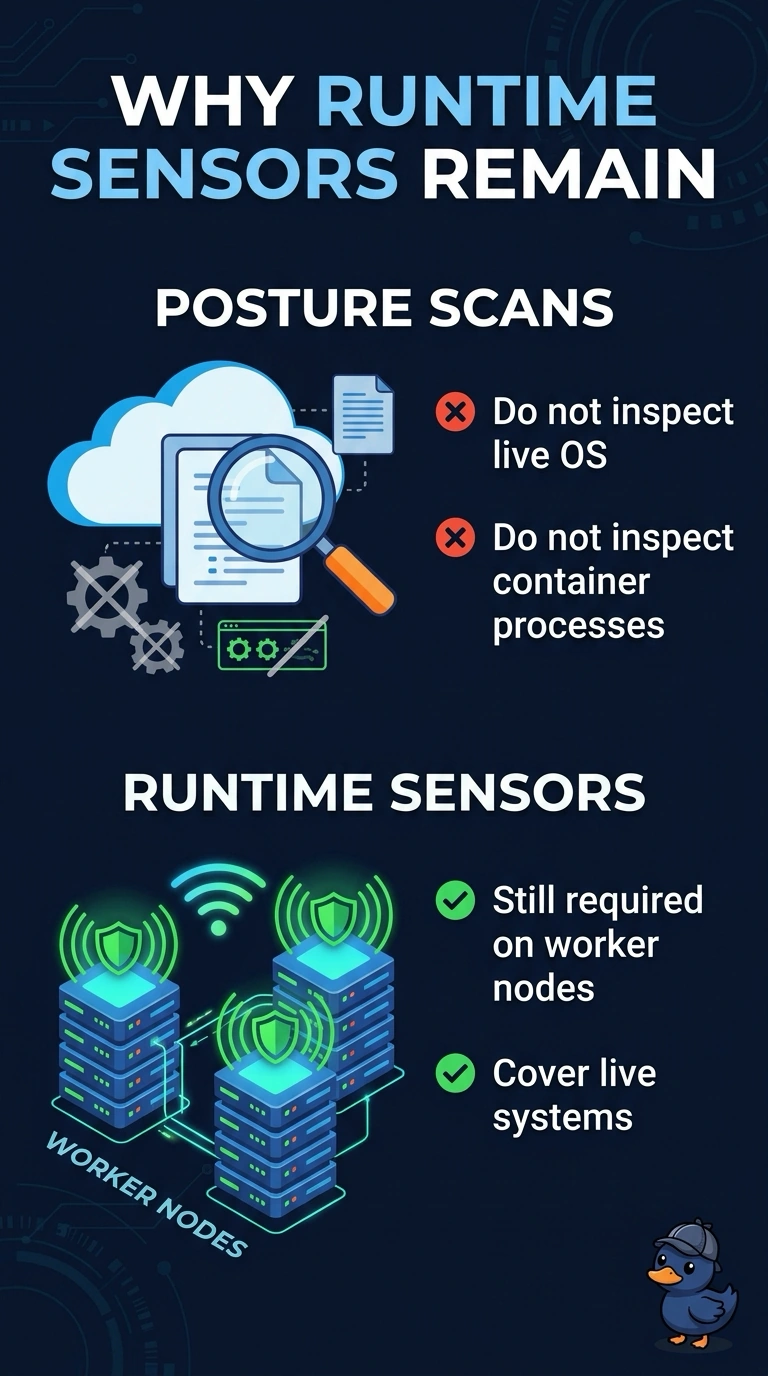
Agentless posture scans check whether the building doors are locked, but they can't see someone sneaking around inside. You still need runtime sensors on worker nodes because posture scans never inspect live processes or kernel behavior.
Full Explanation
Agentless cloud posture assessment inspects cloud control-plane APIs and resource metadata, whereas runtime Falcon sensors operate inside worker nodes to monitor live OS, kernel, and container activity. Because Posture scans do not inspect live OS and container processes, they cannot detect active malware execution, container drift, or suspicious runtime command lines inside running workloads. The claim that Posture scans cannot evaluate cloud IAM policies is false, because evaluating IAM roles, permissions, and account configurations is a core function of cloud posture management. Runtime sensors replace all cloud account registration is also incorrect, as sensors protect compute workloads and containers while cloud account registration provides control-plane visibility across storage, networking, and IAM. Runtime sensors are required to generate scheduled PDF reports is wrong because reporting is a platform management function independent of endpoint sensor telemetry. As a scope caveat, deploying runtime sensors protects the host and container layer but still requires cloud account registration for control-plane posture coverage. For an operational check, verify sensor health and container coverage status on all Kubernetes worker nodes in the host and container inventory.
Prefer to study offline? Printable PDF study book + test engine ($7.50, unofficial). These questions stay free here.