
A retail software team already runs Infrastructure-as-Code (IaC) scanning in its pull requests, yet engineers occasionally apply manual manifest changes directly to a Kubernetes cluster. Why should the team also enable Kubernetes admission control?
Select an answer to reveal the explanation.
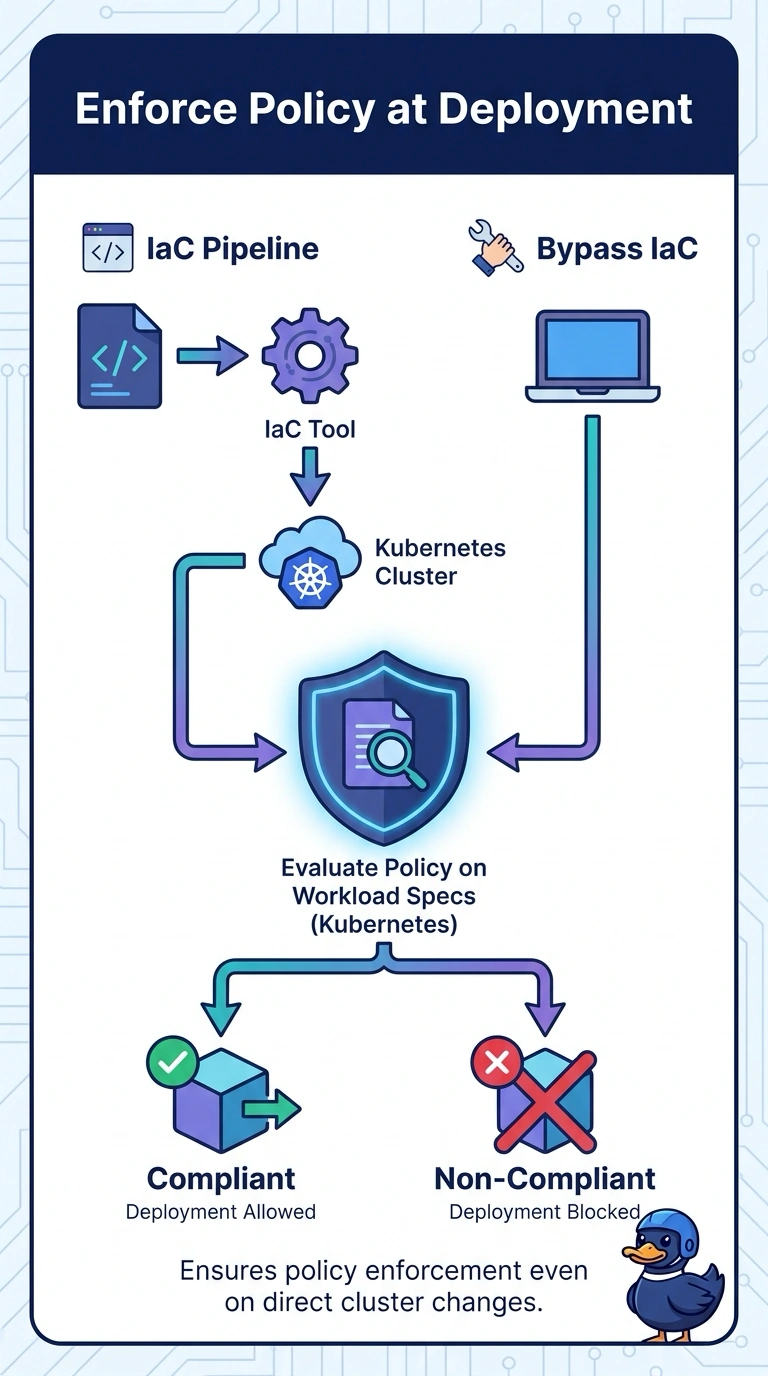
Short Explanation
Think of IaC scanning like inspecting blueprints at the architect's desk, while admission control is the security guard at the building door. If someone walks past the desk with a last-minute change, only the guard at the door can stop it. The trap is assuming pull-request checks cover every path into your live cluster, when manual deployments bypass git workflows.
Full Explanation
Kubernetes admission control acts as a deployment-time gatekeeper inside the cluster API path, making "To evaluate and enforce policy on workload specifications at cluster deployment time even when changes bypass IaC pipelines" the right reason to pair it with IaC scanning. Even strong pull-request checks cannot stop out-of-band kubectl applies or emergency hotfixes submitted directly to the cluster. The other choices confuse distinct security layers. Choosing "To replace agentless cloud posture scanning across managed storage buckets and IAM roles" is incorrect because admission controllers only inspect Kubernetes cluster requests, not cloud control-plane resources. Selecting "To inspect running container processes and block malicious system calls inside active pods" describes post-deployment runtime sensors rather than pre-launch admission checks. Picking "To scan static Terraform templates during local developer builds before code is committed" repeats the pre-commit IaC role instead of closing the live cluster gap. As a caveat, admission control only evaluates new or updated requests at deployment time and does not inspect already-running workloads. For an operational check, review your cluster admission policy logs alongside IaC scan results to confirm manual deployments are being evaluated.
Prefer to study offline? Printable PDF study book + test engine ($7.50, unofficial). These questions stay free here.