
A manufacturing platform team is planning runtime sensor deployment for a Kubernetes cluster running hundreds of different application containers. Why does the team deploy the Falcon sensor at the Kubernetes node level rather than embedding it into each application container image?
Select an answer to reveal the explanation.
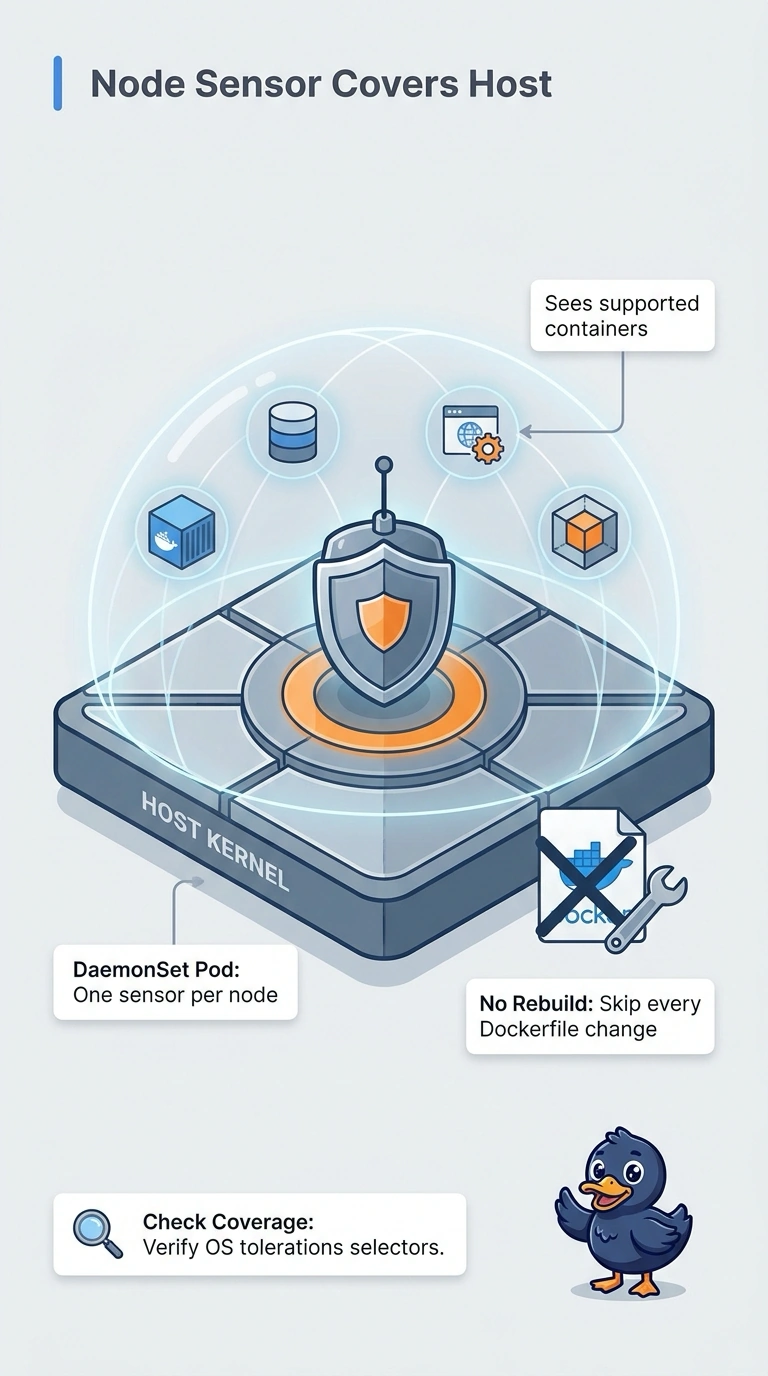
Short Explanation
Putting a node-level sensor on each worker is like installing one security camera system in the hallway instead of wiring a separate alarm inside every tenant's suitcase. The trap is thinking you must rebuild hundreds of Dockerfiles to gain runtime visibility. You get coverage for supported containers on that host without changing every image, limited to eligible supported Linux nodes and container runtime/isolation configurations; verify actual coverage, OS support, selectors and tolerations rather than assume every sandbox/serverless pod shares the monitored host kernel.
Full Explanation
Deploying the Falcon sensor as a Kubernetes DaemonSet places one sensor pod on each worker node, so "A node-level sensor monitors supported containers on that host without changing every application image." is the operational advantage. Because containers on a node share the underlying host kernel, a node-level sensor observes runtime activity across supported workloads without forcing teams to modify build pipelines, for eligible supported Linux nodes and container runtime/isolation configurations; verify actual coverage, OS support, selectors and tolerations rather than assume every sandbox/serverless pod shares the monitored host kernel. The other statements are incorrect. Claiming "Embedding sensors in application images is only supported for serverless functions and managed object storage" is false because managed object storage does not run user containers. Saying "A node-level sensor replaces the need for Kubernetes admission control and cloud posture assessments" overlooks that runtime sensors do not block non-compliant pod specs before launch or evaluate control-plane settings. Stating "Application container images cannot be scanned for package vulnerabilities unless a runtime sensor is baked inside" confuses runtime protection with pre-runtime image assessment, which inspects registries and CI/CD without a sensor inside the image. For an operational check, verify one sensor pod is Running on every intended worker node.
Prefer to study offline? Printable PDF study book + test engine ($7.50, unofficial). These questions stay free here.