
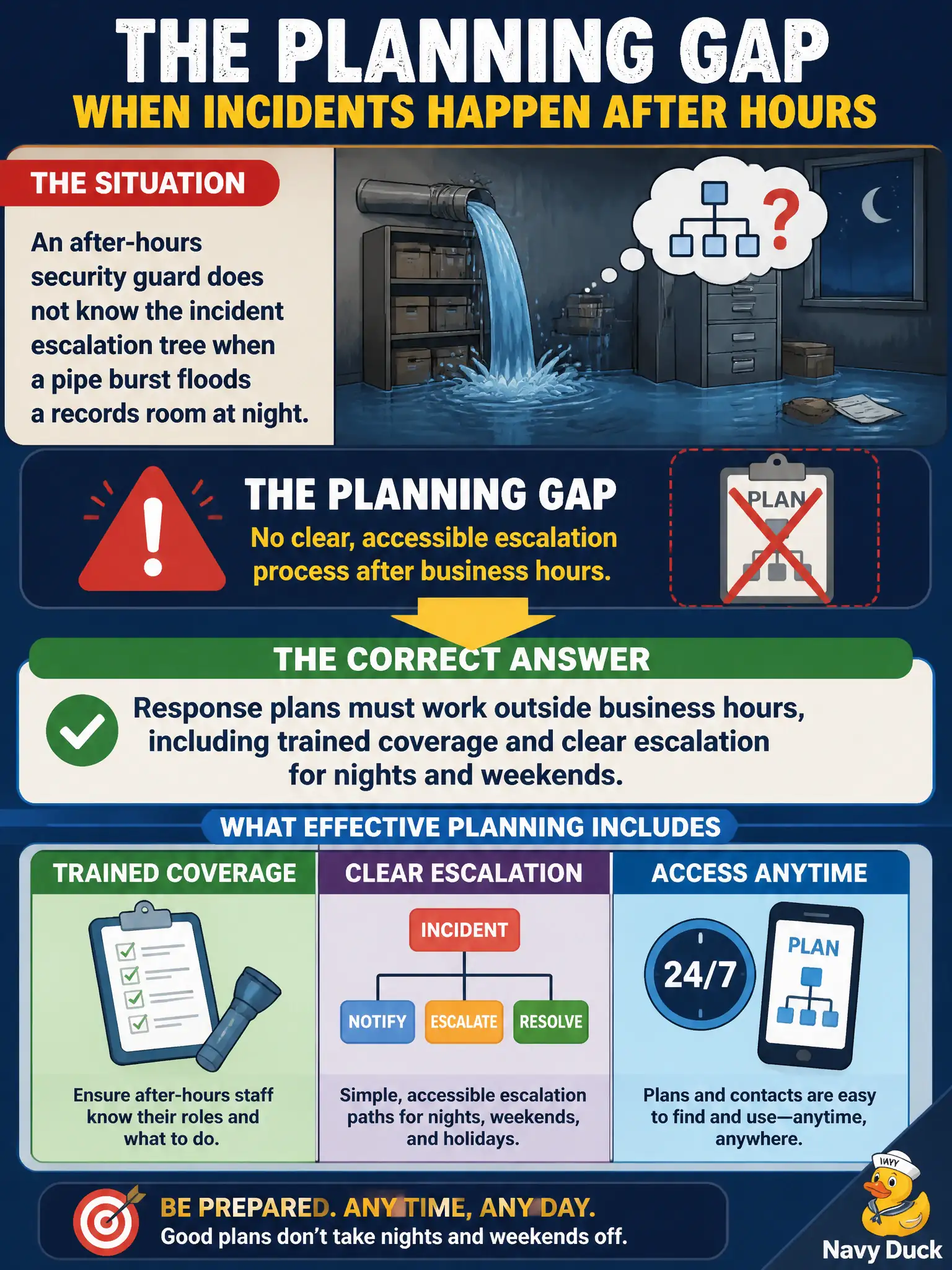
An after-hours security guard does not know the incident escalation tree when a pipe burst floods a records room at night. What planning gap does this expose?
Select an answer to reveal the explanation.
Short Explanation
Bad things love nights and weekends. If the only person on site does not know whom to call, the plan exists for PowerPoint, not for floods. Build the after-hours tree, train the guard, and post it where the night shift can find it.
Full Explanation
Response plans must work outside business hours, including trained coverage and clear escalation for nights and weekends, because pipe bursts and floods do not respect the municipal workday. An after-hours security guard who does not know the escalation tree cannot protect a records room when minutes determine water damage. Civic continuity requires night/weekend roles, contacts, and authority thresholds that are trained and posted for the people actually on site.
Assuming after-hours events can wait for the next business day fails by concept because water, fire, and security events escalate rapidly overnight and waiting multiplies loss. Claiming only daytime managers need escalation trees because guards never face incidents fails because guards are often the first and only on-scene resource at night. Excluding flooding from escalation if it begins after 6 p.m. fails because clock time does not change hazard physics or the need to escalate.
Exam caveat: MSI CRMC response planning evaluates fitness across operating hours. Business-hours-only escalation models are incomplete for continuously occupied or monitored civic sites.
Operational check: Brief and test night guards on the flood/pipe-burst escalation tree; verify they can reach on-call facilities and records leads; run an after-hours drill and fix contact gaps before peak storm season.