
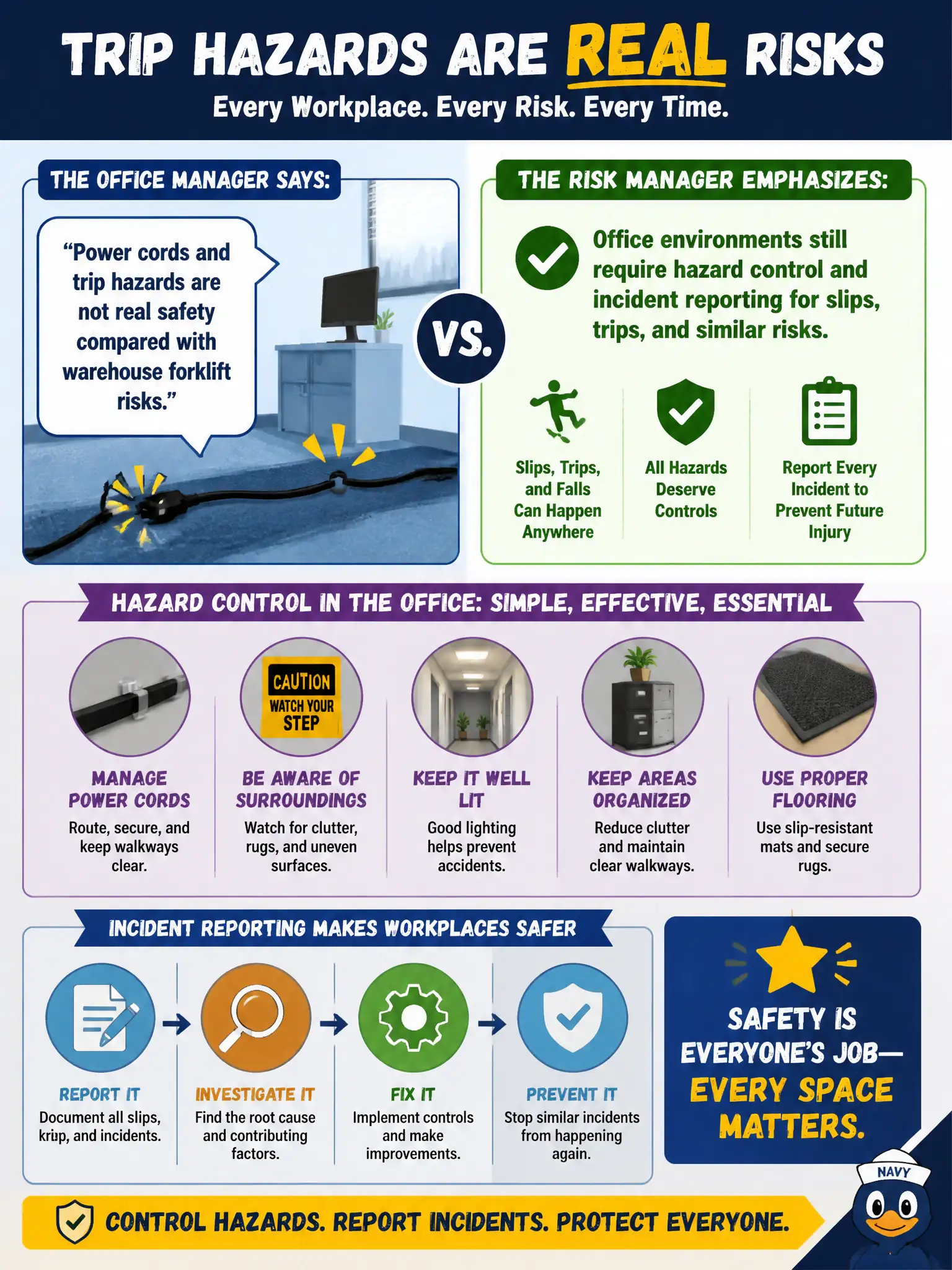
An office manager dismisses trip hazards from power cords as “not real safety” compared with warehouse forklift risks. What should the risk manager emphasize?
Select an answer to reveal the explanation.
Short Explanation
A broken ankle from a cord under a desk is still a broken ankle. Warehouse drama does not cancel office physics. Treat trip hazards as real safety work—route cords, cover them, report falls—because “not the warehouse” is not a control.
Full Explanation
Office environments still require hazard control and incident reporting for slips, trips, and similar risks is correct because administrative workplaces generate real injuries from cords, flooring, and clutter even when warehouse forklift risks are more dramatic. Relative severity elsewhere does not exempt municipal offices from basic hazard control. Risk managers emphasize proportionate controls and reporting for office trip hazards rather than a false hierarchy that ignores them.
Claiming offices are exempt from hazard control once a warehouse program exists fails by concept because risk programs must cover the environments people actually work in; one strong site program does not create exemptions elsewhere. Claiming power-cord trips are only reportable on a loading dock fails because reportability follows injury/hazard occurrence, not an arbitrary dock-only geography. Claiming administrative staff should sign waivers instead of controlling floor hazards fails because waivers do not remove the employer’s duty to control known workplace hazards and are not a substitute for housekeeping and cord management.
Exam caveat: CRMC recognizes office safety as in-scope hazard control and reporting. “Not as dangerous as the warehouse” is not an accepted basis to ignore trip hazards.
Operational check: Add office walk-throughs to the city safety cadence—cord covers, aisle clearance, lighting—log and fix trip hazards, and ensure office incidents enter the same reporting system as industrial sites.