
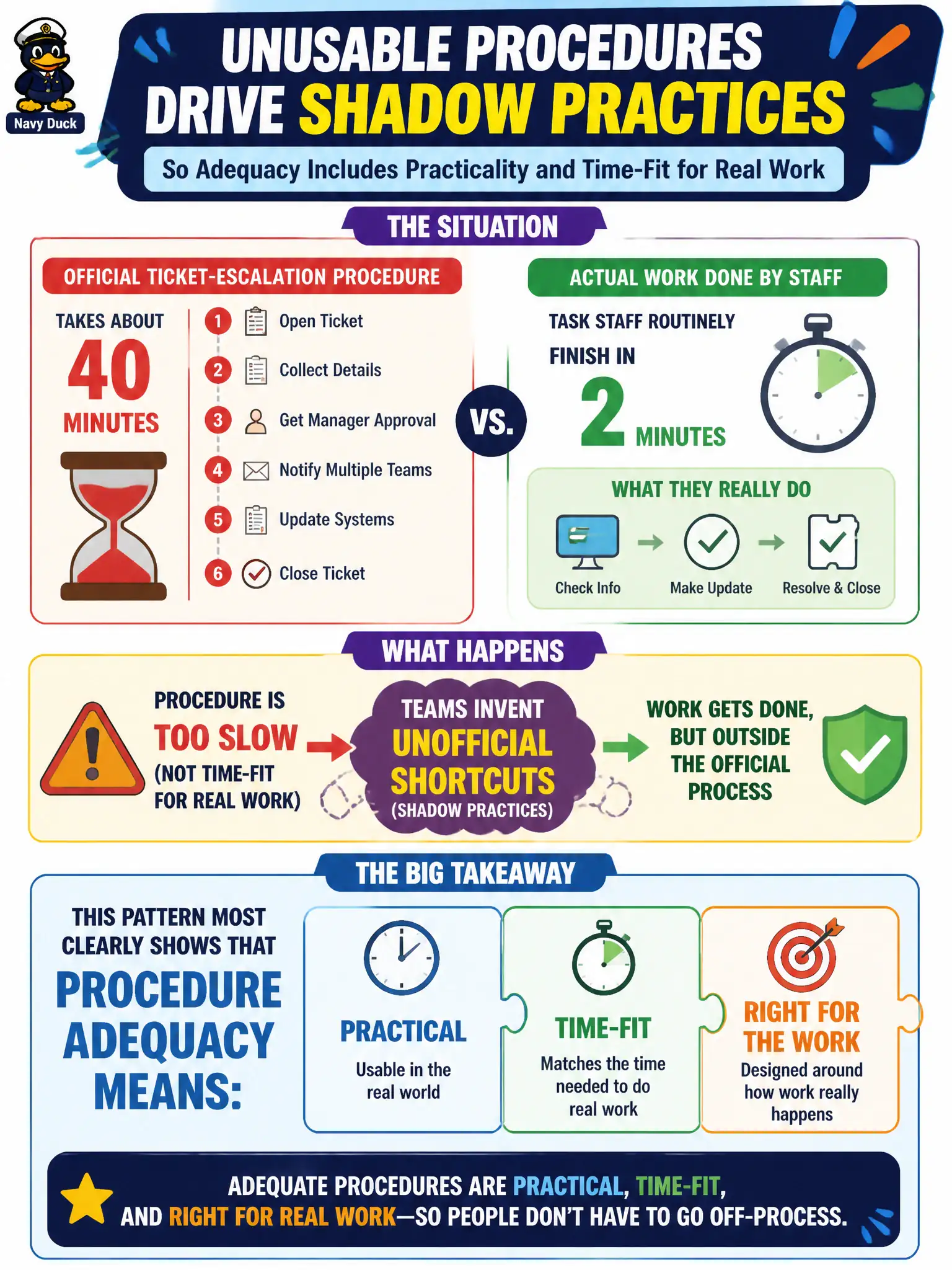
At a regional call center, the official ticket-escalation procedure takes about forty minutes for a task staff routinely finish in two minutes, so teams invent unofficial shortcuts. What does this pattern most clearly show about procedure adequacy?
Select an answer to reveal the explanation.
Short Explanation
If the official path takes forty minutes for a two-minute job, people will invent a back door. That is not rebellion—it is physics. Adequacy means the written method is usable in real time, or you will get shadow processes you cannot train, audit, or insure.
Full Explanation
Unusable procedures drive shadow practices, so adequacy includes practicality and time-fit for real work is correct because a forty-minute official escalation path for a two-minute routine task predicts that staff will invent unofficial shortcuts. Shadow workarounds signal that the controlled procedure is not fit for purpose—not that workers are merely “resistant.” Civic call-center and service operations need procedures that match realistic task time while still capturing required controls.
Treating staff resistance as a reason procedures should never change once published fails by concept because persistent workarounds are data about design fit, not a mandate for rigidity. Claiming shadow workarounds prove controls are stronger when undocumented fails because undocumented practice cannot be trained, audited, or improved consistently and often drops required checks. Claiming any procedure longer than five minutes is automatically out of regulatory compliance fails because duration thresholds alone are not a universal regulatory rule; the issue here is misfit to task, not a blanket minute limit.
Exam caveat: CRMC procedure adequacy includes usability and practicality. Chronic unofficial shortcuts are a trigger to redesign the controlled procedure, not to celebrate underground efficiency.
Operational check: Time the official escalation path versus actual ticket handling at the regional civic call center; redesign the controlled procedure to a realistic sequence that preserves required approvals, train to the new path, and monitor whether shadow shortcuts disappear.