
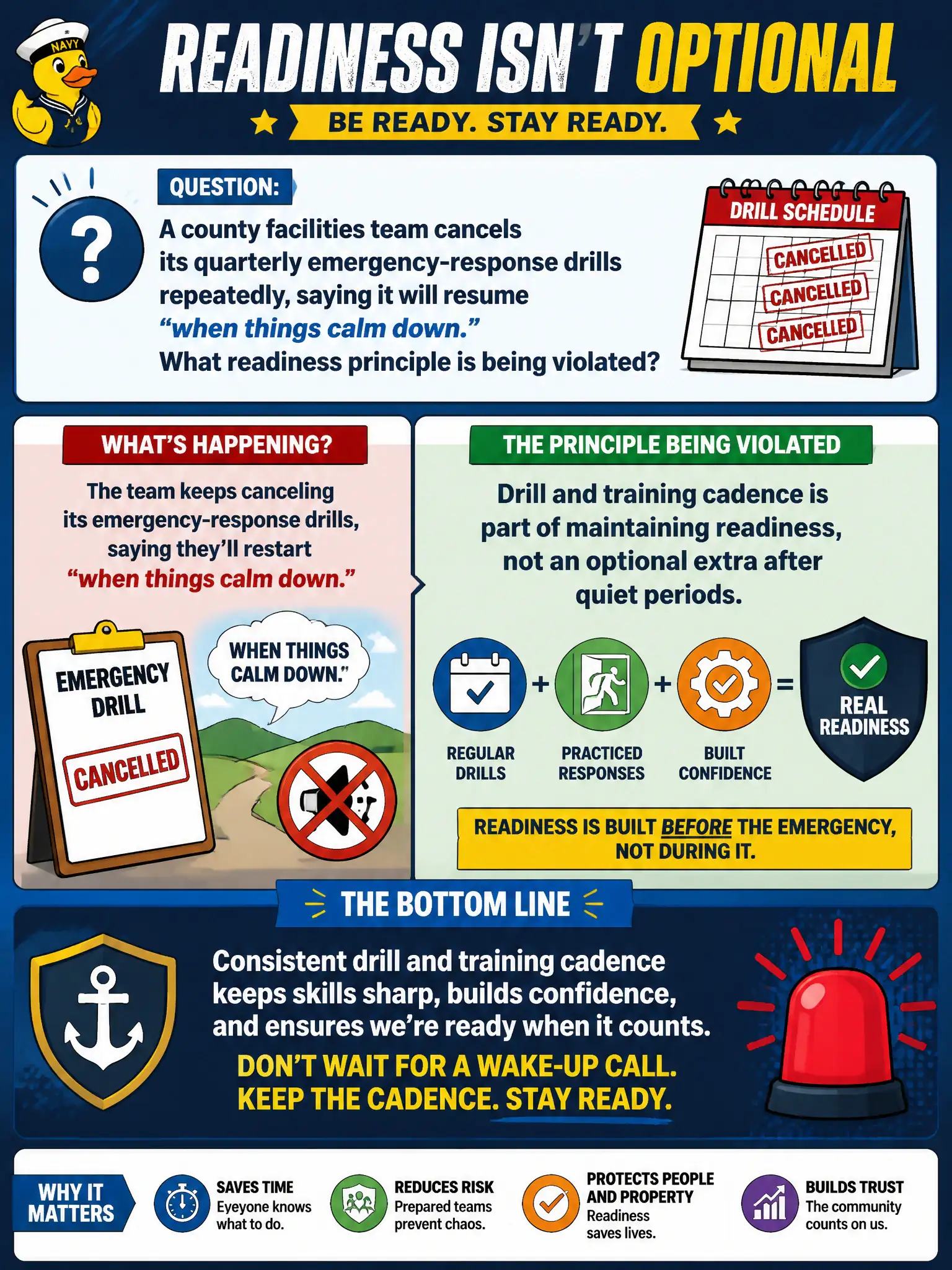
A county facilities team cancels its quarterly emergency-response drills repeatedly, saying it will resume “when things calm down.” What readiness principle is being violated?
Select an answer to reveal the explanation.
Short Explanation
Waiting for calm before you practice is like waiting for a sunny day to learn to swim. Busy seasons are exactly when drills get skipped—and when you most need the muscle memory. Cadence is maintenance; canceling “until things settle” quietly erodes readiness.
Full Explanation
Drill and training cadence is part of maintaining readiness, not an optional extra after quiet periods is correct because canceling quarterly emergency-response drills “until things calm down” often means they never resume—and quiet periods are exactly when skills decay. Written plans without practiced activation degrade under first real stress. County facilities teams maintain readiness by protecting drill time on the calendar as a control, not as leftover capacity.
Treating drills as optional once a written plan exists fails by concept because documentation without rehearsal is unvalidated capability. Claiming canceling drills reduces liability because practice creates incident records fails because avoided practice increases real-incident severity risk; liability myths do not override readiness duty. Claiming only annual tabletops satisfy business continuity maintenance fails because many operational response skills need more frequent drills than a single annual discussion exercise.
Exam caveat: CRMC readiness and continuity maintenance treat exercise cadence as mandatory upkeep. Busyness is a common excuse, not an accepted substitute for canceled drills on the exam.
Operational check: Lock quarterly emergency drills on the county facilities calendar with executive sponsorship, track completion as a risk KPI, and require risk-committee visibility when a drill is deferred—with a near-term makeup date, not an open-ended pause.