
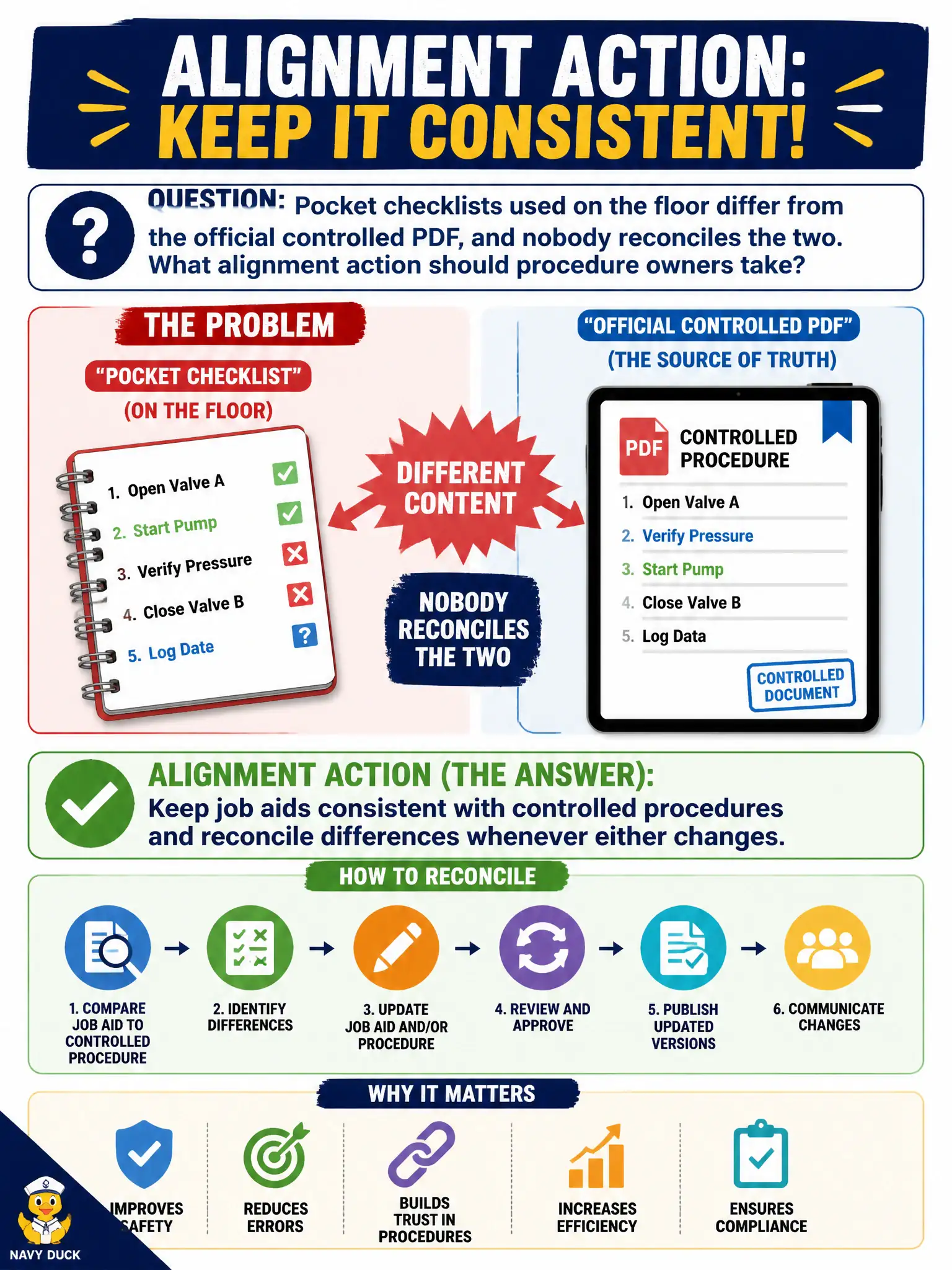
Pocket checklists used on the floor differ from the official controlled PDF, and nobody reconciles the two. What alignment action should procedure owners take?
Select an answer to reveal the explanation.
Short Explanation
Pocket cards that drift from the official PDF are quiet mutiny against the controlled process. Job aids are helpful only when they match the source of truth. Reconcile them whenever either side changes.
Full Explanation
Keeping job aids consistent with controlled procedures and reconciling differences whenever either changes is correct because pocket checklists that diverge from the official PDF create two sources of truth on the floor. Operators will follow the card in their pocket; if it conflicts with the controlled procedure, the organization has lost document control in practice. Civic procedure owners must treat job aids as controlled derivatives that sync when the master changes—and vice versa if a field fix is approved.
Encouraging personal checklist creativity so each operator customizes steps freely fails by concept because uncontrolled personalization recreates the conflicting-SOP problem at individual scale. Declaring pocket aids unofficial forever so mismatches never need resolution fails because unofficial-but-used aids still drive behavior; labeling them unofficial does not remove the risk. Hiding the official PDF so only pocket cards remain fails because the controlled master must remain the authority, with aids aligned to it—not replaced by orphan cards.
Exam caveat: CRMC alignment of job aids with controlled procedures is part of maintenance. Convenience aids are allowed when consistent; divergence without reconciliation is a finding.
Operational check: Inventory floor pocket checklists at municipal sites against the controlled PDF; reconcile or retire mismatches; require a sync step in the document-change workflow whenever either the master SOP or a job aid is edited.