
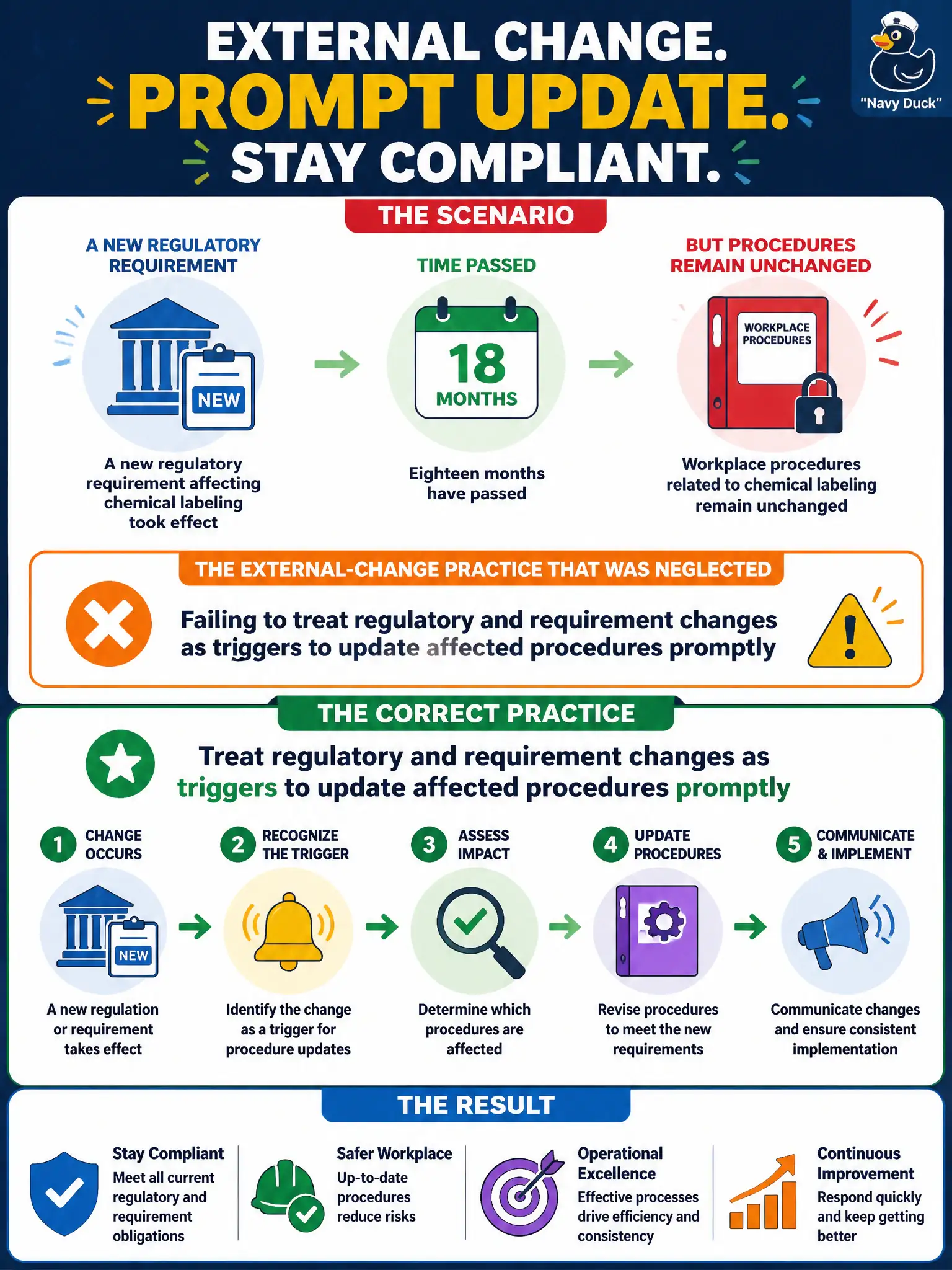
A new regulatory requirement affecting chemical labeling took effect eighteen months ago, yet related workplace procedures remain unchanged. What external-change practice was neglected?
Select an answer to reveal the explanation.
Short Explanation
Regs don’t wait for your document queue—when the rule changes, the procedure has to catch up. Eighteen months of stale labeling steps is exposure with a timestamp. External changes are update triggers, not optional reading.
Full Explanation
Treating regulatory and requirement changes as triggers to update affected procedures promptly is correct because external mandates alter labeling, handling, and training obligations even when internal process equipment stays the same. An eighteen-month lag after a chemical-labeling rule change means workplace procedures and practice may be noncompliant and unsafe relative to current requirements. Civic organizations must watch regulatory feeds and drive controlled-document updates plus training.
Ignoring regulatory changes until a second revision appears years later fails by concept because the first effective date already binds operations; waiting for a sequel is not a control strategy. Relying on informal awareness emails without revising controlled procedures or training fails because informal mail does not update the authoritative steps people are trained and audited against. Assuming prior procedures automatically satisfy new external mandates without review fails because automatic compliance is not a valid presumption when requirements explicitly change.
Exam caveat: CRMC external-change practice lists regulatory updates alongside process and incident triggers for procedure maintenance. Awareness without controlled revision is incomplete.
Operational check: Maintain a regulatory-change log for chemicals used in county shops; within a defined short window after effective dates, revise labeling/handling procedures, update job aids, retrain affected staff, and evidence the change to close the trigger.