
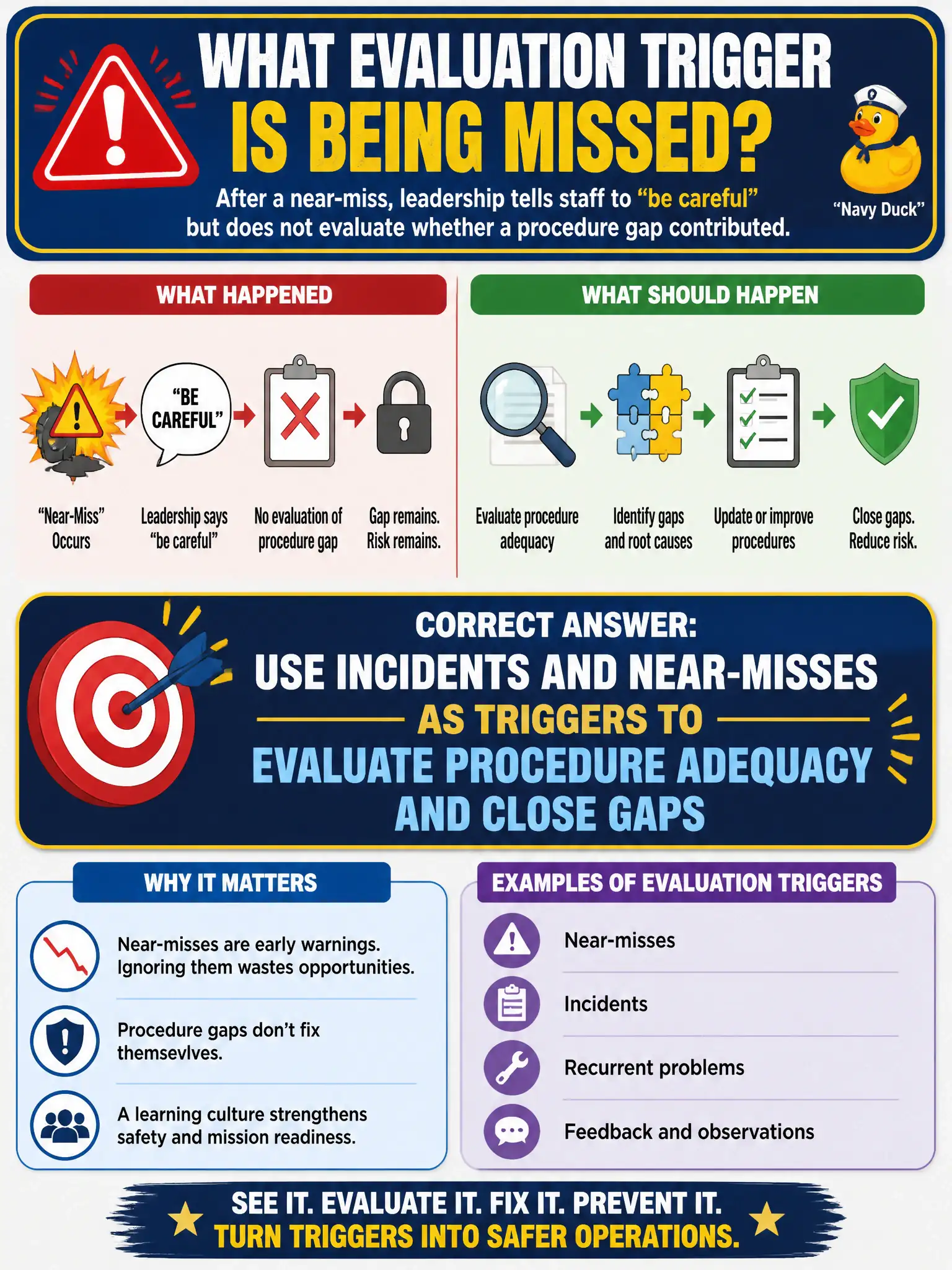
After a near-miss, leadership tells staff to "be careful" but does not evaluate whether a procedure gap contributed. What evaluation trigger is being missed?
Select an answer to reveal the explanation.
Short Explanation
"Be careful" is a pep talk, not a fix. A near-miss is the universe handing you a free rehearsal—check if the procedure left a hole. Evaluate the gap before luck runs out.
Full Explanation
Using incidents and near-misses as triggers to evaluate procedure adequacy and close gaps is correct because near-misses reveal weak steps, missing decision points, or unclear responsibilities before a full loss. Leadership that only says “be careful” treats a system signal as a motivational slogan and leaves the same latent gap in place. Civic risk programs convert near-miss data into procedure review, training updates, and control fixes.
Treating near-misses as purely motivational events that never warrant document review fails by concept because motivation without process learning does not remove the condition that allowed the near-miss. Postponing all procedure evaluation until a full loss with measurable damage fails because waiting for harm abandons preventive learning and contradicts near-miss reporting purpose. Limiting follow-up to individual blame without examining process design fails because person-focused blame misses systemic procedure defects and suppresses future reporting.
Exam caveat: CRMC procedure maintenance treats incidents and near-misses as mandatory evaluation triggers alongside scheduled reviews. “Be careful” messaging is not a substitute for adequacy analysis.
Operational check: For each logged near-miss at a municipal site, require a short adequacy check: Was there a procedure? Was it followed? Was it wrong or unclear? Document the answer and either revise the procedure/training or record why no change was needed.