
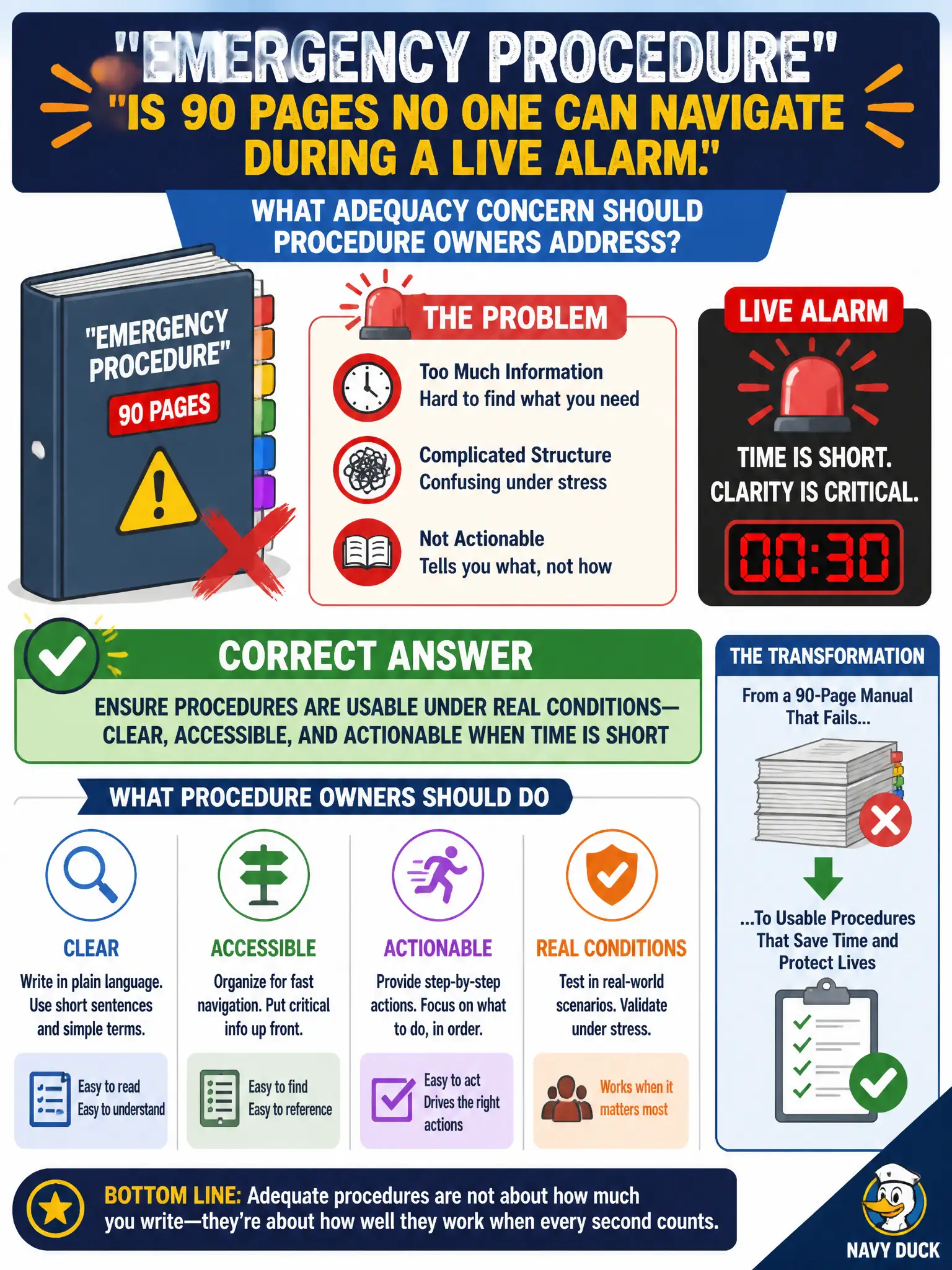
The "emergency procedure" is a ninety-page manual that no one can navigate during a live alarm. What adequacy concern should procedure owners address?
Select an answer to reveal the explanation.
Short Explanation
A phone-book SOP during an alarm is like reading the full tax code while the kitchen’s on fire. Adequacy includes whether stressed people can actually follow it. Short, clear, findable steps beat encyclopedia thickness.
Full Explanation
Ensuring procedures are usable under real conditions—clear, accessible, and actionable when time is short—is correct because adequacy includes human performance under stress, not page count. A ninety-page emergency manual that responders cannot navigate during a live alarm fails its purpose regardless of how complete it looks on a shelf. Civic facilities need findable checklists, clear decision trees, and role-based steps that work when alarms are sounding and minutes matter.
Treating length alone as proof of thoroughness so usability during stress is irrelevant fails by concept because volume without navigability creates delay and improvisation precisely when controls must execute. Storing the manual only off-site so it cannot clutter the response area fails because accessibility at the point of use is part of procedure adequacy; an unreachable document is not a usable control. Requiring responders to memorize all ninety pages instead of improving document design fails because memory contests do not scale across shifts and contractors and ignore proven job-aid design.
Exam caveat: MSI CRMC procedure adequacy evaluates whether people can execute under realistic constraints. Completeness and usability are both required; encyclopedic unreadability is not credited as control strength.
Operational check: Time a night-shift supervisor at a city facility finding the correct alarm response steps from the live procedure set; if they cannot start correct actions within a short defined window, redesign into role-based quick guides linked to the controlled master and retest.