
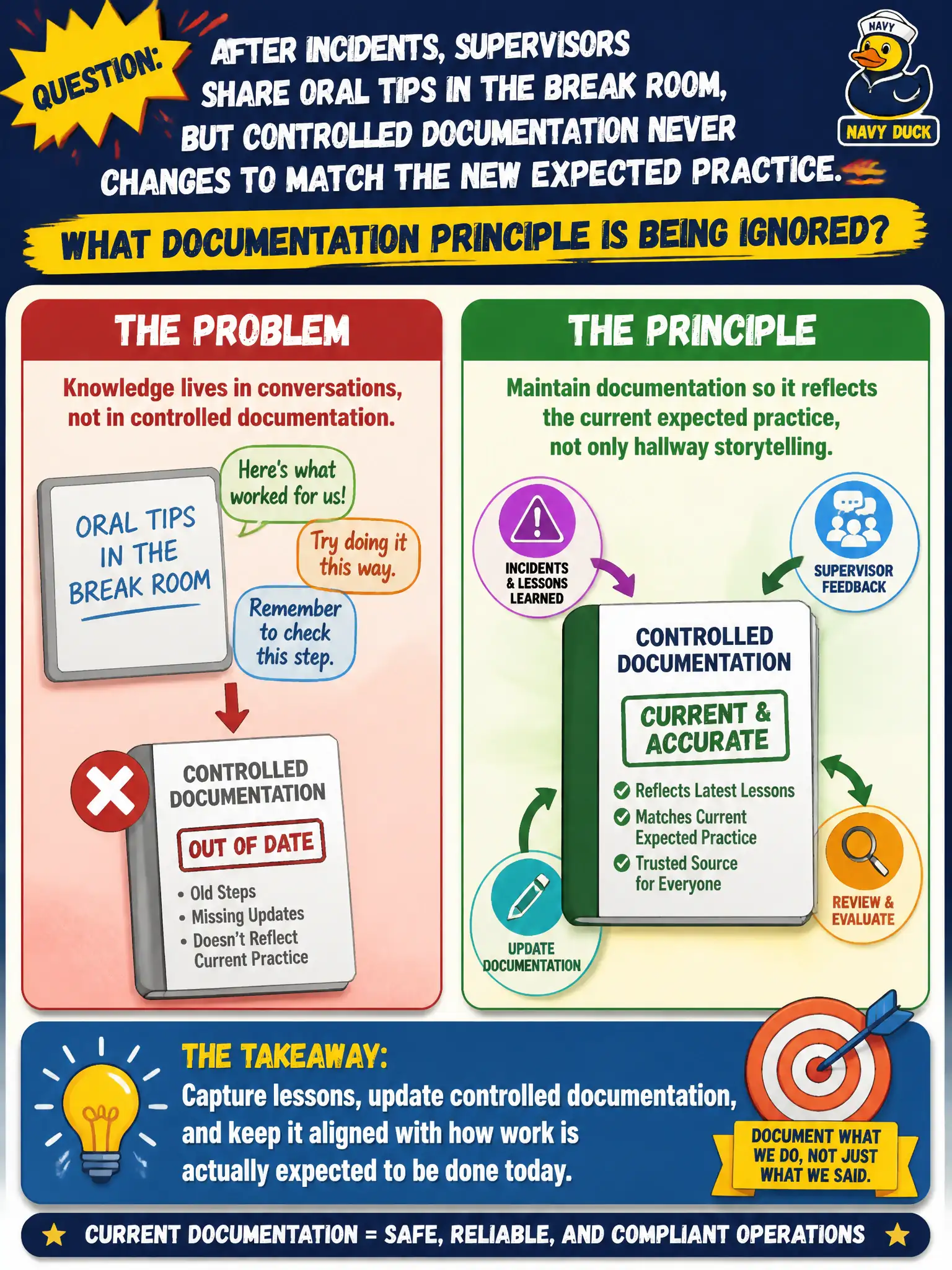
After incidents, supervisors share oral tips in the break room, but controlled documentation never changes to match the new expected practice. What documentation principle is being ignored?
Select an answer to reveal the explanation.
Short Explanation
If the real way of working lives only in hallway chatter, the next night shift won’t get the memo. Write the learning into the controlled doc so practice and paper match. Oral tips fade; updated procedures stick.
Full Explanation
Maintaining documentation so it reflects current expected practice—not only hallway storytelling—is correct because controlled procedures are the shared baseline for training, inspection, and accountability. Oral tips after incidents may contain valuable learning, but if SOPs stay frozen, night shifts, new hires, and contractors never inherit the improvement. Civic operations with rotating crews especially need the written control updated when expected practice changes.
Preferring undocumented oral tradition because it updates faster fails by concept because speed without control creates inconsistent practice and erases institutional memory when people leave. Freezing SOPs permanently and banning edits after first release fails because permanent freeze guarantees divergence between paper and reality as conditions change. Storing incident learnings only in personal notebooks that leave with employees fails because personal capture is not organizational control and vanishes with turnover.
Exam caveat: CRMC documentation principles treat current expected practice as what must appear in controlled procedures. Informal communication can accelerate awareness but does not replace document control.
Operational check: After each significant incident learning at a county facility, open a controlled-document change: capture the new expected step, approve it, train affected crews, and retire oral-only workarounds from being the sole source of truth.